How are sanctions affecting Russia’s oil and gas exports?
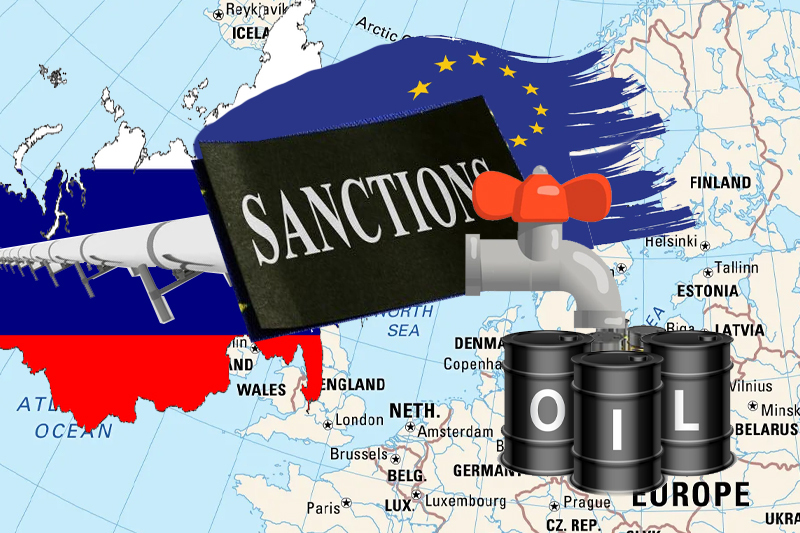
Since Russian President Vladimir Putin on 24 February launched a special military operation in Ukraine, several countries have pledged to end or restrict their energy imports to curtail Moscow’s revenue and hinder its war effort.
The Russian economy heavily relies on its energy sector and Europe is a key importer of Russian energy, making cutting back tough. Nevertheless, Europe’s energy divorce from Russia hasn’t been slow.
Keep Reading
What sanctions are in place?
Since the EU prohibited purchasing seaborne Russian crude oil last year, Russia’s exports have dropped by 9%. Europe has made up for the resulting drop in its oil supply by finding other sources.
A ban on refined oil products is expected to come in from 5 February.
The US made a huge announcement in March 2022 that it was halting the import of Russian oil.
The UK, to align its approach with the EU and the other partners such as the G7 – in order to maximise the impact of sanctions on Russia – imposed stringent prohibitions on the import of Russian crude oil and refined products from 5 December.
The G7 countries – Canada, France, Germany, Italy, Japan, the US, and the UK – as well as Australia capped the price of Russian oil at $60 in December. But the market price recently has been below that level.
How effective have the sanctions been?
The oil price cap and the ban on oil imports are causing Moscow to lose out on about $175 million a day from fossil fuel exports, according to a study by the Centre for Research on Energy and Clean Air (CREA).
On top of oil sanctions, Western nations have also adopted various measures to make trade with Russia tougher.
Is Russian gas targeted?
Russia’s gas sector has also been impacted, although reducing gas imports has been a significant challenge for many European countries. In 2021, EU countries relied on Russia for 40% of their natural gas. But that had dropped to 17% by August 2022, EU figures show.
The UK has not been a major importer of Russian gas, and now it imports none.
Several European countries have now started shifting towards Liquefied Natural Gas (LNG) imports. EU states are increasingly looking to ship LNG in tankers from producers, such as the US (the world’s number one LNG exporter) and Qatar.