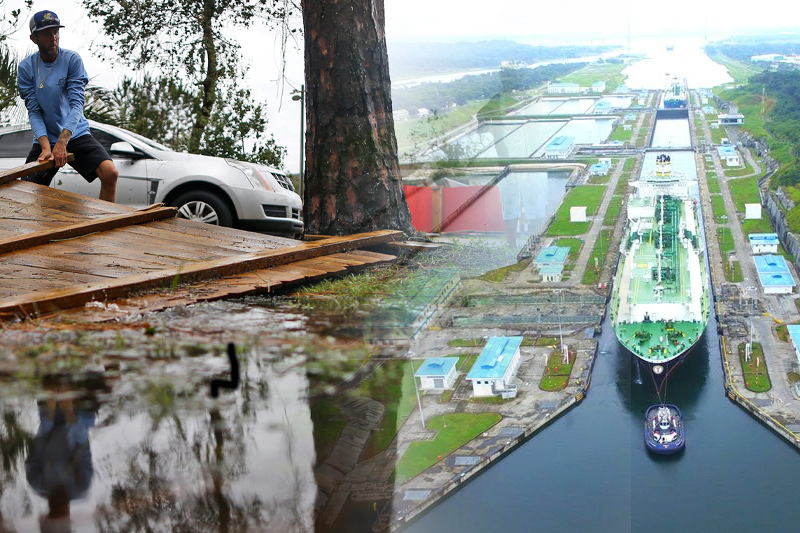
Climate change poses a serious threat to the Panama Canal
According to a report by journalist Grace Livingstone, who is based in Panama City, global warming and shifting weather patterns are having an effect on the water supply for the Panama Canal, which is one of the most important waterways in the world, as well as on the ability of millions of Panamanians to access drinking water.
The Panama Canal is widely considered to be one of the greatest engineering achievements of the 20th century.
This man-made waterway linking the Pacific and Atlantic Oceans was finished in 1914, and it practically cut in half the amount of time it took to travel from the West Coast of the United States to Europe.
To this day, vessels must navigate their way through a system of locks in order to navigate the varying heights that occur along its 80-kilometer (50-mile) length. They are raised to a height that is 26 meters (85 feet) above the ground before being lowered again.
According to Mahelis de Garca, a guide who works at the Panama Canal, the locks of the canal function in a manner similar to an elevator in that they raise the vessels by releasing massive volumes of water from manmade lakes located atop the mountains.
However, because climate change is causing changes in the weather patterns, operating the canal is becoming an increasingly difficult task.
The officials in charge of the Panama Canal report that 2019 was the sixth driest year in Panama during the past seven decades, with rainfall levels that were 20% lower than the historic average.
But a lack of precipitation isn’t the only thing that might make things tough; years with a lot of rain can also be problematic since it can lead man-made lakes to get flooded.
The canal needs to find new places to get water from and innovative ways to store it as the number of dry years and stormy years increases.
When a ship passes through the locks, 55 million gallons or 250 million liters of freshwater are utilized, and the excess is discharged back into the ocean. The locks are used by an average of 37 ships each and every day, resulting in the consumption of more than 2 billion gallons (9 billion liters) of freshwater.
According to John Langman, the vice president of water projects at the Panama Canal, they are attempting to find ways to ensure that the canal does not run out of water.
“We are aware of the immense importance that the canal plays in Panama’s economic situation,” you said.
Related Posts
He explains that because 2019 was an exceptionally dry year, the canal authorities were forced to reduce the amount of water that was used to operate the locks. As a result, ships were not able to carry as much cargo as they normally would have been able to because there was less water between the keel of the ship and the bottom of the canal. He also mentions that this caused a delay in the opening of the canal.
The canal authorities are looking into ways to store more water during wet years so that they will have enough water during dry years. This will allow the locks to continue to work properly.
They are currently doing feasibility studies on a variety of different possibilities, one of which is the deepening of existing artificial lakes in order to collect more rainwater.
According to Mr. Langman, their first priority will be to hunt for a solution within the watershed that surrounds the canal; nevertheless, it is possible that they will need to investigate water sources in other parts of the country.
There is not one option that is simple.
The authorities in charge of the canal are looking into the potential of constructing a dam on the river Indio in the province of Coclé, which is located in the middle of Panama.
However, this could result in the displacement of thousands of small farmers, which has caused Diego Herrera, who farms forty hectares of land with his family in Coquillo, to express concern.
“What options do we have if they decide to drown our land? Where do you suggest we go? They have not provided us with any information regarding the new location of our new home.”
It is essential to note that this dam is only one of many potential choices that are now being considered, and the canal authorities have emphasized that they will choose a solution that has the least detrimental effects on both the environment and the community as a whole.
Not only ships and businesses stand to benefit from the discovery of new water sources.
In addition, the Panama Canal Authority provides potable water to almost half of the population of Panama, which includes the people who live in Panama City, the nation’s capital.
The man made lakes that supply the water for drinking and the water that is used to power the locks are one in the same.
The Panama Canal Authority is exploring desalinating sea water so that it can be used for human consumption. This would allow for a greater amount of the water stored in the man-made lakes to be put to use in the construction of the canal.
According to environmentalist Raisa Banfield, who was formerly the deputy mayor of Panama City, the country’s water resources are coming under increasing amounts of strain as the population of Panama City rises along with the number of new buildings constructed and forest areas cleared for development.
The effects of climate change have accelerated the need to find remedies.
Due to the fact that it has been tracking rainfall since 1880, the Panama Canal has an exceptionally good collection of meteorological data.
According to Steven Paton, a researcher at the Smithsonian Tropical Research Institute in Panama, this dataset, which spans 142 years, reveals shifts in rainfall patterns that are consistent with climate change.
He claims that throughout the course of the previous 25 years, “We have had eight of the ten storms that were considered to be the most severe, as well as the two driest years and the driest three years in a row, all of which had an average rainfall that was lower than any other three-year period. We have achieved unprecedented levels of success.”
He also notes that weather patterns are becoming less predictable; for instance, the start of Panama’s rainy season in 2022 was the earliest it had ever been recorded since records began being kept.
He claims that the events of this year are unprecedented and that there is no comparable precedent.
The original steel-plated gates that were manufactured more than a century ago are still in use to open the locks for ships coming from all over the world; however, because of changes in the patterns of rainfall, it is becoming increasingly difficult to obtain the water that is necessary to operate the canal.