

North Korea Expands Nuclear Program With New Uranium Enrichment Facility at Yongbyon
There’s fresh evidence that North Korea is expanding its ability to make weapons-grade nuclear material, and the international community is once again finding out mostly through satellite photos and propaganda images rather than actual inspections.
A New Building at Yongbyon
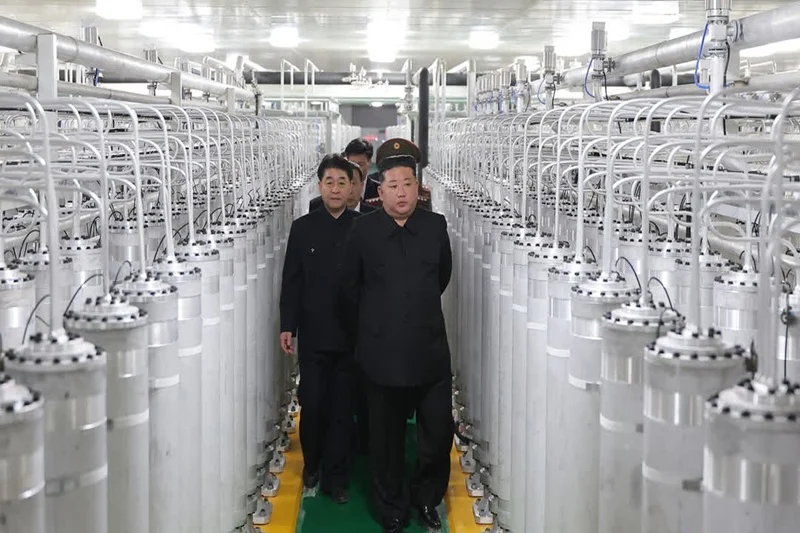
The IAEA says North Korea has put up a new two-story building at its Yongbyon nuclear complex, and it’s big enough to hold up to 28 centrifuge cascades. This would be the second uranium enrichment building at the site. The tip-off came from an unlikely source: North Korean state media itself. Photos released during Kim Jong Un’s visit in June showed centrifuge cascades already installed on both floors. IAEA analysts then cross-referenced that footage with satellite imagery to confirm the construction and figure out what they were looking at.
For context, centrifuges spin uranium to increase the concentration of a particular isotope. Enriched enough, that material can fuel a reactor or, taken further, become the core of a nuclear weapon.
Why the IAEA Is Flying Blind
Here’s the uncomfortable part: IAEA inspectors haven’t set foot inside North Korea since 2009. Everything the agency knows now comes from piecing together satellite images, open-source material, and whatever North Korea chooses to broadcast on its own state TV.
IAEA chief Rafael Grossi has called the continued production of weapons-grade material a serious concern, and the agency maintains that this activity runs counter to UN Security Council resolutions. Given how little visibility outsiders actually have, that’s not a small statement.
It’s Not Just Yongbyon
Yongbyon isn’t the only site showing signs of growth. The IAEA also flagged an expanded annex at the Kangson enrichment facility built back in 2024 that now appears to be up and running. Put the two together, and the pattern looks less like routine maintenance and more like a deliberate push to scale up enriched uranium production. North Korea, for its part, has never hidden its stance: Kim Jong Un has repeatedly said the country’s nuclear arsenal isn’t going anywhere and, if anything, will keep growing.
Why This Actually Matters
The real issue isn’t one new building, it’s what more enrichment capacity means down the line. More centrifuges running means more weapons-grade material, which means the potential for more warheads and a larger, more resilient stockpile over time. That creates a genuine headache for the US, South Korea, and other regional players trying to track the program. Without inspectors on the ground, nobody can say with confidence exactly how much material North Korea is producing and experts have long suspected the full picture is bigger and messier than what satellites alone can reveal. If this much is visible from orbit, it’s fair to wonder what isn’t.
Want more nuclear security updates?
Could Zaporizhzhia face greater danger?
Check out warnings over overnight shelling near the plant.
Why did Zelensky criticize the IAEA?
Find out why demilitarization delays sparked criticism.
Could Ukraine’s nuclear plant spiral?
Uncover the IAEA’s latest safety warning.
Will Iran remove IAEA cameras?
See why Iran threatened to remove monitoring cameras.
Did Iran breach the nuclear deal?
Look into Iran’s admission after the IAEA inspection.
A Bigger Problem for the Region
For South Korea and Japan, this is one more layer on top of an already tense security situation involving North Korea’s nuclear and missile programs. It also complicates the diplomatic road ahead any future denuclearization talks would now have to grapple not just with the weapons North Korea already has, but with its steadily improving capacity to make more. For now, the takeaway is fairly simple: Pyongyang is still investing heavily in its nuclear program, and with inspectors locked out, the rest of the world is left watching from a distance, trying to piece together a picture that keeps getting harder to see clearly.
FAQs
1. What is the new facility at Yongbyon?
It is a newly constructed two-storey uranium enrichment facility at North Korea’s Yongbyon nuclear complex. The IAEA says it could accommodate up to 28 centrifuge cascades.
2. What does uranium enrichment mean?
Uranium enrichment increases the concentration of uranium-235. Higher levels of enrichment can be used for nuclear fuel and, at weapons-grade levels, for nuclear weapons.
3. Can the IAEA inspect North Korea’s nuclear facilities?
No. IAEA inspectors have not been inside North Korea since 2009, so the agency currently relies largely on satellite imagery and open-source information.
4. Why is the Yongbyon facility important?
Greater enrichment capacity could allow North Korea to produce more weapons-grade nuclear material, potentially supporting the expansion of its nuclear arsenal.
5. Is North Korea still expanding its nuclear program?
Yes. The IAEA has identified developments at both Yongbyon and the Kangson enrichment site, indicating continued expansion of North Korea’s nuclear infrastructure.

