Continued coral bleaching due to record ocean heating risks Great Barrier Reef
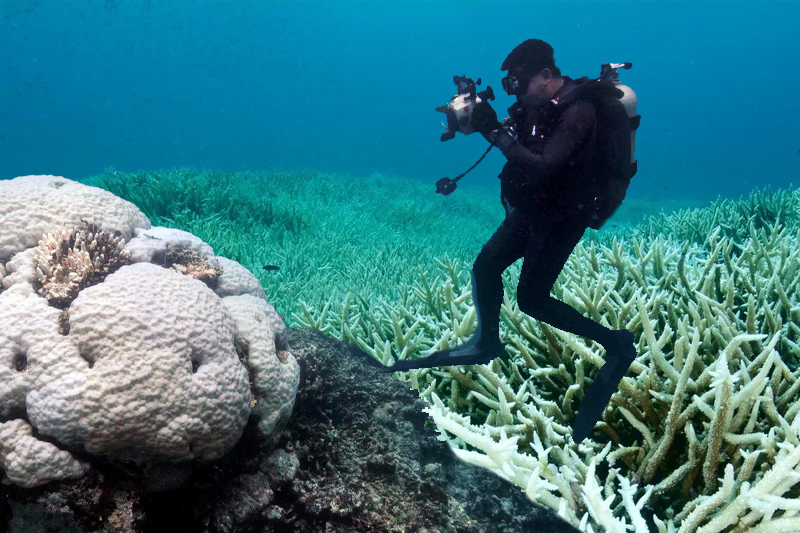
Ocean temperatures in the region of Great Barrier Reef have reached extreme levels this month, raising concerns over a second consecutive summer of mass coral bleaching. Data from the US government’s National Oceanic and Atmospheric Administration (Noaa) shows “sea surface temperatures over the northern parts of the reef have been the highest for any November on a record going back to 1985”.
Furthermore, with the peak period for accumulated heat over the Great Barrier Reef to come not before February, cooler weather conditions and cyclone activity before that time frame could shed off an event of mass bleaching. Prof Terry Hughes, a leading expert on coral bleaching at James Cook University, said he had “never seen heat stress accumulating on the reef this early, but a well timed cyclone in December could reduce the risk of bleaching”. He said, “It is certainly the case that temperature records are tumbling. The warning signs are clear.”
Sea surface temperatures this year (the top, black trajectory) on the far northern #GreatBarrierReef are hotter in Oct/Nov than any early summer on record. https://t.co/B6yXy77Ae5
— Terry Hughes (@ProfTerryHughes) November 25, 2022
If this keeps up, NOAA is predicting another mass coral bleaching event, as early as January. https://t.co/RrCPHBbvi3 pic.twitter.com/chCszbA9Ab
Hughes said: “According to Noaa’s predictions there’s a good chance we will see another back-to-back bleaching event. That was not supposed to be happening until the middle of this century.”
Keep Reading
Rising ocean temperatures globally due to massive surge in human emissions of greenhouse gases, primarily from burning of fossil fuels, has caused six mass bleaching events of the coral of Great Barrier Reef in 1998, 2002, 2016, 2017, 2020 and 2022.
According to scientists, the corals have ability to recover from bleaching, provided the temperatures are not too high. Scientists have seen a rise in the amount of coral over the reef in recent years – a recovery driven by fast-growing corals that experts say are also the most susceptible to bleaching, The Guardian mentions.
Prof Ove Hoegh-Guldberg, a pioneering coral bleaching scientist at the University of Queensland, said: “This is about the steady but rapid rise in ocean temperatures and this is very worrying. This [heat stress] is happening many weeks earlier than usual – in the past it has been in January. I have had to check my watch.” He added, “The fact it’s probably the warmest November on record [over the reef] and given what we know about heat stress on corals, this does not bode well.”