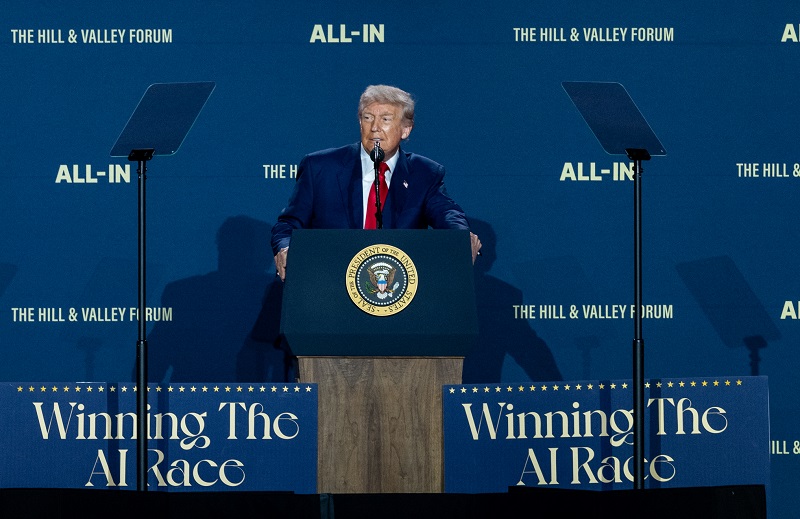
Trump’s AI Plan Gains Tech Giant Support in Bid to Rival China
The U.S. government has initiated a new artificial intelligence (AI) effort to ensure that the nation can gain its presence in the world in terms of AI innovations. The new plan with the support of major technology companies describes the measures that will allow lifting blistering regulations, modernizing the digital infrastructure, and increasing American AI exports, primarily, to fight with the Chinese AI expansion on the international arena.
The administration of President Donald Trump published the AI Action Plan, a 28-page piece that explains how the United States should be at the center of establishing ethics at the global level of AI. It puts a strong focus on deregulations, promotes the idea of collaboration between people and the state, and oriented itself towards the export of bulk AI duos, models, chips, applications, software, and so on.
Key goals of the plan include:
- Simplifying federal approval processes for AI-related infrastructure projects.
- Establishing global markets for U.S.-built AI technologies.
- Opposing China’s involvement in international AI policymaking bodies.
The move has been touted by tech giants such as Google and Amazon, Meta, and Palantir. Palantir defined AI as a birthright to the country that was the first to experience technological revolutions in the world. A trade association representing internet companies (Industry group NetChoice) also hailed the plan as it is going to, “supercharge innovation by eliminating unwarranted delays and government red tape.”
However, the plan is not without its critics. Among the most debatable is its suggestion to eliminate ideological bias in the AI systems implemented in the federal government agencies. In the decision making processes across various sectors of the government, the administration holds that language models should be neutral and objective.
There have been criticisms of this directive and the use of AI in law, usually by other legal experts and ethicists in AI, though these critics have expressed concerns regarding censorship and constitutional rights. According to them, the regulation of the content of the products of AI models may bring challenges to the First Amendment and present possible political interference in the progress of science.
Another concern involves international diplomacy. Although the plan refers to the U.S. as achieving AI dominance, analysts fear that such use of words will only worry allies who do not want to be fully reliant on American technology. They demand a weighted alliance in which they can grow with others and not act as rulers where others follow.
Center for a New American Security Vivek Chilukuri pointed out that the US already enjoys great dominance in regards to the AI supply chain. He cautioned that there is danger in forcing this dominance narrative and losing some of the other democratic countries that do not like the idea of centralizing all the development efforts.
The plan is also trying to unify ethical principles around the world as it advocates U.S. governance principles over the structures that will be imposed by dictatorial states such as China. Those in charge claim that such an approach would guarantee an opportunity to construct AI technologies with democratic values and transparency but not surveillance or domination.
On the whole, the AI Action Plan should be viewed as the unwavering attempt by the Trump-administration to restore and enhance the technological superiority of America. Although accepted by the leaders of industry it is to be tested in the areas of implementation and ethical principles and international cooperation.
When properly implemented, the plan would be able to put the U.S. in a position of having long-term control in AI. However, whether it will be effective or not will be determined by the degree to which it will have struck a balance between competitiveness and collaboration as also control and freedom