

NASA Roman Space Telescope Launch: How a Former Spy Satellite Will Explore Dark Energy and Exoplanets
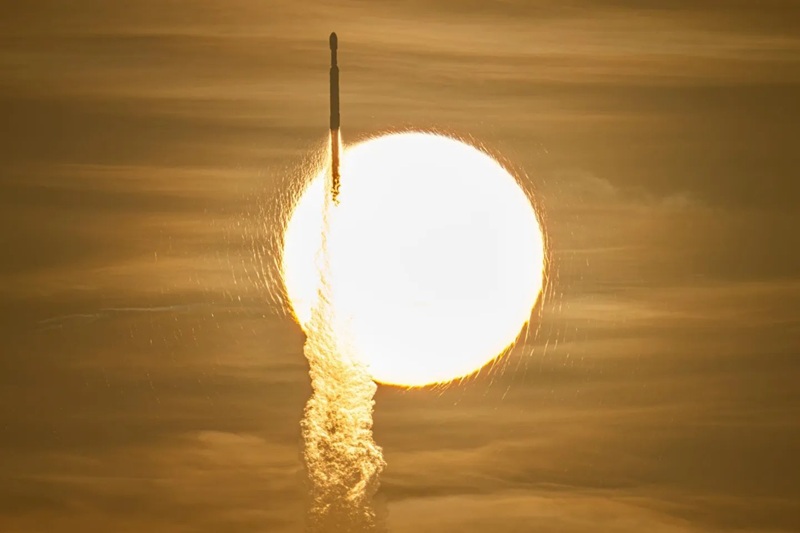
There’s something almost poetic about NASA’s newest space telescope. The hardware at its core wasn’t built with astronomy in mind; it started life inside a classified government surveillance program. Now it’s on its way to deep space, tasked with helping us understand two of the universe’s biggest mysteries: dark energy and the search for other worlds. On the morning of August 30, the Nancy Grace Roman Space Telescope lifted off from Launch Complex 39A at Kennedy Space Center, riding a SpaceX Falcon Heavy into the sky at 7:26 a.m. EDT. It’s now on a three-month cruise to its permanent post at the Sun-Earth L2 point, about a million miles from home.
From Secret Satellite to Scientific Instrument
Roman’s backstory is genuinely unusual for a space telescope. Back in 2012, the National Reconnaissance Office, the agency that builds and operates America’s spy satellites, handed NASA a pair of 2.4-meter telescope systems that had originally been designed for surveillance work, not stargazing. NASA held onto that hardware and eventually built a mission around it, first under the name WFIRST (Wide Field Infrared Survey Telescope), later renamed in honor of Nancy Grace Roman, NASA’s first chief astronomer. It’s a rare case of technology making the leap from classified spycraft to open scientific research. NASA didn’t just repurpose the hardware as-is, either engineers reworked it extensively for astronomy. The primary mirror is 2.4 meters across, basically the same size as Hubble’s, but Roman was built to capture a dramatically wider slice of sky in every shot.
Chasing the Universe’s Biggest Mystery
Dark energy remains one of physics’ most stubborn puzzles. We know the universe’s expansion is speeding up, but nobody has a solid explanation for why. Roman’s approach is to go big: it will observe enormous numbers of galaxies, tracking how the universe’s expansion and the distribution of matter have shifted across cosmic history. Its Wide Field Instrument alone can see at least 100 times more sky than Hubble in a single exposure, and over its mission, Roman is expected to capture light from roughly a billion galaxies. That’s the kind of dataset that could actually move the needle. If it turns out dark energy has changed over time, physicists may need to rethink some fundamental assumptions about how the cosmos works and if gravity behaves in ways current theories don’t predict, that opens up even bigger questions.
Stay informed with the latest stories making headlines worldwide.
Could Typhoon Narra Worsen China Floods?
Check out how Typhoon Narra is affecting southern China and displacing thousands.
Can Pakistan-Iran Talks Bring Peace?
Find out how Pakistan-Iran talks are progressing toward regional peace and stability.
Why Is Saudi Arabia Investing Near Paris?
Uncover Saudi Arabia’s $7 billion plan to build three theme parks near Paris.
How Did Death Valley Turn Deadly?
See what happened when a French tourist became stranded in extreme Death Valley heat.
Will Pakistan-Iran Talks End Conflict?
Track down the latest developments as both sides push to resolve the regional conflict.
Thousands of New Worlds
Dark energy isn’t Roman’s only job. It’s also going planet hunting. Its main technique is gravitational microlensing, essentially watching for the way a star’s gravity can bend and briefly magnify light from another star passing behind it. By keeping tabs on millions of stars at once, astronomers can catch the subtle flickers that reveal a planet, including small rocky worlds and ones sitting in the temperature range where liquid water could exist. NASA estimates this survey alone could turn up around 2,500 new exoplanets. On top of that, Roman is carrying a coronagraph, a device that blocks out a star’s glare so faint nearby objects, like planets or the disks of dust and gas where planets form, can actually be seen directly. It’s as much a technology demonstration as a science instrument.
Filling a Gap Between Hubble and Webb
Roman isn’t meant to replace Hubble or the James Webb Space Telescope, think of it more as filling in what they can’t do. Hubble captures sharp, detailed images. Webb peers deep into infrared to catch faint, distant objects. Roman’s specialty is speed and breadth: scanning huge swaths of sky quickly, then flagging the interesting stuff for Hubble or Webb to zoom in on later. NASA is planning for a five-year primary mission, with hopes of stretching that to a decade. And in keeping with how most NASA science works, the data will eventually be released publicly, so researchers anywhere can dig through it. Beyond the technical milestones, there’s something worth sitting with here: a piece of hardware once built for secrecy is now pointed outward, its purpose entirely rewritten. What it finds new planets, strange galaxies, maybe answers about the fabric of the universe itself will be public from day one.
FAQs
What is the NASA Roman Space Telescope?
The Nancy Grace Roman Space Telescope is NASA’s next-generation space observatory designed primarily to study dark energy, dark matter, exoplanets and infrared astrophysics.
When did the Roman Space Telescope launch?
NASA’s Roman Space Telescope launched on August 30, 2026, aboard a SpaceX Falcon Heavy rocket from Kennedy Space Center in Florida.
Was the Roman telescope originally a spy satellite?
Roman uses telescope hardware that was transferred to NASA by the National Reconnaissance Office. The inherited 2.4-meter optical system became an important foundation for the WFIRST mission, which evolved into Roman.

