

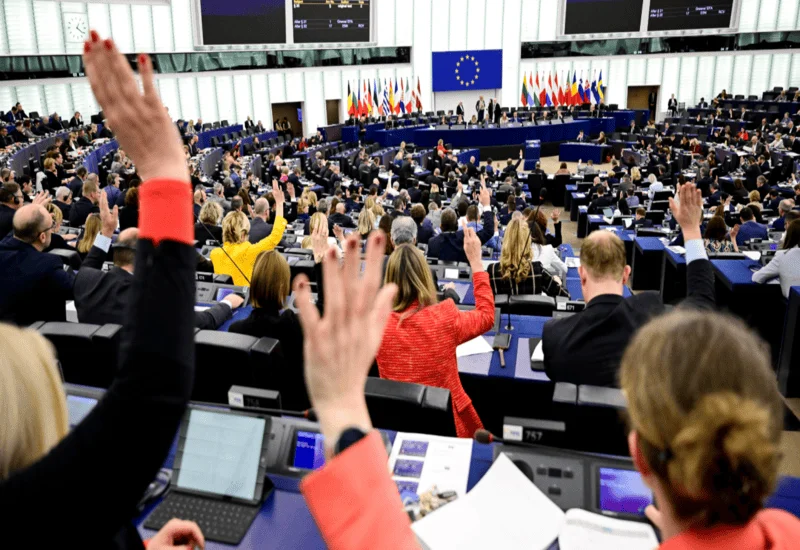
European Parliament Debates Muslim Brotherhood Network as EU Vote Nears
A closely watched debate in the European Parliament is putting the Muslim Brotherhood and the wider issue of political Islam in Europe back under the microscope. On 7 October MEPs met in Strasbourg to discuss whether the European Union needs a more coordinated strategy to combat what the parliamentary procedure calls “Islamist entryism” and the influence of the Muslim Brotherhood network.
The debate comes a day before the European Parliament votes on resolutions on the issue. The parliamentary procedure, registered under 2026/2868(RSP), is scheduled for a plenary vote on 8 October.
What Is the European Parliament Discussing?
It is not merely an argument religious. A major divide in the European debate is between Islam as a religion and political Islam as an idea of ideology or political idea. That distinction matters because the measures being discussed are about organizations, networks, political influence, funding and security-related questions, not Islam or Muslims as a religious community.
These points were already raised during the LIBE debate of the European Parliament in June 2026. Members of the European Parliament asked whether the current EU tools were enough to respond to violent and non-violent forms of Islamic extremism, as well as information-sharing between member states, Europol cooperation and the role of online platforms. Members also raised questions about organisations linked to political Islam, including the Muslim Brotherhood, foreign funding and whether additional EU-level measures or sanctions should be considered.
What Is Actually Being Proposed?
The October procedure is officially called ‘The need for an EU strategy to counter Islamist entryism and the influence of the Muslim Brotherhood network’. It is treated as a resolution on a subject of current interest, rather than as normal EU legislation. In the current parliamentary record there are five motions, B10-0424, B10-0427, B10-0428, B10-0429 and B10-0430, tabled between 29 and 30 September. At a more general policy level the debate is about enhanced European coordination, sharing of information, the scrutiny of networks and funding. Whether the current tools available to the EU are sufficient. These themes develop some of the questions already raised by the LIBE Committee in June.
Importantly, a parliamentary resolution should not automatically be understood as an EU-wide ban or criminal designation. The legal effect depends on what Parliament ultimately adopts and what action is subsequently taken by the relevant EU institutions and member states.
France Has Already Put the Issue on the European Agenda
But the debate comes as there has been a major development in France. On 22 January, the French National Assembly approved a European resolution calling for the Muslim Brotherhood movement to be added to the EU’s list of terrorist organizations. The resolution was passed with 157 votes in favor, 101 against and one abstention, the official parliamentary record showed. That French initiative adds important context to the wider European debate, but a national parliamentary resolution does not in itself determine EU policy.
Why the October 8 Vote Matters
For European governments and institutions, the central question is how far the EU should go in coordinating its response to networks that some policymakers associate with political Islam.
For civil society and Muslim communities, the debate also raises questions about how security measures can be pursued without treating an entire religion or population as a security problem. That balance will be important as Parliament moves from discussion to a recorded vote. The European Parliament’s procedure currently shows the October 8 plenary vote as scheduled. After the vote, attention is likely to shift to the exact text adopted, the level of support among political groups and whether the European Commission or member states take further steps.
For audiences across France, Germany, Italy, Spain, Belgium and the Netherlands, the most important takeaway is therefore straightforward: October 7 was the debate; October 8 is the decision point. What Parliament adopts and what EU institutions do afterward will determine whether this discussion becomes a broader European policy process or remains primarily a political statement.
Europe’s political and legal battles are reshaping debates over security, rights, and democratic accountability
Could Russia Face Europe’s Terror Label?
Check out how the European Parliament’s move could affect Russia and European security debates.
Why Is Hungary Facing Rights Pressure?
Find out why the European Parliament is challenging Hungary over LGBTQ+ rights.
Can Parliament Challenge Hungary And Poland?
Uncover how MEPs are supporting legal action involving the European Commission and two EU members.
Why Is Florida’s CAIR Decision Global?
Browse how Florida’s controversial decision involving CAIR and the Muslim Brotherhood is drawing international attention.
What Does Florida’s Terrorism Framework Mean?
See what Florida’s new terrorism framework means for CAIR and the Muslim Brotherhood.

