China’s Open-Source AI Challenge: Can Beijing’s Strategy Reshape the Global AI Race and Widen Economic Inequality?
The AI race used to be simple: whoever builds the smartest chatbot wins. That’s not quite true anymore. Increasingly, the real fight is over who controls the technology, who gets to use it, and who actually profits from it and China just made an interesting move in that fight. Companies like DeepSeek and Alibaba have been releasing powerful AI models out in the open, letting developers anywhere download them, tinker with them, and build their own products on top. It’s a direct challenge to the closed, locked-down systems that big American tech companies have built their businesses around, and it’s starting to change how AI spreads around the world.
Why open-source, and why now?
The logic here isn’t complicated. Instead of guarding a model behind an API and a paywall, you hand over the weights and let people do what they want with it.
For China, this isn’t just generosity, it’s strategy. US restrictions on advanced chips have made it harder for Chinese companies to compete purely on raw computing power. So instead, they’re competing on software, talent, and reach. If you can’t out-build the hardware, you out-distribute the software. It’s working, to a degree. Models like DeepSeek and Qwen have become genuine fixtures in the global open-weight AI scene, with plenty of developers outside China building on them.
Beijing’s bigger play
This isn’t just a business strategy, it’s also diplomacy. At the World AI Conference in Shanghai this past July, Xi Jinping pitched wider global access to AI and positioned China as the country looking out for developing nations that might otherwise get left behind. China has been pushing similar messaging through international AI governance talks too.
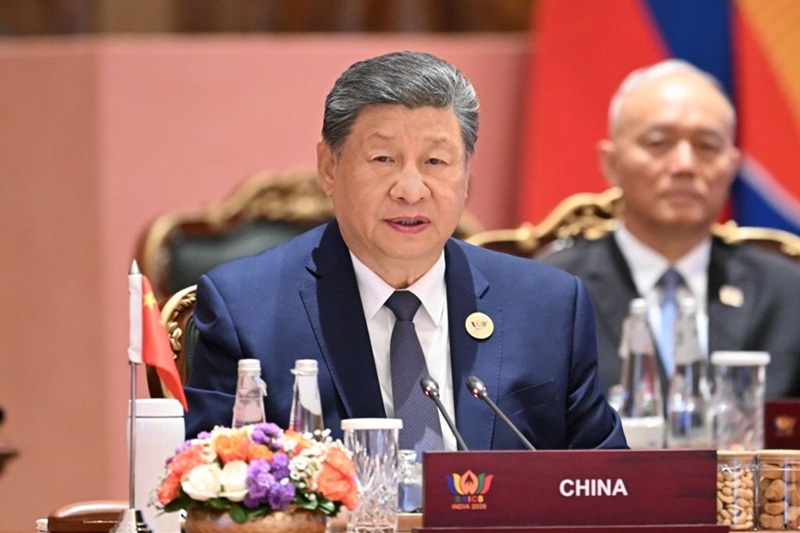
Then, at this month’s BRICS summit in New Delhi, China went a step further and proposed something it’s calling a BRICS AI Open Source Zone essentially a push to formalize tech and economic cooperation around open AI among BRICS nations. There’s also a grassroots angle: Hangzhou’s Global Open-Source AI Challenge has apparently pulled in developers from 91 countries, with 70 finalist projects picked out of almost 3,000 submissions. It’s a clear signal that China wants to build a real international community around its open models, not just release code and hope people notice.
Could this actually narrow the digital divide?
There’s a genuinely good argument here. Cheap, accessible AI could be a real boost for places that could never afford proprietary stuff such as schools, small businesses, independent developers working on translation tools, local-language apps, research projects. A 2026 academic study on Chinese open-source models suggested exactly this: that tools like DeepSeek could help chip away at the global digital divide simply by lowering the barrier to entry. But access isn’t the same as equal benefit and that’s where things get more complicated.
The other side: AI could just as easily deepen inequality
The same technology that boosts productivity can also wipe out jobs and concentrate wealth in fewer hands. An IMF working paper from August 2026 looking at AI and economic divergence across Asia found that countries who adopt AI early tend to pull ahead, while those with weaker infrastructure, skills, or capital risk falling further behind. Even within a single country, the gains tend to flow disproportionately to highly skilled workers and people who already own assets, not to workers whose income depends on more traditional jobs. So open-source AI could genuinely cut both ways: making powerful tools cheaper and more available on one hand, while piling pressure on workers and businesses that can’t keep up on the other.
A separate study in Scientific Reports looked specifically at AI diffusion, education, and income inequality within China, and found that a region’s educational capacity plays a big role in determining who actually captures the economic upside of AI.
What Else Is Making Headlines?
What Made Diana’s Dress So Iconic?
Check out the story behind Princess Diana’s famous Revenge Dress and its upcoming Sotheby’s auction.
Why Is California Restricting Social Media?
Find out how California’s new law targets addictive social media features for children under 16.
Why Does UN Reform Matter at BRICS?
Uncover why António Guterres is highlighting Security Council reform and multilateralism at BRICS 2026.
How Is BRICS Reshaping Global Trade?
Explore how the expanded 11-nation BRICS bloc is transforming global trade and economic cooperation.
Why Is Britain Obsessed With Bayeux?
Experience the Bayeux Tapestry exhibition in London as renewed public fascination sweeps across Britain.
So what happens next?
None of this means China is about to dominate global AI outright; the US still leads on cutting-edge research, computing infrastructure, and commercial deployment. But China is clearly playing a different game: instead of chasing the single most powerful model, it’s chasing adoption, accessibility, and ecosystem size. That might end up mattering more in the long run. The question probably isn’t which country builds the best model, it’s whose ecosystem quietly becomes the default, embedded in how businesses, governments, and developers actually work day to day.
If China pulls that off, it could end up shaping global AI standards for years to come. But it also leaves governments everywhere with a harder problem to solve: making sure cheaper, more open AI actually expands opportunity, instead of letting automation and unequal access to skills and capital widen the gaps that already exist.
FAQs
1. What is China’s open-source AI strategy?
It involves making AI models and related technologies more accessible to developers so they can download, adapt and build applications around them.
2. Why is DeepSeek important to China’s AI strategy?
DeepSeek helped demonstrate that Chinese developers could produce competitive AI models while contributing to the growing open-weight AI ecosystem.
3. Can open-source AI reduce global inequality?
It could lower the cost of accessing advanced AI, particularly for developing economies. However, unequal access to skills, infrastructure and capital could still produce economic gaps.
4. Could China’s AI strategy challenge US technology companies?
It could increase competition by giving developers an alternative ecosystem, although the US retains major strengths in AI research, computing and commercial technology.
5. Why does AI matter for economic inequality?
AI can raise productivity but may reward highly skilled workers and owners of capital more quickly than workers in jobs vulnerable to automation. The IMF has highlighted these distributional risks.