

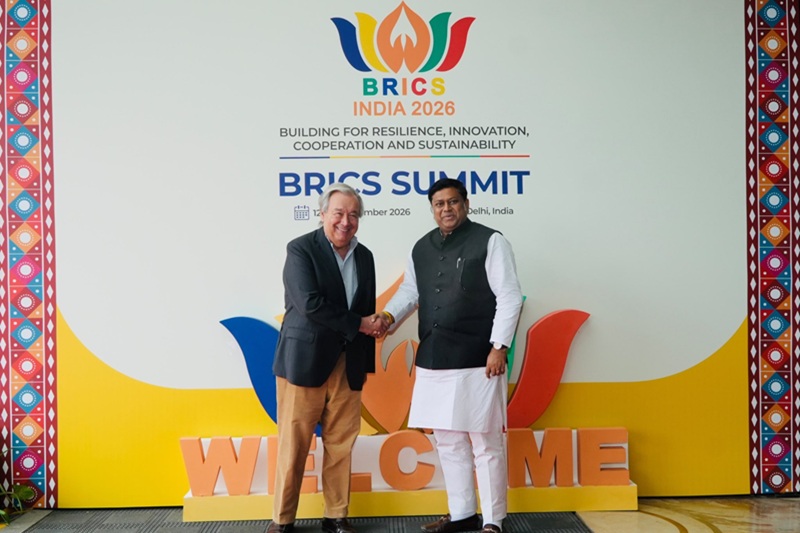
UN Secretary-General António Guterres at BRICS 2026: Why UN Security Council Reform and Multilateralism Matter
There’s a question hanging over global politics right now that’s getting harder to brush aside: do the institutions built after World War II still make sense for the world we’re actually living in? That’s roughly the pitch UN Secretary-General António Guterres is expected to bring to New Delhi this weekend. He landed in India on September 11, ahead of the 18th BRICS Summit running September 12–13, and he’s set to use his platform there to push, once again, for reform of the UN Security Council and a renewed commitment to working together across borders.
Why BRICS, Why Now
This year’s summit carries the theme “Building for Resilience, Innovation, Cooperation and Sustainability” and doubles as a 20th-anniversary celebration for the bloc. Guterres has been slotted into the September 13 session on shaping inclusive global growth, and by most accounts, his core argument will be that the world has changed too much economically, demographically, geopolitically for a governance system designed in 1945 to still fit. It’s not a random venue for that message. BRICS has grown into a coalition spanning Asia, Africa, the Middle East and Latin America, which gives it real weight when the conversation turns to who gets a say in how the world is run.
The Security Council Problem
Here’s the crux of it: the Security Council still runs on a structure where five countries China, France, Russia, the UK and the US hold permanent seats and veto power, while ten other seats rotate. Critics have been saying for years that this setup badly underrepresents Africa, Asia and Latin America, regions that make up most of the world’s population but have none of that permanent influence. Guterres isn’t new to this argument. Back in May, he called Security Council reform “absolutely essential,” making the case that both the permanent and non-permanent ranks need to grow to reflect how the world actually looks today. India, for its part, has long lobbied for a bigger seat at that table, and BRICS as a bloc has backed broader UN reform and more representation for developing nations before.
More Than Just Adding Seats
For Guterres, though, this isn’t only about who sits where. It’s about whether multilateralism itself, the basic idea of countries solving problems together through shared institutions can survive in a world that’s pulling in more fragmented directions. He’s warned repeatedly that this kind of cooperation is eroding at precisely the moment wars, climate change, economic instability and rapid tech change demand more of it, not less.
BRICS has leaned into this role as an advocate for the Global South, and at its foreign ministers’ meeting earlier this year, members reaffirmed their push for a more equitable and accountable international order.
Why It Matters Beyond the Summit Room
The timing isn’t exactly quiet. This year’s gathering unfolds against the backdrop of the Iran conflict, friction between major powers, and mounting disputes over trade, energy and security. BRICS itself isn’t a unified bloc without disagreements, so getting consensus on big geopolitical questions won’t be simple.
Even so, having Guterres in the room adds an institutional weight to the summit that extends beyond BRICS’s own internal politics. His remarks could bolster the broader case that emerging economies deserve more influence over decisions that shape the global economy and international security. It might all sound abstract from the outside, but these are the same institutions that end up shaping wars, sanctions, humanitarian response, energy markets and global stability. The real question isn’t just whether the Security Council eventually expands, it’s whether the world’s institutions can evolve fast enough to stay relevant in a geopolitical landscape that barely resembles 1945.
FAQs
When’s the summit?
New Delhi, September 12–13, 2026.
Is Guterres actually attending?
Yes he’s already in India for it.
What’s his main focus?
Multilateralism and Security Council reform, mainly.
Why does India want reform?
It argues the current setup doesn’t reflect today’s power balance and has pushed for a permanent seat.
Why does this matter to BRICS?
It gives emerging economies a coordinated platform to demand more say in global decision-making.

