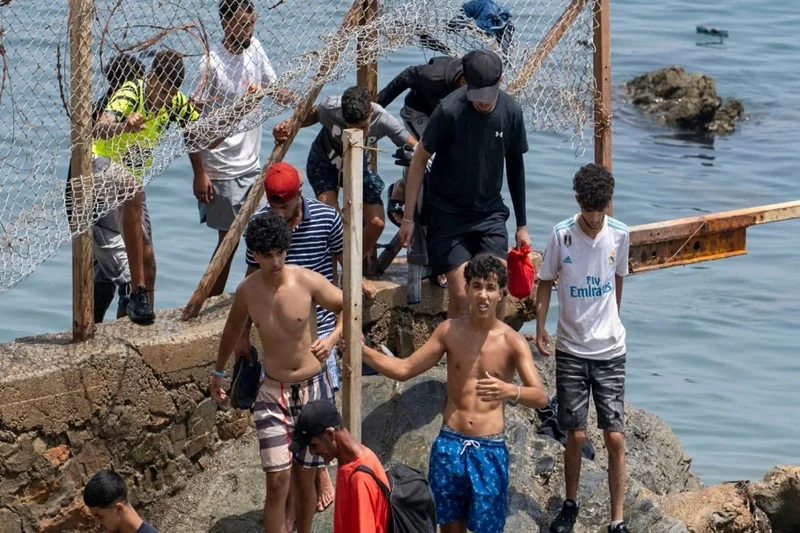
Spain’s Intelligence Agency Warned of Ceuta Mass Crossing Before 70,000-Migrant Surge
A day before tens of thousands of migrants poured into Ceuta this past July, Spain’s intelligence service had already sounded the alarm. Now that the warning has come to light, the question hanging over Madrid isn’t whether officials saw it coming, it’s why so little seemed to change once they did.
The Warning
On July 29, Spain’s National Intelligence Centre, the CNI, flagged something specific: online chatter was pushing migrants toward Ceuta, encouraging them to either scale the border fence or swim around it into Spanish territory. The timing wasn’t random. The following day, July 30, was Morocco’s Throne Day, a national holiday that would likely pull security forces away toward ceremonial duties rather than border patrol. The CNI didn’t sit on this. It passed the warning along to Moroccan intelligence and to Spain’s own government office in Ceuta, even naming two social media groups with a combined reach of roughly 180,000 followers who were organizing the push. A separate security assessment that same day went further, rating the odds of a swimming crossing as high and a fence crossing as medium likely.
Then the Numbers Came In
What happened next outpaced almost anyone’s estimate. Spanish officials say around 70,000 people crossed into Ceuta over that stretch; some tallies put the real number above 72,000, depending on whether attempted crossings are counted alongside completed ones. For a territory of about 85,000 residents, it was less an “influx” than a near-doubling of the population in a matter of hours. Prime Minister Pedro Sánchez says his government scrambled to respond by deploying more police, Civil Guard units, military personnel, drones, helicopters, and boats to the border. But scrambling after the fact is exactly what’s now under the microscope.
A Political Fight Over “How Much Did We Know”
Sánchez has stuck to a fairly careful line: yes, intelligence flagged the possibility of a mass crossing, but nobody predicted it would reach this scale. His defense minister, Margarita Robles, has pushed back a bit on that framing, insisting the CNI’s warning to the Ceuta delegation was clear enough to act on. It’s a distinction that matters more than it might seem. An intelligence warning that says “expect a crossing attempt” is very different from one that says “expect 70,000 people.” Critics argue the gap between those two things is exactly where Spain’s response fell short; even a day’s notice should have been enough to shore up weak points and stage emergency resources, if the warning had been taken seriously enough.
What About Morocco?
The other thread running through this story is murkier. Spain’s own police and several media reports have suggested Moroccan security forces were oddly hands-off during parts of the crisis raising the obvious question of whether that passivity was deliberate. Sánchez, for his part, has repeatedly declined to say Rabat orchestrated the surge, calling the evidence inconclusive. The declassified documents show Spain warned Morocco ahead of time, but that’s a far cry from proving coordination or intent on Morocco’s side.
More on the Ceuta Migrant Crisis
Why Are Spain’s Ceuta Protests Growing?
Check out why demonstrators are criticizing Spain’s response.
What Happened During Ceuta’s Mass Crossing?
Find out why thousands returned to Morocco.
Why Is Europe Strengthening Border Controls?
Uncover the EU’s push for stronger borders.
How Did Thousands Enter Ceuta Quickly?
Browse the scale of the massive migrant crossing.
What Did European Leaders Approve?
See how quickly the Council approved migrant measures.
Where Things Stand Now
Weeks later, the fallout hasn’t cleared. Thousands of migrants including unaccompanied minors are still in Ceuta, and local residents along with opposition politicians have been vocal about how the crisis was handled. If there’s a bigger lesson here, it’s how fast a border situation can spiral once it moves online. A couple of social media groups with 180,000 combined followers turned a fairly specific, one-day-ahead warning into one of the largest single migrant arrivals in Ceuta’s history. Spain didn’t lack information. What’s being debated now is whether it had or used enough time to act on it.
FAQs
1. What happened in Ceuta in July 2026?
Tens of thousands of migrants crossed from Morocco into Spain’s North African enclave of Ceuta on July 30 and 31, creating a major border and humanitarian crisis.
3. How many migrants entered Ceuta?
Spanish government figures put the number at around 70,000, while other reports have cited more than 72,000 or higher depending on the counting method.
4. Was Morocco involved in the mass crossing?
There have been allegations about the role of Moroccan security forces, but Spain’s government has said there is no conclusive evidence that Morocco deliberately organised the surge.
5. Why are intelligence warnings important?
They have triggered questions about Spain’s preparedness and whether authorities could have taken stronger measures after receiving advance information about a potential mass crossing.