

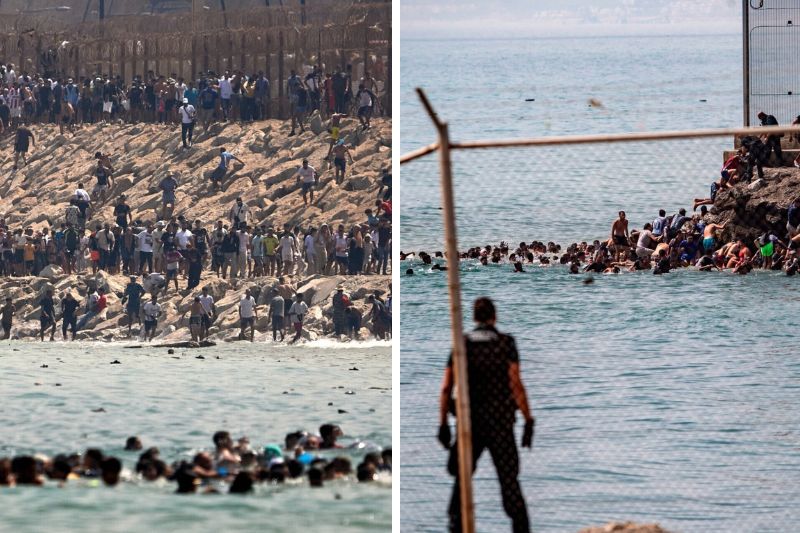
Ceuta Migrant Crisis: Nearly 49,000 Migrants Enter Spanish Enclave From Morocco in Just 24 Hours
Europe’s southern border just saw one of the biggest single-day migrant crossings in recent memory. Spanish officials say roughly 49,000 people entered the North African enclave of Ceuta from Morocco in the span of 24 hours, a number so large it’s rattled local authorities, pulled the Spanish military into the streets, and reignited the long-running fight over how Europe handles migration. Online, the footage is hard to look away from: thousands of people swimming through choppy water or simply walking across the border, arrivals continuing well into the night. Officials have confirmed that at least 18 people died during the crossing attempts.
A Border That Simply Couldn’t Keep Up
This wasn’t a gradual buildup, it was a flood. The number of people who crossed in a single day works out to more than half of Ceuta’s entire population, which sits at around 83,600 residents. Local officials say they’d already been warning Madrid that pressure was building and had asked for more support, but nothing prepared them for how fast Thursday’s crossings actually happened. In response, Spain has sent troops into both Ceuta and Melilla, its other North African enclave, where another 300 to 400 migrants also crossed overnight.
Why Ceuta, and Why Now?
Ceuta and Melilla occupy a strange spot on the map of Spanish cities sitting on the African continent, which makes them the only land borders the EU actually shares with Africa. For migrants trying to escape conflict, poverty, or simply looking for a better shot at life, that geography makes Ceuta one of the few walkable doors into Europe. It’s also one of the most dangerous: people routinely risk their lives swimming around the border barriers or packing into overcrowded boats. The timing here is notable. This surge comes not long after Spain’s Supreme Court ruled that migrants intercepted at sea on their way to Ceuta or Melilla can’t simply be sent back to Morocco without following proper legal procedure. Nobody in an official capacity has drawn a direct line between the ruling and the sudden crossings, but the coincidence hasn’t gone unnoticed.
An Unfolding Humanitarian Strain
The scale of the arrivals is creating problems that can’t wait. Emergency crews are scrambling to provide food, shelter, and medical care to thousands of new arrivals all at once, while rescue teams continue combing the coastline after several people drowned trying to make the crossing. Human rights groups have said for years that the western Mediterranean route is one of the deadliest ways into Europe, particularly for those attempting to swim past the fences or board unsafe vessels and this week is a stark reminder of why.
Stay Ahead with Today’s Biggest Global Stories
Can Gaza Peace Finally Last?
Explore how Hamas accepted a ceasefire roadmap featuring complete disarmament and what it means for the region.
Who Made Algeria’s Political History?
Discover how Khalida Boufedeche became Algeria’s first woman parliamentary speaker and why it matters.
Why Are Copper Prices Dropping?
Check what caused copper prices to fall before the Fed’s rate decision and how global supply influenced markets.
How Is Europe Supporting Ukraine?
Explore how the European Commission’s €3.47 billion package will strengthen Ukraine’s defence capabilities.
What Did Zendaya Reveal Recently?
Discover what Zendaya shared about working with Tom Holland and their friendship on the Spider-Man set.
What It Means Going Forward
Beyond the immediate scramble, this crisis is likely to ripple outward. Spain’s immigration system will feel the strain, and the incident is expected to fuel fresh debate within the EU over how member states manage their borders. Locally, the pressure on healthcare, housing, and emergency services is severe. This is the kind of surge that tests a small territory’s infrastructure fast. Security forces are now walking a tightrope: keeping order while still meeting their humanitarian obligations to the people who’ve just arrived. There’s also a diplomatic angle brewing. This could push Spain and Morocco back to the table for renewed talks on migration control, border security, and search-and-rescue cooperation. For now, the real question is whether this was a one-off surge or the opening chapter of something longer and harder to manage. The next few days should make that clearer.
FAQ
What actually happened in Ceuta?
Spanish officials estimate about 49,000 migrants crossed from Morocco into Ceuta within 24 hours one of the largest surges the enclave has ever seen.
Where exactly is Ceuta?
It’s a Spanish autonomous city on the northern coast of Africa Spanish and EU territory, despite sitting on the African continent.
Why are people crossing here specifically?
Ceuta is one of the closest and most accessible entry points into the EU for migrants seeking safety, asylum, or better economic opportunity.

