

Spain PM Pedro Sánchez Denies Prior Warnings Before Ceuta Migrant Crisis: What Happened?
Spain’s political scene has been in turmoil since the crisis at Ceuta, and it’s showing no signs of cooling off. Prime Minister Pedro Sánchez is pushing back hard against accusations that his government knew a massive wave of migrants was coming from Morocco and simply failed to act. His line: there was no specific alert warning of a surge on this scale. What started as a border emergency has turned into something much bigger: a fight over intelligence failures, border security, and Spain’s often-complicated relationship with Rabat.
What actually happened
On July 30 and 31, Ceuta Spain’s autonomous city on the North African coast saw an almost unbelievable number of people cross in the space of two days. Estimates range from around 60,000 up past 70,000, with many swimming from the Moroccan side and others simply walking toward the border. Spanish police were overwhelmed almost immediately, and the military had to step in as things spiraled. People died, others were injured and it quickly became one of the worst border crisis Spain has dealt with in years.
Sánchez’s defense
Addressing parliament on September 3, Sánchez said his team had gone back through everything, messages, intelligence reports, security briefings and found nothing that specifically flagged an event of this size or predicted it was likely to happen. He also pushed back on the idea that Morocco orchestrated the whole thing, saying there’s no solid proof Moroccan authorities planned or organized the crossing. That hasn’t satisfied his critics.
The intelligence question won’t go away
Earlier reporting including from Euronews pointed to intelligence assessments in the days beforehand that flagged the possibility of large numbers attempting to cross, along with a noticeable uptick in people swimming toward Ceuta before the huge surge hit. So the real argument now is about definitions: Sánchez says routine intelligence chatter isn’t the same as a concrete warning about an event of this magnitude. His opponents say any warning sign, however early, should have triggered a stronger response. Where that line gets drawn may end up being the crux of the whole investigation.
Morocco’s role
Because Ceuta borders Morocco directly, migration and diplomacy are never far apart here. Sánchez has been careful not to point fingers at Rabat, even as some reports raise uncomfortable questions. El País cited a police report suggesting Moroccan gendarmes may have actually helped steer groups toward the Spanish border. The government’s official stance, though, is that there’s still no hard evidence tying Moroccan authorities to planning the crossing.
The political fallout
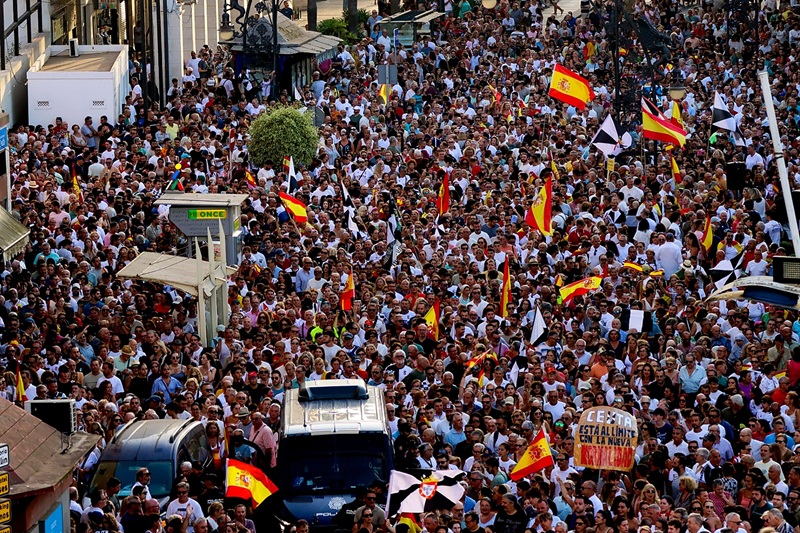
Protests have broken out across Spain, with critics accusing the government of dropping the ball. Opposition leaders including the PP’s Alberto Núñez Feijóo and Vox’s Santiago Abascal showed up at separate rallies in Madrid, demanding tighter border controls and real accountability. In response, Sánchez has floated the idea of a permanent Frontex presence in Ceuta and Melilla, along with deeper EU cooperation on irregular migration.
Where this goes next
The core question hanging over all of this: did Spain actually have enough intelligence to see this coming? If investigators find that warnings existed and were ignored, Sánchez could be in real political trouble. If his version holds up, attention will likely shift toward fixing emergency response systems and tightening cooperation with Morocco going forward. Either way, Ceuta has exposed just how fast a heavily guarded European border can be overwhelmed and reopened a debate Spain has never fully resolved: how to secure its territory without losing sight of the poverty and desperation driving people to make the crossing in the first place.
FAQs
1. What is the Ceuta migrant crisis?
It refers to the mass arrival of migrants from Morocco into Spain’s North African enclave of Ceuta on July 30–31, 2026.
2. Did Pedro Sánchez receive warnings before the crisis?
Sánchez says there were no specific alerts or extraordinary warnings predicting the likelihood and scale of the mass crossing.
3. How many migrants entered Ceuta?
Estimates vary, but reports have put the number at roughly 60,000 to more than 70,000 people.
4. Was Morocco responsible for the migrant influx?
Spain’s government says there is currently no definitive evidence proving that Moroccan authorities planned or executed the mass crossing, although reports have raised questions about their role.
5. What has Sánchez proposed after the crisis?
The prime minister has said Spain will seek a permanent Frontex presence in Ceuta and Melilla and stronger European cooperation on irregular migration.

