Why Koreans loved a WWII-era American personality test
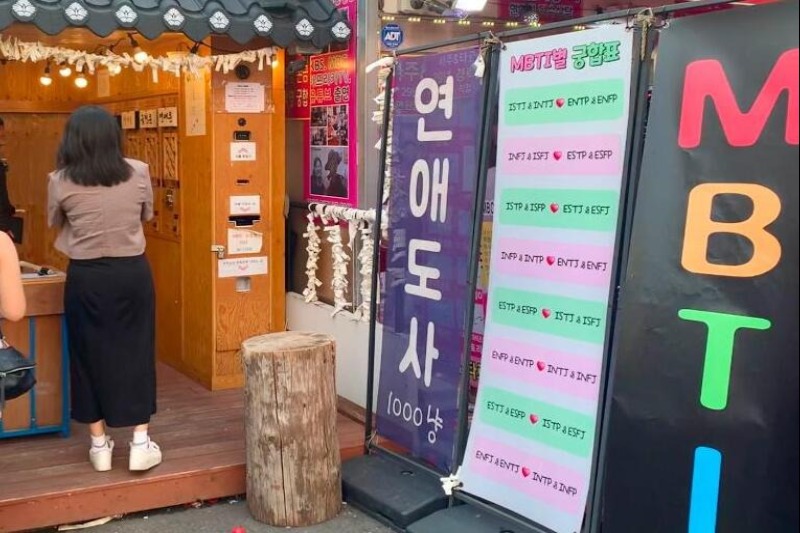
Seoul seems smitten; among the traditional Hangul characters, it’s hard to miss MBTI.
These four letters are in advertising, conversations, computer games, and Spotify playlists. In a cafe, first-date couples may be discussing them; a fortune-teller may use them to predict your future; a third of dating app profiles may include them.
The Myers-Briggs Type Indicator (MBTI) is a personality test that separates people into 16 types.
Two Americans designed the exam to link women to wartime professions. Since then, it has gone in and out of style, becoming a prominent career counseling tool in the 1990s.
Most recently, hip young South Koreans have made knowing your MBTI type a dating craze.
Some persistent believers in their 20s and 30s are using the MBTI to rule out incompatible personalities.
Lim Myoung-ho, a Dankook University psychology professor, says the MBTI approach to dating appeals to the “MZ Generation.”
“In this society, knowing your type beforehand is more effective,” Lim added.
Lee Da-hyun, a 23-year-old Seoul university student, always shares her MBTI type before meeting someone.
“I needn’t explain myself. I can save time by declaring I’m ENFP (“energetic and friendly”),” said Lee. “Today, everyone understands their personality type.”
“Lee’s experiences have enhanced her system faith. Her boyfriend’s type is compatible with hers, and “we’ve been together over 1,000 days,” she claimed.
Some are skeptical. Some experts worry if younger people are dismissing prospective companions in the false notion of finding love in a four-letter combination.
Katharine Cook Briggs and Isabel Briggs Myers established their indicator in the 1940s, when women were encouraged to take on industrial positions vacated by males deployed to war.
Related Posts
Their exam suggests that people are extroverted or introverted, sensing or intuitive, thinking or feeling, and judging or perceiving.
Each “preference” is represented by a letter, and their combinations constitute 16 personality types.
The test’s simplicity helps it endure. By the 1980s, the MBTI was widely employed in Western corporate hiring and management development.
Skepticism concerning the test’s scientific qualities has reduced its popularity in the workplace.
Many psychologists doubt its methods, citing insufficient evidence and inconsistent outcomes. They claim taking the test twice may get different results.
“It’s straightforward to use, but there’s a risk of overgeneralization or obsession,” says Lim.
Briggs and Myers have no professional expertise in psychology, human features exist on a more complicated spectrum than the test’s binary, and the assigned “type” may impact a person’s behavior and decisions, making it a self-fulfilling prophecy.
David J. Pittenger, a Marshall University psychology professor, noted in 1993 that “the exam appears to capture several common personality features, but the statistics do not show that there are 16 separate types of personality.”
“The MBTI provides minimal practical or theoretical contributions to behavior understanding.”
Young South Koreans are ignoring the test’s flaws for now. They’ve done this before.
In the early 2000s, many South Koreans believed blood type was linked to personality and romantic compatibility — Type Os were purportedly more outgoing.
Companies are quick to cash on, launching MBTI-themed computer games, beer, and vacations.
“MBTI Blind Date” lets gamers converse with characters representing each of the 16 personality types to measure compatibility.
Developer Thinkflow said 1.2 million people downloaded it in its first week.
“It’s like a date simulation to eliminate failure or make a relationship more efficient,” said Thinkflow CEO Lee Su-ji.
Paradise Group offers vacation recommendations based on your MBTI type, while Jeju Beer Company created cans with the 16 personality codes.
MBTI is returning to the workplace, alarming some.
A review of a Korean job recruitment website reveals scores of postings seeking various MBTI types; one marketing function seeks ENFP types, who are “energetic and imaginative”.
Observers are concerned about the MBTI’s scientific validity and what this abrupt trend may say about young people.
Professor Lim noted the MBTI’s recent growth coincided with the Covid-19 pandemic. People liked being able to categorize themselves with others.
“People are certainly more anxious, therefore they require psychological support,” Lim added. People feel less anxious in groups.
Young Koreans are nervous even without the coronavirus. Hypercompetitive job markets, soaring unemployment rates, ballooning housing prices, and poisonous office cultures are blamed for fostering a generation of gloomy millennials.
In the early 2010s, the MZ Generation was called the “n-po” generation because many forewent marriage, children, home ownership, and friendships.
Those that enter the rat race have little time or patience for dating, which is where the MBTI comes in.
Yoon Ji-hye, a Seoul university student, doesn’t “need to invest much time” in a bad match.
“I’m not compatible with T types (analytical and logical), but I’m great with ESFP types,” stated ENFP Yoon.
Many experts suggest it’s unhealthy to overemphasize MBTI results in dating, friendship, or job.
Lim noted that people might “provide fake answers easily in this exam” and that using it to “avoid (or exclude) someone” is against the creator’s goal.
Lim said Myers and Briggs believed their findings would help people recognize diversity.
Even Myers-Briggs, publisher of the official MBTI exam, expressed caution.
Cameron Nott, the firm’s Asia-Pacific managing director, said the company is “quite thrilled” about the test’s popularity in South Korea, but it shouldn’t be used to find a matching mate.
“Dating someone with similar personality preferences might be beneficial, but ‘opposites attract,’ so excluding a potential mate based on their MBTI type could mean missing out on a great relationship,” Nott added.