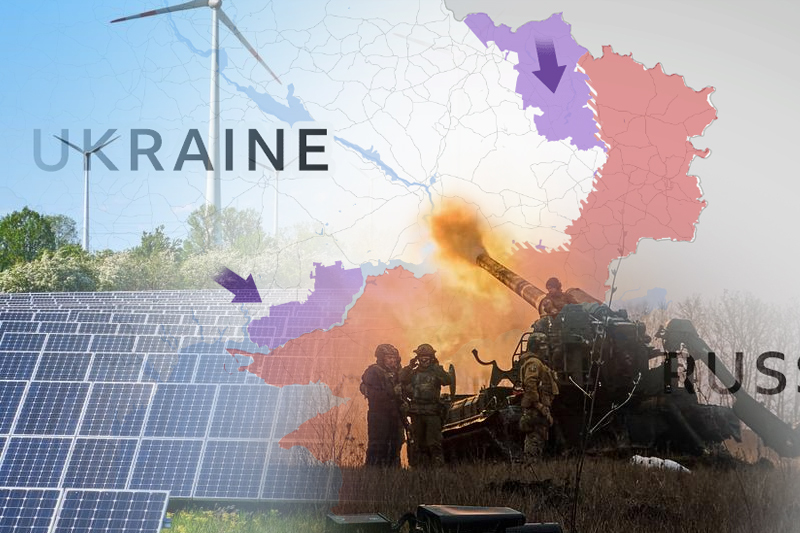
War in Ukraine will hasten the transition to clean energy: BP
Russia’s conflict in Ukraine is anticipated to have an impact on long-term energy demand and speed up the transition to renewable and low-carbon energy as nations increase their domestic energy supply, according to a report released today by BP.
Due to rising food and energy prices as well as decreased trade activity, the Ukraine war will cause a 3% reduction in global economic activity by 2035 compared to BP’s benchmark 2023 Energy Outlook prediction.
In accordance with its central forecast scenario, which is based on governments’ existing energy transition plans, BP reduced its predictions for the demand for oil and gas by 5% and 6%, respectively.
According to BP, the shifts are mainly concentrated in Europe and Asia, both of which rely substantially on energy imports.
According to BP, whose chief executive Bernard Looney wants to rapidly increase the company’s renewables division and reduce oil and gas output by 2030, its three scenarios place the peak of the world’s energy consumption between the late 2020s and 2035.
Russia exports a lot of goods, including energy.
Keep Reading
However, after the war, the world’s energy trade routes underwent a significant upheaval, notably after Moscow stopped exporting the majority of its natural gas to neighbouring Europe and Europe forbade the import of Russian oil.
While this was happening, governments accelerated domestic energy output, including nuclear, renewables, hydropower, and coal due to a spike in global energy costs last year.
Overall, BP predicts that primary energy consumption will decrease by 2% in 2035 compared to the forecast from the previous year, with improvements in energy efficiency accounting for 50% of the decrease and a decrease in economic activity for the remaining 25%.
“The increased focus on energy security as a result of the Russia-Ukraine war has the potential to accelerate the energy transition as countries seek to increase access to domestically produced energy, much of which is likely to come from renewables and other non-fossil fuels,” BP’s chief economist Spencer Dale stated.
According to BP’s three scenarios, oil demand is expected to begin decreasing quickly after 2030, but it will still be a significant part of the world’s energy system by 2035, when it will reach 70 to 80 million barrels per day (bpd), down from today’s consumption of almost 100 million bpd.
Under BP’s base case, carbon emissions in 2030 are 3.7% lower than they were in the prior projection.