

Trump Weighs Next Move on Iran as US Considers More Troops and Another Aircraft Carrier in the Middle East
A warship leaving San Diego rarely gets people talking over breakfast. This one has, because it may be a sign of what Washington plans to do next in the Middle East.
What’s Happening Right Now
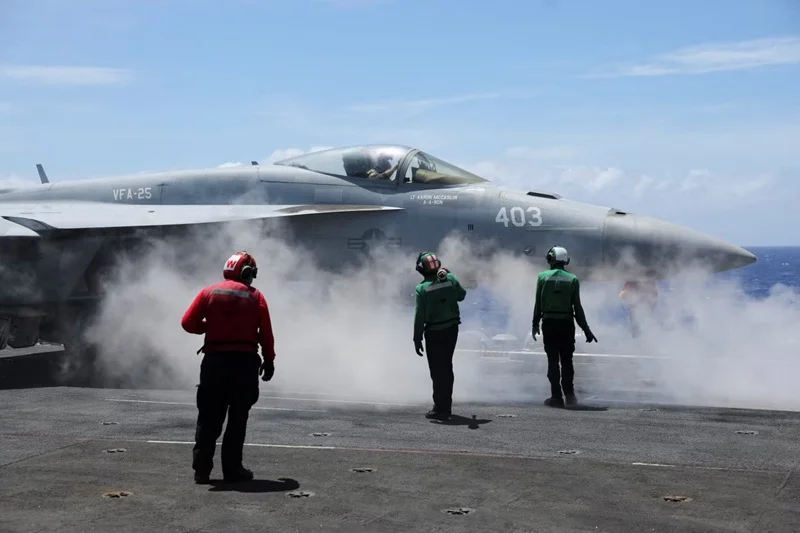
The USS Theodore Roosevelt Carrier Strike Group and the USS Makin Island Amphibious Group are heading to the Middle East, a U.S. official told CBS News. A U.S. official told the Associated Press that about 7,000 sailors and 2,000 Marines are on their way. Reports differ slightly on the troop count. The Wall Street Journal’s figure, as relayed by Mediaite, is 10,000. AP and CBS say roughly 9,000.
Two carriers, the USS George H.W. Bush and USS George Washington, are already in the region, and about 20 Navy ships are helping with escort operations. The new forces are due by late November, though some officials say three carriers could be in place by the end of October.
Why Now? Diplomacy Hit a Wall
The buildup follows a messy diplomatic week. Secretary of State Marco Rubio reportedly asked Iranian diplomats to leave the country after talks on the sidelines of the UN General Assembly faltered. Axios reporter Barak Ravid described it as a highly unusual diplomatic rebuke. Last week, Trump also rejected a seven-day cease-fire proposal from Iran, calling it unacceptable. In his UN speech, he said he has a “big decision” to make about Iran.
How We Got Here
This is not a new standoff. The US and Iran agreed to a two-week ceasefire on April 8, and the US began a naval blockade of Iranian ports on April 13. Trump later extended the truce indefinitely, but it has repeatedly strained. The flashpoint has been the Strait of Hormuz, a narrow waterway that carries about one-fifth of the world’s crude oil. Every time it closes, energy markets feel it.
Why It Matters to Ordinary People
Fuel and prices. Brent crude has topped $108 a barrel during earlier breakdowns in talks. Earlier this year, Goldman Sachs warned that a prolonged Hormuz closure could keep Brent above $100 for the rest of 2026. For households far from the Gulf, from Mumbai to Michigan, higher oil means pricier petrol, freight and groceries.
Politics. Trump is weighing renewed strikes or a return to talks ahead of the midterm elections. He has also vowed the war will end “right after the election,” if not sooner.
Risk of miscalculation. More ships and aircraft in tight waters give both sides more chances for a deadly accident. That is true even if nobody wants a bigger war.
What the Buildup Signals
Here’s my read. A third carrier works two ways. It’s leverage at the negotiating table, and it’s insurance if bombing resumes. Both can be true. Reports suggest the strike option is real. Trump has reportedly told aides he expects to resume bombing Iran in November. Military moves of this size also take weeks, which gives diplomacy a window, if either side wants it.
Iran’s response matters just as much. Tehran has previously threatened to fully close Hormuz and open additional fronts, including the Bab al-Mandeb Strait. Any new strike could trigger exactly that.
FAQs
1. How many troops is the US sending to the Middle East?
AP and CBS report about 9,000, including roughly 7,000 sailors and 2,000 Marines. The Wall Street Journal’s figure is closer to 10,000.
2. Which aircraft carrier is being deployed?
The USS Theodore Roosevelt, along with the USS Makin Island amphibious group. The USS George H.W. Bush and USS George Washington are already there.
3. Does this mean the US will attack Iran?
Not necessarily. Trump is reportedly weighing renewed strikes or a return to talks. The buildup keeps both options open.
4. Why is the Strait of Hormuz so important?
About a fifth of the world’s seaborne oil passes through it, so disruptions quickly push up fuel prices worldwide.
5. When will the new forces arrive?
Officials say late November, though three carriers could be in place by the end of October.
Related Reads You Shouldn’t Miss
How Is China Reshaping Indo-Pacific Alliances?
Check out how Quad nations are responding to growing security challenges in the Indo-Pacific.
Why Are China and Russia Growing Closer?
Find out how Arctic shipping routes are strengthening China-Russia geopolitical ties.
What Happens Inside The Twilight Zone?
Dive into the mysterious nightly migration of trillions of deep-sea creatures.
Which Religions Are Among History’s Oldest?
Explore 10 ancient religions that have shaped human history and civilizations.
Why Are North Korea’s Missiles Alarming Asia?
Uncover why North Korea’s new missile developments are raising concerns in Japan and South Korea.

