

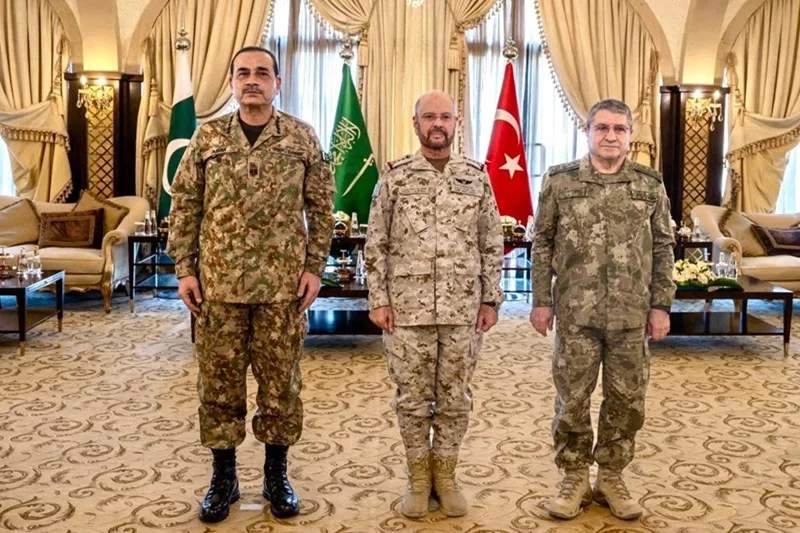
Pakistan, Saudi Arabia and Turkey Deepen Military Alliance as Chiefs Discuss Joint Defence and Intelligence Sharing
When the military chiefs of three major Muslim-majority nations sit down together in the same room, the world takes notice. That’s exactly what happened this week in Riyadh, where top defence officials from Pakistan, Saudi Arabia and Turkey met to discuss something that could reshape security dynamics across the Middle East and South Asia for years to come.
This wasn’t just another diplomatic photo-op. It was a follow-up to a landmark pact signed just weeks ago, and it signals that these three countries are serious about standing together against shared threats.
What Actually Happened in Riyadh
Turkey’s Chief of General Staff General Selcuk Bayraktaroglu met with Saudi Arabia’s Chief of General Staff General Fayyadh bin Hamed Al-Ruwaili and Pakistan’s Chief of Defence Forces and Army Chief Field Marshal Asim Munir in Riyadh on Friday. The three-way meeting focused on boosting intelligence sharing, tightening military coordination, and integrating defence capabilities across the three militaries.
In plain terms: these countries want their armies, intelligence agencies and defence systems to talk to each other more closely, react faster to threats, and back one another up when trouble arises.
Why This Meeting Matters
The chiefs didn’t meet in a vacuum. They reviewed the security threats facing Saudi Arabia and condemned attacks by Yemen’s Iran-backed Houthi rebels targeting the holy city of Makkah, along with the kingdom’s civilian and economic infrastructure. That’s a big deal. Makkah isn’t just any city, it’s the spiritual heart of the Islamic world, visited by millions of pilgrims every year. Any threat to it resonates far beyond Saudi borders.
The Backstory: A Pact Born from Crisis
This latest meeting builds directly on an agreement signed a little over a month ago. Saudi Arabia, Pakistan and Turkey signed the Makkah Joint Defence Agreement, declaring that an armed attack on any one of the three countries would be treated as an attack on all of them. That’s essentially a mutual defence clause, similar in spirit to NATO’s famous Article 5. The pact followed nearly a year of negotiations and arrived as the wider Iran war exposed serious security gaps for Gulf states, disrupting oil and cargo shipping through the vital Strait of Hormuz. It’s worth noting this isn’t Pakistan and Saudi Arabia’s first rodeo when it comes to defence cooperation. Pakistan had already signed a separate Strategic Mutual Defence Agreement with Saudi Arabia back in September 2025, under which aggression against one party would be treated as aggression against both though it stopped short of guaranteeing automatic military intervention. The Makkah pact essentially widens that circle to include Turkey.
A Relationship Decades in the Making
None of this cooperation appeared overnight. Pakistan and Saudi Arabia’s military relationship goes back generations. Pakistan’s air force has coordinated with Saudi Arabia’s since the early 1960s, and cooperation expanded significantly under a 1982 protocol covering training, defence production and joint exercises. Pakistani troops have maintained a presence inside the kingdom for decades, and the two navies regularly run joint drills together. What’s new now is the formal, three-way structure and Turkey’s growing role as an equal partner alongside two countries that have leaned on each other for half a century.
Why It’s Not Just About the Military
This alliance carries weight well beyond troop movements and radar systems.
Regionally, it signals a hardening bloc of Sunni-majority powers responding to instability triggered by the Iran conflict and continued Houthi attacks from Yemen.
Economically, protecting shipping routes through the Strait of Hormuz matters enormously; a huge share of the world’s oil passes through it, and any disruption sends ripples through global energy prices.
Diplomatically, it strengthens Pakistan’s standing on the world stage, giving Islamabad a louder voice in Gulf security matters while offering Saudi Arabia and Turkey a battle-tested military partner.
For everyday people in these three countries, the practical impact may take time to surface but greater regional stability, deterrence against attacks on shared holy sites, and closer economic ties often follow such alliances.
Frequently Asked Questions
1. What is the Makkah Joint Defence Agreement?
It’s a mutual defence pact signed by Saudi Arabia, Pakistan and Turkey, stating that an attack on any one signatory will be treated as an attack on all three.
2. Why did the military chiefs meet in Riyadh?
To discuss deeper intelligence sharing, military coordination, and turning the Makkah agreement into practical, working cooperation between the three armed forces.
3. Is this a new alliance, or does it build on existing ties?
It builds on decades of Pakistan-Saudi military cooperation dating back to the 1960s, now formally expanded to include Turkey.
4. How does the Iran war connect to this pact?
The conflict exposed security vulnerabilities for Gulf states and disrupted shipping through the Strait of Hormuz, pushing these nations toward closer collective defence.
5. Does this mean Pakistan is now obligated to send troops if Saudi Arabia is attacked?
The broader pact treats an attack on one as an attack on all, but it does not automatically mandate military intervention; the specifics of response remain a matter of political decision-making.
Explore the latest Trump moves shaping global politics, energy, and security.
Who Will Trump Send Abroad Next?
Check out the latest ambassador appointments and their potential diplomatic significance.
Could Venezuela’s Oil Transform America’s Energy Future?
Find out what the reported oil deal could mean for U.S. energy strategy.
Why Did Trump Cut Military Exercises?
Uncover the details behind the substantial reduction in joint military exercises.
Why Did Netanyahu Reject Trump’s Gaza Plan?
Dive into the key disagreements surrounding the proposed 15-point Gaza plan.
Can Trump’s Gaza Deal Survive Spoilers?
Look into the challenges that could affect the agreement and prospects for lasting peace.

