

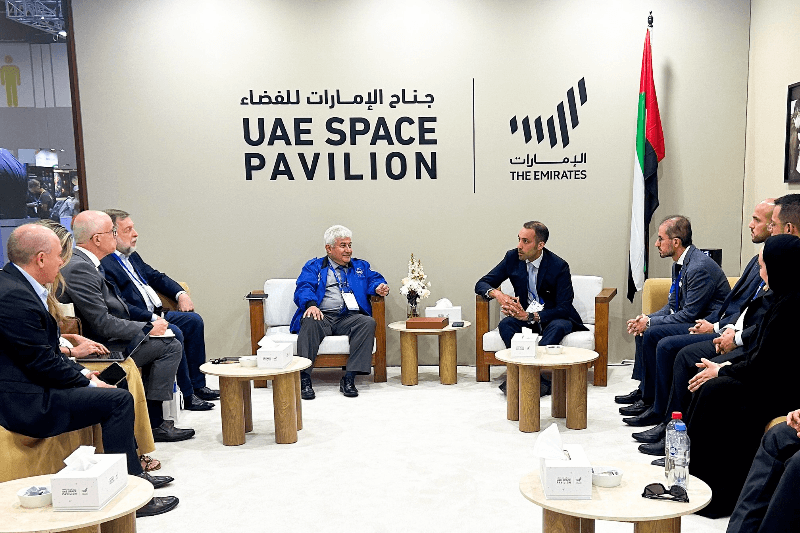
World Space Week 2025: UAE Reaches New Heights in Global Space Exploration
Every year, from October 4 to 10, the world celebrates World Space Week, as declared by the United Nations. The week highlights the achievements and aspirations of nations committed to advancing space science and technology. Among these nations, the United Arab Emirates (UAE) stands out as a rising leader, making remarkable progress in space research, innovation, and international cooperation.
From Mars to the Moon, and soon to the asteroid belt, the UAE is showcasing its vision to inspire future generations of scientists, engineers, and explorers. Its growing network of research centers and global partnerships positions it as a vital hub in the global space community.
UAE Missions to Space: Pioneering the Future
1. Emirates Mars Mission (Hope Probe)
Launched on July 19, 2020, the Hope Probe became the Arab world’s first interplanetary mission, successfully entering Mars’ orbit on February 9, 2021. Led by the Mohammed bin Rashid Space Centre (MBRSC), in collaboration with NASA and leading universities from the US, UK, and UAE, the mission aims to study the Martian atmosphere and weather cycles. This landmark mission placed the UAE among the few nations exploring the Red Planet.
2. Emirates Lunar Mission (Rashid Rover)
The Rashid Rover, launched aboard Japan’s HAKUTO-R Mission 1 on December 11, 2022, marked the UAE’s first lunar exploration attempt. Although its landing on April 25, 2023, was unsuccessful, it was a significant technological achievement for the region. Developed entirely by MBRSC, the mission has paved the way for Rashid Rover 2, strengthening the UAE’s expertise in rover technology and lunar research.
3. Emirates Mission to the Asteroid Belt
Announced in May 2023, this ambitious mission aims to explore six asteroids by 2028, with a planned landing on 269 Justitia in 2034. The mission, led by the UAE Space Agency in partnership with the University of Colorado’s LASP, will help scientists better understand asteroid formation, deep-space mining, and planetary defense.
4. Emirates Airlock for Lunar Gateway (Artemis Program)
In January 2025, the UAE signed an agreement to contribute the Emirates Airlock to NASA’s Lunar Gateway, part of the Artemis Program. This airlock will play a key role in lunar surface missions and radiation studies, while also preparing for future human missions to Mars. It signifies the UAE’s growing stature as a trusted global partner in space exploration.
Global Partnerships: UAE Expands Its Space Network
The UAE’s progress in space exploration extends beyond missions — it thrives on international cooperation. Through strategic partnerships, the nation is building a foundation for sustainable global research and innovation.
- USA (Firefly Aerospace): To deliver the Rashid 2 Rover to the Moon’s far side.
- France (CNES): Supporting imaging and data processing for Rashid 2 and other future collaborations.
- China (CNSA): Joint work on the Chang’e 7 Mission, aiming to deploy Rashid 2 on the lunar surface.
- Egypt: New MoU focusing on Earth observation, satellite technology, and peaceful space exploration.
- South Africa (SANSA): Cooperation in data exchange, regulation, and talent development.
- South Korea: Joint development in satellite navigation and communications technology.
- Japan (ispace): Collaborated on the Emirates Lunar Mission to deliver lunar payloads.
The UAE’s journey into space reflects its forward-thinking vision and determination to become a leading force in global exploration. Through landmark missions, cutting-edge technology, and strategic alliances, the nation is turning its ambitions into reality. As the world celebrates World Space Week 2025, the UAE stands as a shining example of how commitment, collaboration, and innovation can propel humanity toward the stars.

