

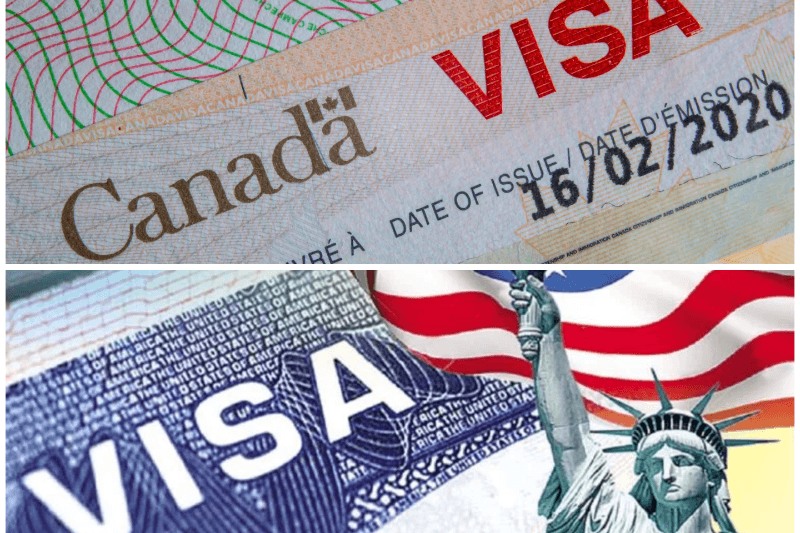
USA vs Canada Student Visa: Cost, Approval Rate, PR Chances
When you decide on a university to study overseas, monetary issues aren’t the only things you need to consider; you also have to consider the cost of living, as well as whether your visa will be approved. After graduation, there is another important factor: what you will do next. The USA and Canada are two of the most popular destinations for Indian students among other countries. However, their offerings are different, as are the costs, the success of obtaining a visa, and the opportunity to become a permanent resident of either country.
This article will outline some of the key differences between the USA and Canada, allowing you to make a decision about which is best for you based on your own aspirations.
Cost of Studying in USA vs Canada
Tuition fees in the USA range from approximately $20 to $60 per year, depending on the school and course taken. In addition to tuition, the cost of living, which can also vary depending on where you live, can be anywhere from $10 thousand to $18 thousand per year. All of these costs combined make it more than likely that you will pay over $50 thousand per year to attend university in the USA. Although there are scholarships available, most are competitive and not guaranteed.
By comparison, Canadian schools are less expensive than schools in the United States. Tuition ranges from approximately CAD 15,000 to CAD 35,000 annually. The cost of living is also lower in Canada than in the USA, and you can expect to spend between CAD 10,000 and CAD 15,000 per year on living expenses as well. Consequently, many students find that studying at universities in Canada is significantly more affordable than studying at universities within the USA.
Visa Approval Rate: USA vs Canada
The U.S. student visa (F-1 visa) requires the applicant to attend an interview at the embassy. Your chances of being approved depend on proof of sufficient finances, the education you’ve completed, and how confidently you answer questions during the interview process. This interview process can create uncertainty regarding an applicant’s visa decision. Approval rates for the USA depend on the applicant but are typically between 65%-80%.
PR Chances and Future Opportunities
Students in the United States can work following graduation using the Optional Practical Training (OPT) program; however, long-term residency will depend on whether or not the applicant is selected through a lottery for an H-1B work visa, and even if the H-1B is obtained, there is no guarantee that the applicant will then receive their Green Card, with the process taking several years.
In contrast, there is a defined process in Canada for students transitioning from study, to work, and then to permanent residence (PR). Following graduation, students can apply for a Post-Graduation Work Permit (PGWP) for up to three years; this work experience qualifies students to apply for PR through Express Entry or Provincial Nominee Programs (PNPs).
FAQs
1. Which is better for students: USA or Canada?
It depends on your goal. The USA is better for top universities and high-paying careers, while Canada is better for affordability and PR opportunities.
2. Which country has a higher visa approval rate?
Canada generally has a higher visa approval rate because its process is more document-based and less dependent on interviews.
3. Is studying in Canada cheaper than the USA?
Yes, Canada is usually more affordable in terms of both tuition fees and living expenses.
4. Can I get PR after studying in the USA?
It is difficult. There is no direct PR pathway, and the process depends on work visas and employer sponsorship.

