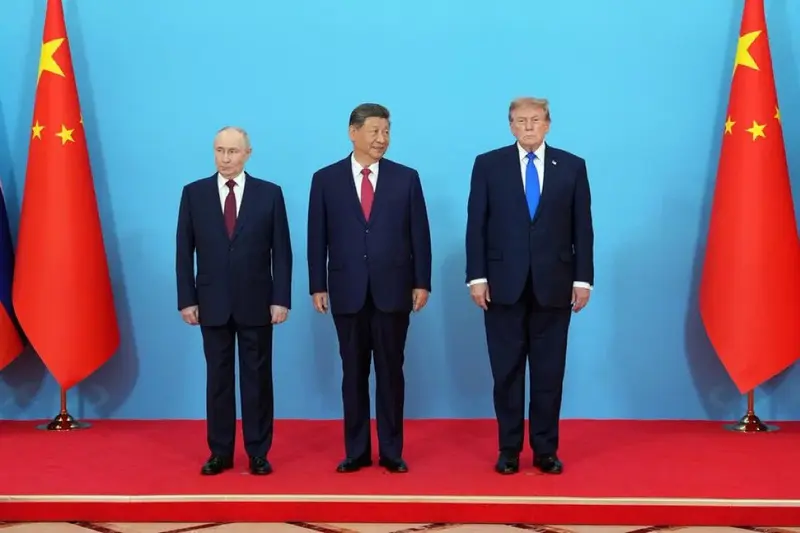
What the US-China-Russia Summit Revealed About the Changing Global Order
For the first time ever, the leaders of the United States, China and Russia sat down together with no other heads of state in the room. Never before had the three met at a table like this to hash out global issues.
Three nuclear powers, two ongoing wars, one table. It was hard to look away.
What Happened in Shenzhen
On Thursday, November 19, Donald Trump, Xi Jinping and Vladimir Putin met in Shenzhen, China, on the sidelines of the APEC conference. Xi chaired the talks, which ran a little over an hour and ended with a joint “peace declaration.”
What They Actually Agreed To
The declaration is light on detail, but it covers three themes:
- Energy: The leaders stressed stable energy flows. Supplies have been shaky since the US attacked Iran in February and Tehran closed the Strait of Hormuz.
- Nuclear risk: They pledged to start a dialogue on reducing nuclear dangers and preventing proliferation.
- The ICC: They warned the International Criminal Court and similar bodies against overstepping. None of the three countries belongs to the court.
Big Words, Few Answers
Here’s the catch. Iran barely came up, apart from Trump repeating that Tehran can’t have a nuclear weapon. A Kremlin spokesperson said Ukraine wasn’t even the central topic.
It also isn’t clear how “stable energy” will happen while the three countries want very different things.
Why It Points to a Changing Global Order
For decades, the US-led system largely set the rules of world politics. This summit suggests that era is fading.
The Washington Post said the meeting highlights a complicated, emerging multipolar order, with China rising as a strategic competitor to Washington. Meanwhile, NPR argued the summit’s biggest deliverable was arguably the image itself: a US president sitting with the leaders of China and Russia.
Europe, notably, wasn’t invited. European leaders gathered nervously in Berlin to coordinate support for Ukraine while the trilateral talks went on. Al Jazeera went as far as asking whether this could be the start of a “G3.”
What It Means for Everyday People
This part is analysis, not confirmed outcome. If energy supplies really do steady, fuel and food prices could ease. If the nuclear dialogue produces anything concrete, the world gets a little safer. But smaller nations may worry that major decisions are being made without them. For countries like India, which balance ties with all three powers, that’s a real concern.
Explore the Human Stories, Global Reactions, and Accountability Debates Surrounding Gaza
How Has Gaza’s War Changed One Family?
Explore the devastating human toll of the Gaza war through the story of a man who lost 39 relatives.
What Does Germany’s ICJ Case Mean?
Why Is Gaza’s Death Toll Rising?
Why Are UK, Canada and Australia Condemning Israel?
Why Are Australia-Israel Relations Growing Tense?