

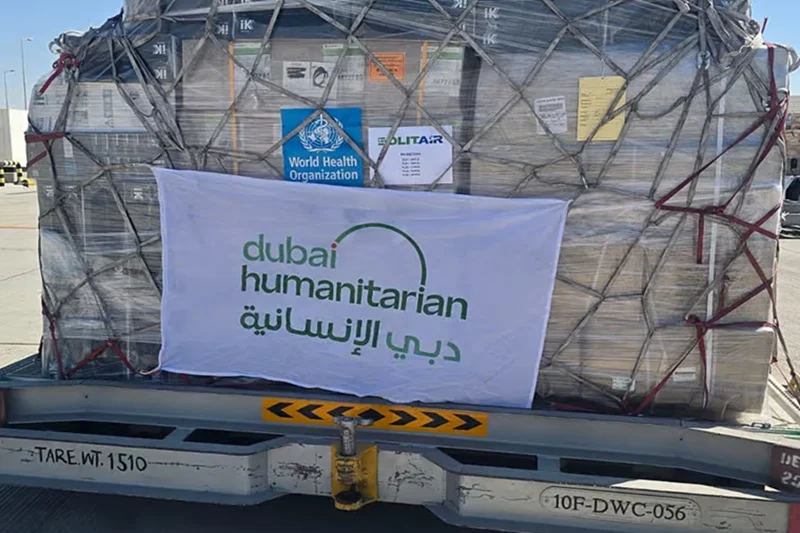
UAE Ebola Relief Airlift Delivers 60 Tonnes of Emergency Aid to DR Congo
As the Ebola outbreak continues to threaten vulnerable communities in the Democratic Republic of the Congo (DRC), the United Arab Emirates has increased its humanitarian response. In a clear display of urgency and international support, Dubai Humanitarian organized a second emergency relief airlift within a week to deliver crucial medical supplies and aid to the region. This mission, directed by His Highness Sheikh Mohammed bin Rashid Al Maktoum, Vice President and Prime Minister of the UAE and Ruler of Dubai, highlights the UAE’s growing role as a global leader in humanitarian efforts during health crises. The aid shipment was transported from Uganda on a fully loaded Boeing 747 aircraft provided by Dubai Royal Air Wing. According to officials, the aircraft carried nearly 60 metric tonnes of emergency supplies aimed at supporting Ebola response operations in eastern DRC.
UAE Strengthens Emergency Ebola Response
The latest relief mission brought together several major humanitarian organizations, including the World Health Organization (WHO), UNICEF, and the United Nations Humanitarian Response Depot (WFP-UNHRD). The supplies included life-saving medical equipment, protective gear, emergency health kits, and materials to support those helping frontline workers contain the outbreak and protect affected communities. Giuseppe Saba, CEO and Board Member of Dubai Humanitarian, said the operation reflects the UAE’s long-standing commitment to humanitarian work worldwide. “This is the second airlift we are facilitating within a week in response to the Ebola outbreak,” Saba said. “Despite all challenges, we see the continuation of humanitarian operations as a responsibility, not just an option.” His comments also underscored the growing importance of quick-response logistics in global health emergencies, particularly in areas where weak healthcare systems cannot manage outbreaks on their own.
International Cooperation at the Center of the Mission
The operation was closely coordinated with the European Commission’s Directorate-General for European Civil Protection and Humanitarian Aid Operations (DG ECHO). This effort highlights the growing partnership between the UAE and the European Union. This collaboration follows an administrative agreement between Dubai Humanitarian and the European Union, signed last year. The agreement aims to improve the speed and effectiveness of humanitarian responses around the world. Maciej Popowski, Director-General for the EU’s Civil Protection and Humanitarian Aid Operations, stressed the need for international cooperation to control the outbreak. He stated, “The EU stands in solidarity with all affected communities and remains firmly committed to supporting efforts to contain the virus and save lives.” Health experts warn that coordinated international intervention is vital because Ebola outbreaks can escalate quickly if medical resources and containment measures are delayed.
Why the Ebola Situation in DR Congo Matters
The Democratic Republic of the Congo has faced several Ebola outbreaks over the past decade. These outbreaks are often made worse by conflict, displacement, and a lack of healthcare resources. Ebola is a highly infectious and often deadly virus. It spreads through direct contact with the bodily fluids of infected people. Without quick containment, outbreaks can put a huge strain on local health systems and pose broader regional risks. Humanitarian analysts say that quickly sending medical aid can greatly lower transmission rates and improve survival. The UAE’s rapid response is seen as more than just a diplomatic gesture; it provides practical help at a crucial time. The delivery of 60 tonnes of aid within days of the initial response shows how logistics hubs like Dubai are becoming increasingly important in global efforts to respond to disasters and epidemics.
UAE Expands Its Global Humanitarian Influence
Over recent years, the UAE has built its international humanitarian reputation through emergency relief operations, medical assistance programs, and disaster response initiatives in Africa, Asia, and the Middle East. This latest Ebola relief effort is part of the country’s larger strategy to combine diplomatic influence with humanitarian work. Analysts say these operations also boost international trust and support the UAE’s role in managing global crises. As outbreaks and health emergencies grow more common worldwide, experts think that partnerships between governments, aid agencies, and international organizations will be even more important in the coming years.

