

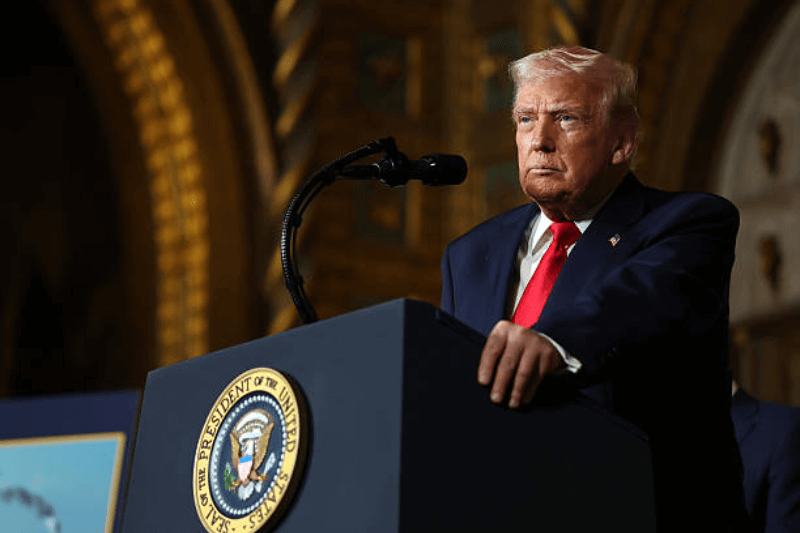
Trump’s NSS Drops Democracy Focus: Migration, Deals Replace Global Freedom Push
The new National Security Strategy (NSS) by Donald Trump is an indicator of a radical change in the post-Cold War tradition of democracies promotion as a primary U.S. foreign policy agenda. The document predicts border security, migration control, and transactional economic transactions with partners who are eager to promote American interests instead of framing the American power as the promotion of liberal values. Words like democracy, human rights, and the language of the rules-based order are still there, but they are more of a rhetoric than commitments to guide alliances or military assistance. The outcome is a policy that reinvents the U.S. world leadership as hard-edged interest-driven bargaining, rather than a freedom-first initiative.
From Freedom Agenda To Transactional Deals
- The past policies of Republicans and Democrats presented democracy and human rights as strategic resources in the long term, which were the reasons behind their aids, trade, and interventions.
- Trump’s NSS treats questions like market access, energy routes, and tech supply chains as higher priorities than how partners govern at home.
- The less liberal and authoritarian regimes that engage in co-operation in migration, security or investment have less conditions related to public democracy attached.
Migration And Borders Take Center Stage
- The new NSS makes irregular migration, border control, and asylum deterrence a domestic politics matter rather than a national security issue.
- The theme of partnerships with transit and country of origin is based on their readiness to police borders, accept returns and limit movement rather than political liberalisation.
- It is a securitised migratory prism that would transform weak states into subcontractors and relegate the rights protection of migrants and refugees.
Redefining Allies And Adversaries
- Friends are becoming selected based on alignment in deals, energy, defence purchases, technology and migrations deals not on common democratic standards.
- Strategic ambiguity arises where by the U.S. accuses the repression of certain rivals and at the same time ignoring analogous acts in governments which have signed favourable agreements.
- The civil society organizations and pro-democracy activists outside the country can lose their bargaining power as the public pressure of Washington on the perpetrators is more discriminatory and low-profile.
What It Means For Global Freedom
- In the absence of democracy as a principle organising the world, the NSS naturalises a world of bargaining between states in which the rights of citizens are side deals.
- Greater references, reduced funding and less diplomatic support are likely to be experienced by the activists who previously used the language of U.S. democracy as a shield.
- The turn also gives propaganda victory to the opponents that claim that the U.S was never about democracy, but power and bargains.

