Trump’s Israel Visit: A New Chapter for Peace or Another Diplomatic Mirage?
President Donald J. Trump’s visit to Israel on October 13, 2025, marked one of the most dramatic diplomatic gestures of his renewed political era. Stepping onto Israeli soil with the declaration, “The war is over,” Trump sought to project an image of a dealmaker-turned-peacemaker, positioning himself once again as a central figure in Middle East diplomacy.
The visit came just days after a U.S.-brokered ceasefire between Israel and Hamas ended months of devastating conflict in Gaza. For the world, it represented both a potential turning point and a test of whether bold American diplomacy could finally reshape one of the world’s most intractable conflicts.
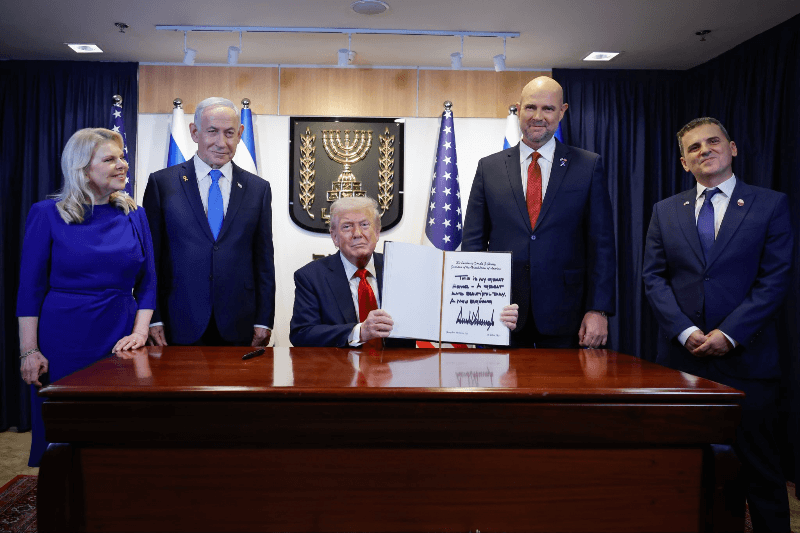
President Donald J. Trump signs the guest book at the Knesset
— The White House (@WhiteHouse) October 13, 2025
"This is my great honor – A great and beautiful day. A new beginning." pic.twitter.com/JZrhTm0JRU
The American Lens: Reasserting U.S. Global Leadership
From Washington’s perspective, the visit was as much about reclaiming U.S. credibility as it was about stabilizing Gaza. The Biden and post-Biden years had left global observers questioning whether the United States could still serve as an honest broker in the Middle East. Trump’s team seized that gap, orchestrating a series of diplomatic maneuvers that culminated in the Gaza ceasefire.
The trip serves multiple domestic and strategic goals:
- Restoring Diplomatic Authority:
By mediating a ceasefire and facilitating hostage releases, Trump has positioned the U.S. once again as an indispensable power in Middle East negotiations. - Domestic Optics and Political Capital:
At home, the optics of ending a war and freeing hostages offer a powerful narrative of leadership and resolve. The visit allows Trump to showcase an international “win” that plays well across political lines. - Strategic Leverage:
The administration has used its influence with Israel, Egypt, and Qatar to push forward a 20-point Gaza Peace Plan—calling for phased troop withdrawals, reconstruction oversight, and the creation of an International Stabilization Force to secure the region.
Still, beneath the triumphal tone lies a recognition that American leadership now faces stiffer global competition than ever—from China, Russia, and regional coalitions carving out their own influence.
The Global Response: Hope, Hesitation, and Hard Calculations
The international reaction to Trump’s visit has been broad but cautious.
Europe’s Support, Russia’s Critique
European governments broadly welcomed the move. The EU’s foreign affairs council called it a “courageous and necessary step toward sustainable peace.”
Russia, by contrast, criticized the plan as “vague and politically selective,” citing its lack of clarity on Palestinian sovereignty and West Bank governance.
Arab States Walking a Tightrope
Arab nations have responded with a blend of relief and restraint. Egypt, the host of the upcoming Sharm El Sheikh Peace Summit, has enjoyed renewed diplomatic prestige, while Jordan, Saudi Arabia, and the UAE have framed the ceasefire as a humanitarian imperative.
Yet, within these states, public opinion remains cautious. Support for Palestinian rights remains deep-rooted, and many fear the peace plan could become another framework that prioritizes control over justice.
Africa’s Emerging Role
Across Africa, where economic and security links to the Middle East have deepened, reactions were largely positive. Governments in Kenya, Nigeria, and Ghana issued statements emphasizing the global importance of regional stability. African commentators noted that prolonged conflict in Gaza has ripple effects—from energy prices to migration and counterterrorism cooperation.
Inside Gaza: Fragile Peace, Tentative Future
While international leaders celebrated the ceasefire, the humanitarian picture in Gaza remains grim. Thousands of homes have been destroyed, infrastructure is shattered, and millions face displacement.
The deal’s success hinges on the creation of a new technocratic authority in Gaza—excluding Hamas—supported by Arab and Western donors.
Critics warn that without local legitimacy, any external governance model could quickly collapse. Questions also persist over how Israel and the U.S. intend to prevent militant resurgence or political chaos during the reconstruction phase.
What’s at Stake for Trump and the World
Trump’s Israel visit is being hailed by allies as a “second Camp David moment”—a chance to set in motion a wider peace architecture that includes Israel, Egypt, Jordan, and select Gulf and African partners.
However, skeptics caution that similar moments in history—filled with optimism and global fanfare—have often unraveled amid mistrust and unmet promises.
If the ceasefire endures and reconstruction begins swiftly, Trump’s trip could redefine the narrative of U.S. diplomacy and revive faith in its capacity to mediate global conflicts.
If it fails, it may become a symbol of overreach—a performance of peace without the hard work of political compromise.
Looking Ahead: The Weeks That Will Decide Everything
The next 30 days will determine whether the visit translates into enduring progress. Key milestones to watch include:
- The deployment of the International Stabilization Force in Gaza.
- Confirmation of Arab and Western funding pledges for reconstruction.
- Formation of a new Gaza administrative council under regional supervision.
- Continuation of hostage and prisoner exchanges without violations of the ceasefire.
Each of these steps will test whether Trump’s message of “a new dawn for the Middle East” can stand up to the realities of a region shaped by decades of mistrust.
Trump’s Israel visit has revived the language of peace and diplomacy in a region weary of war. Yet even the most powerful speeches and handshakes must contend with the depth of the conflict’s scars.
For the United States, this visit is more than a foreign policy milestone—it’s a statement of intent to lead again on the global stage. For the rest of the world, it’s a reminder that peace in the Middle East remains both the most necessary and the most elusive of international goals.
If Trump’s gamble holds, history may mark October 13, 2025, as the day diplomacy regained momentum. If not, it will be remembered as another missed chance in a region that has seen too many.