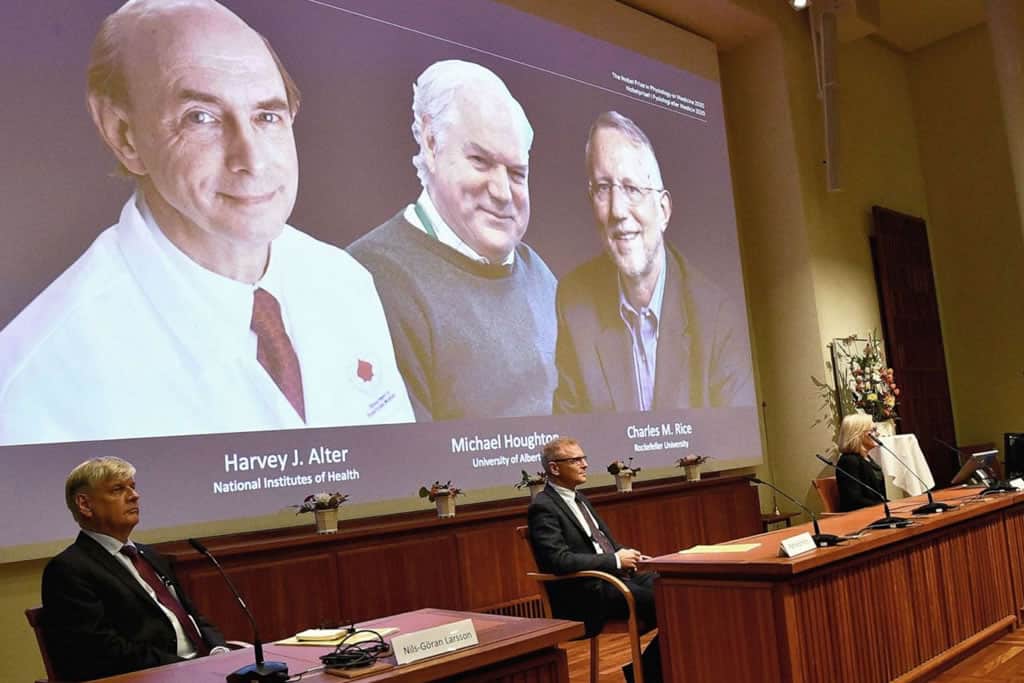
Nobel Prize 2020 for Medicine winners announced: Three scientists share the prize for Hepatitis C virus discovery
Last updated on July 3rd, 2026 at 11:24 am
American researchers Harvey J Alter and Charles M Rice, and British scientist Michael Houghton have been awarded the Nobel Prize for Medicine or Physiology for the year 2020. The Nobel Assembly at Karolinska Institute decided to award the prestigious prize jointly to the three scientists for “the discovery of Hepatitis C virus.” The committee said that the three scientists have made a “decisive contribution to the fight against blood-borne hepatitis.” The disease is considered to be a global health problem which has led to cirrhosis and liver cancer in people across the world.
Hepatitis C virus discovery was result of seminal work done by Alter, Rice and Houghton. Earlier the discovery of Hepatitis A and B have been groundbreaking steps towards disease simplification, but a majority of blood-borne Hepatitis cases remained a mystery. Hepatitis C virus discovery led to explanation of these chronic cases of Hepatitis, enabling saving of several lives through blood tests and treatment plan involving new medications.
Understanding Hepatitis – a global disease
Hepatitis is essentially liver inflammation, derived from Greek words for liver and inflammation, is caused by viral infections. However, excessive alcohol, environmental toxins and autoimmune disorders also play an important role as the causative agents.
Two main types of infective hepatitis were known back in 1940s – Hepatitis A was confirmed to be transmitted through contaminated food or water and seldom leads to long term effect on patient; and Hepatitis B which is transmitted through blood and bodily fluids and poses much serious impact as it can potentially convert to a chronic condition with cirrhosis and liver cancer development. Hep B is said to be ‘insidious’ as people can be infected with it but remain asymptomatic for years together and then emerge with complications.
Blood borne Hepatitis is known to be associated with mortality and morbidity of significant levels, leading to over a million deaths per year around the world. This makes it a major global health concern, comparable to tuberculosis and HIV infections.
Identification of Hepatitis C virus
In 1976, Baruch Blumberg was awarded Nobel Prize for Medicine or Physiology for his discovery of Hepatitis B, a form of blood-born Hepatitis that led to diagnostic tests and effective vaccine development. During the same period, Harvey J Alter was studying Hepatitis occurrence in patients with history of blood transfusion in US National Institutes of Health. However, the number of blood transfusion related cases had reduced post discovery of Hepatitis B. But the fact that still a large number of cases remained was worrying for Alter and his colleagues and they continued their study. Hepatitis A tests that were developed during that time clarified that these unexplained cases were not of Hep A.
A significant number of those cases were caused by an unknown infectious agent, thus raising concerns. Alter showed that blood from these cases can transmit the infection to chimpanzees when transmitted. This mysterious Hepatitis variant came to be known as “non A, non B” Hepatitis.
Identifying this virus was a high priority now. Michael Houghton took up the work of isolating genetic sequence of this virus while working in pharmaceutical firm Chiron. From blood of infected chimpanzees Houghton and his colleagues made a collection of DNA fragments from the nucleic acids isolated. Patient serum was used to identify the cloned viral DNA in blood encoding viral proteins. Through comprehensive series of study one positive clone was found. This clone was then found to be derived from novel RNA virus that belonged to Flavivirus family. It was then named Hepatitis C. Antibodies from blood of the unexplained Hepatitis cases too implicated the mystery cause as Hepatitis C virus.
Charles M Rice then worked on answering the question if the cloned virus was able to replicate and cause the disease. Rice worked at Washington University in St. Louis and found that a region in end of Hepatitis C virus genome could be the key in virus replication which was missing in the original genome sequence and was devoid of inactivating genetic variations. Charles M Rice determined that the Hepatitis C virus was independently capable of causing the unexplained transfusion-mediated hepatitis.
The discovery of Hepatitis C virus by the three Nobel Laurates is landmark in field of Medicine globally in fight against the viral diseases. Through discovery highly sensitive blood tests were developed which have “essentially eliminated post transfusion hepatitis” in many parts of the world, thereby improving global health. Hopes of eradicating Hepatitis C virus from the world have been possible through the groundbreaking work of these Nobel Prize winners.
The prestigious Nobel Prize comes with a gold medal and 10 million Swedish kronor (over USD 1,118,000) in prize money. This is courtesy of 124 year old bequest left by creator of the prize Swedish inventor Alfred Nobel.