

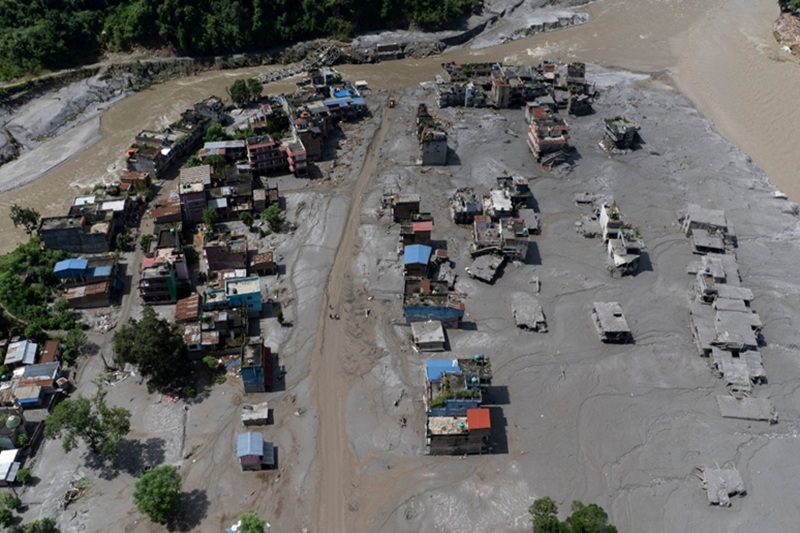
Nepal Seeks $20 Million From UN Climate Fund After Devastating Floods as New Study Links Disaster to Climate Change
Three weeks after a wall of ice, rock, and mud tore through northern Nepal, killing more than 1,300 people and leaving thousands still unaccounted for, the country has gone to the United Nations with a request: an initial $20 million from the global fund set up to help nations cope with climate disasters they didn’t cause.
It’s a modest task given the scale of what happened. The disaster started on August 26 as a massive avalanche of rock and ice along the Nepal-China border. Within moments, it had turned into a churning debris flood that flattened villages, wiped out roads and bridges, and knocked out power and water systems across the region. The UN estimates roughly 84,270 people were affected. Nepali officials say the full cost of rebuilding could run into the billions meaning this first request is really just a down payment on a much larger need. Nepal isn’t approaching this as a charity case. It’s framing the request as a matter of climate justice: the country produces a tiny fraction of the world’s greenhouse gas emissions, yet its mountain communities are on the front lines of a warming planet.
What the science says
A rapid-response study released September 17 by World Weather Attribution, a group of scientists who specialize in tracing extreme weather back to its causes, backs up much of that argument. Their assessment found that human-caused warming has been steadily destabilizing the high mountain terrain where the collapse happened melting glaciers, thawing permafrost, and stripping away the natural “glue” that normally holds steep slopes together.
In the days before the disaster, the researchers noted unusually warm conditions and higher-than-normal meltwater, both of which likely helped push an already unstable slope past its breaking point. To be clear, the scientists aren’t saying climate change was the sole trigger. The region’s underlying geology was already fragile, and the lasting damage from Nepal’s devastating 2015 earthquake almost certainly played a role too. What they’re describing is a pileup of factors, some geological, some climate-driven, that together made a rare, catastrophic event more likely.
Related Articles You May Find Interesting
Why Did Crypto Clarity Act Fail?
Check out the key reasons the cryptocurrency bill failed to advance in the US Senate.
Who Are Trump’s New Envoy Picks?
Find out about Wesley Hunt and Kimberly Greenwood’s new diplomatic appointments.
Why Did US Expand Iran Sanctions?
Uncover the networks targeted by the latest US sanctions over alleged support for Hezbollah and Iraqi militias.
How Could Financial Power Shape Markets?
Explore Scott Bessent’s views on using financial power as a foreign policy tool and its global impact.
What Happened in Turmus Ayya?
Dive into the US ambassador’s West Bank visit amid rising settler violence in Turmus Ayya.
A bigger problem than one flood
This is becoming a familiar and troubling pattern across the Himalaya. As glaciers retreat and permafrost thaws, new hazards are emerging in places that communities and governments once considered safe. Nepal is already contending with a rising threat from glacial lake outburst floods and landslides, and a UN-backed climate initiative has warned that this kind of glacial retreat puts hydropower, farming, tourism, and basic infrastructure increasingly at risk.
That’s part of why the outcome of this funding request matters well beyond Nepal’s borders. The Loss and Damage Fund created specifically so wealthier, high-emitting nations could help cover the costs falling on countries like Nepal has been criticized for moving slowly, with pledges piling up faster than actual money reaching the people who need it. For Nepal, this isn’t just about clearing debris and rebuilding homes. It’s about funding better early-warning systems and glacier monitoring so the next collapse doesn’t catch communities off guard all while trying to recover from this one. How quickly, and how fully, the international community responds may say a lot about whether climate finance can actually keep pace with climate disasters.
FAQs
1. Why is Nepal seeking $20 million from the UN?
Nepal is seeking an initial $20 million from the UN’s Loss and Damage Fund to help address losses from the devastating August 2026 disaster.
2. Was the Nepal flood caused by climate change?
Scientists say climate change increased the likelihood and severity of the conditions behind the disaster. However, geological factors also played an important role.
3. What caused the August 2026 disaster?
A huge rock-and-ice avalanche in the Himalaya triggered a destructive debris flood that spread through northern Nepal and neighbouring areas.

