

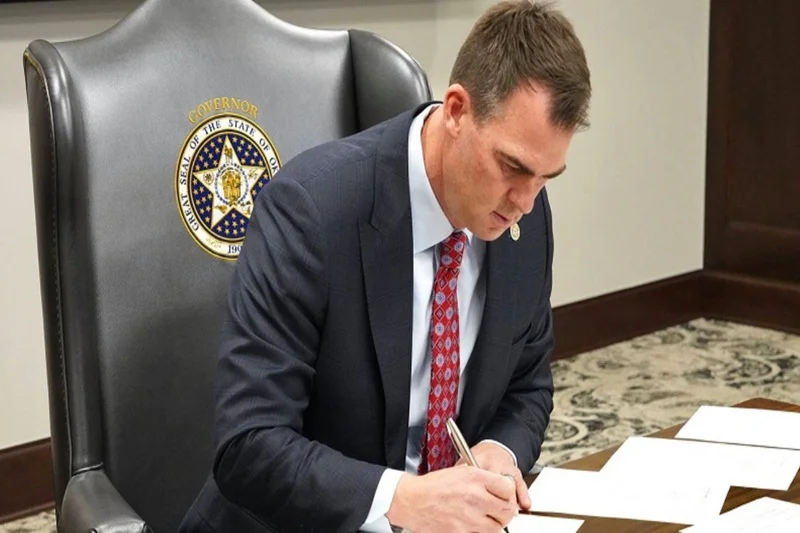
Oklahoma Governor Kevin Stitt Orders Investigation Into Muslim Brotherhood and CAIR, Calls for Federal Terror Listing
Oklahoma has opened a new front in the expanding U.S. debate over the Muslim Brotherhood and its alleged American affiliates. Oklahoma Governor Kevin Stitt signed an executive order Aug. 12, 2026, ordering state agencies to investigate the operations of the Muslim Brotherhood, the Council on American-Islamic Relations (CAIR) and affiliated organizations and to consult with federal authorities about designating them as terrorists.
The move is attracting attention because it sits at the intersection of counterterrorism policy, state power, federal law and constitutional protections. But one caveat is key: Stitt’s order does not designate CAIR or the Muslim Brotherhood as a federal Foreign Terrorist Organization (FTO). Instead, it refers to an investigation in Oklahoma and suggests possible federal action.
What Kevin Stitt’s Executive Order Does
The Aug. 12 order directs Oklahoma public-safety and homeland-security officials to conduct what the administration describes as an “intelligence-based assessment” of Muslim Brotherhood-related activity in the state. The Oklahoma Department of Public Safety and the Oklahoma Office of Homeland Security have defined roles in the state’s counterterrorism and intelligence infrastructure. Oklahoma’s Counter Terrorism Intelligence Center, or OCTIC, is the state’s fusion center that works with local, state, tribal and federal partners on terrorism intelligence, criminal intelligence and threat assessments. So Stitt’s latest order is first and foremost an emphasis on investigation: finding organizations, relationships, activities and any evidence that could establish a security or legal concern. The governor is also asking state authorities to lobby for federal action if their assessment turns up evidence that would support such a recommendation.
Investigation Is Not the Same as an FTO Designation
This is probably THE key point in understanding the Oklahoma action. A governor can’t just designate a group as a Foreign Terrorist Organization under federal law.” The U.S. Secretary of State makes FTO designations under Section 219 of the Immigration and Nationality Act after the government finds that the statutory requirements have been satisfied.
Federal law requires that an organization be foreign, engage in terrorism or retain the capability and intent to do so, and its terrorist activity threatens U.S. nationals or U.S. national security. Designation involves an administrative record and consultation with other federal officials before publication.
That means Oklahoma can investigate, gather intelligence under applicable state authority, take lawful state-level measures and recommend federal action. The federal government retains the authority to impose an FTO designation under federal law.
Why Stitt Says the Investigation Is Necessary
The governor’s argument is part of a broader federal campaign against parts of the Muslim Brotherhood network. In November 2025, President Donald Trump signed Executive Order 14362 directing federal officials to initiate a process to evaluate certain Muslim Brotherhood chapters for FTO and Specially Designated Global Terrorist designations. That process resulted in federal action in January 2026. The Treasury Department has designated the Egyptian and Jordanian Muslim Brotherhood branches as Specially Designated Global Terrorists, and the State Department has designated the Lebanese Muslim Brotherhood, also known as al-Jamaa al-Islamiyah, as both an FTO and an SDGT.
Federal authorities also have continued to go after individuals and entities they say are connected to Muslim Brotherhood and Hamas financial networks. In July 2026, Treasury announced additional sanctions involving an Egyptian Muslim Brotherhood official and entities it said provided material support to Hamas. Stitt’s order has turned the investigation into that broader national security debate over Oklahoma. But government officials’ claims should not be accepted as a matter of course as established facts about every organization described as an affiliate. The point of an investigation is to find out what evidence is there.
What Is CAIR and Why Is It Being Investigated?
Founded in 1994, CAIR is a non-profit Muslim civil rights and advocacy organization. Its stated mission is to defend civil rights, promote justice, increase understanding of Islam and empower American Muslims. The group, however, has long been scrutinized for its historic links to individuals and groups linked to the Hamas-support network investigated in the Holy Land Foundation terrorism-financing case. In 2007, Federal prosecutors prepared a list of unindicted co-conspirators or joint ventures in that case, which included CAIR. It’s important to note that being identified as an unindicted co-conspirator does not mean you have been charged or convicted of a crime. A federal appeals court later ruled the government had blundered in releasing the list, and it was resealed.
The Holy Land Foundation itself and its leaders were prosecuted for providing material support to Hamas, which the United States has designated as a terrorist organization. CAIR has consistently rejected accusations that it is a terrorist organization and says its work centers on civil rights, religious freedom and combating discrimination. That distinction matters. Historical allegations and associations can be relevant to an investigation, but they are not, by themselves, proof that a present-day organization has committed a terrorist offense.
Why the Oklahoma Move Matters Nationally
Oklahoma’s move is part of a larger political and legal battle over how governments should address alleged foreign influence and Islamist networks operating in the United States. Texas and Florida have already taken state action against CAIR and the Muslim Brotherhood. Those moves prompted constitutional and federalism questions, including lawsuits about whether states could impose their own terrorist classifications. A federal judge in Florida has temporarily blocked enforcement of Florida’s order, citing First Amendment and federal authority issues.
Oklahoma differs in one important respect: the Stitt order emphasizes investigation and an intelligence assessment rather than asserting that the governor himself can impose a federal FTO designation. It could take the sting out of the next debate, replacing a headline-grabbing label with what investigators actually find.
Tracking the Muslim Brotherhood’s Global Network
What Does El-Ebiary’s US Focus Mean?
Check out how the US is targeting Muslim Brotherhood financial networks.
How Are New Sanctions Disrupting Terror Financing?
Find out how Treasury sanctions target key financial networks.
How Does Brotherhood Influence Reach Ukraine?
Uncover the cross-border networks and influence linked to Ukraine.
Why Is Europe Warning About Influence?
Browse Nathalie Goulet’s concerns over Muslim Brotherhood influence in Europe.
Could Netherlands Ban Muslim Brotherhood Groups?
See how the Dutch parliament’s PVV motion could reshape policy.
What Happens Next?
The question is the evidence. If Oklahoma investigators uncover credible evidence of illegal activity, support for designated terrorist groups or other security threats, state officials could pass along the information to federal agencies and recommend further action. Such a finding would be significant as well if the investigation fails to turn up much or any evidence connecting Oklahoma-based organizations to terrorism.
The fight comes down to a tough balance for Oklahomans: Governments have an obligation to identify real security threats, but investigations involving religious and advocacy groups must also operate within constitutional protections for free speech, association and religious freedom. For now, Governor Stitt has ordered Oklahoma to investigate. He has not independently created a federal Foreign Terrorist Organization designation for CAIR or the Muslim Brotherhood. That decision remains a matter of federal law and federal authority.
FAQs
1. Did Oklahoma designate CAIR as a Foreign Terrorist Organization?
No. Stitt’s executive order directs a state investigation and calls for potential federal action. A federal FTO designation is made under federal law by the U.S. Secretary of State.
2. What is CAIR?
The Council on American-Islamic Relations, or CAIR, describes itself as a Muslim civil-rights and advocacy organization focused on religious freedom, civil rights and combating discrimination.
3. Why is CAIR being investigated?
The Stitt administration points to alleged historical connections between CAIR, the Muslim Brotherhood and Hamas-related networks. CAIR disputes those allegations and says it is being targeted because of its civil-rights advocacy.

