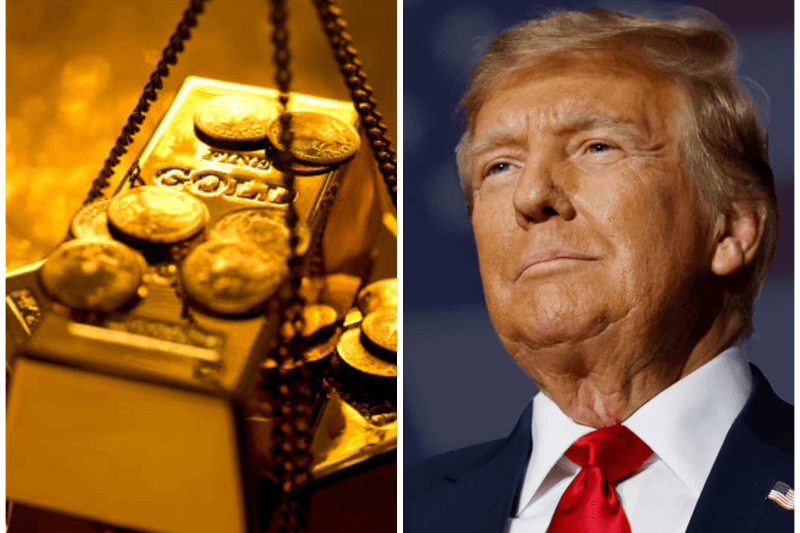
Gold Prices Surge Worldwide Following Trump’s April 2025 Tariffs
The global economic landscape shifted dramatically in April 2025 following U.S. President Donald Trump’s sudden imposition of sweeping tariffs on countries with significant trade surpluses. At the center of this disruptive move was a new policy framework targeting exports from China, India, the European Union, and select Gulf nations with tariffs ranging between 10% and 145%. While the policy aimed to “rebalance global trade,” its unintended consequence was an immediate spike in global inflation, surging commodity costs, and an unprecedented rally in gold prices.
Within days of the announcement, gold prices broke past $3,100 per ounce, peaking at over $3,500 in some trading sessions. Central banks, sovereign wealth funds, and private investors increased their holdings, pushing demand to multi-year highs. At the same time, import-dependent economies, especially those heavily reliant on gold for cultural, industrial, or monetary purposes, saw rapid price increases, squeezing consumer purchasing power and amplifying inflationary pressure.
Wider Global Inflation and Gold Price Response
Gold’s sharp ascent in price affected inflation metrics globally, particularly in economies reliant on gold either as a cultural good, reserve asset, or industrial material.
1. United Arab Emirates (UAE)
The UAE, traditionally a gold trade hub, was impacted by a 10% U.S. tariff on refined precious metals. Domestic prices reacted accordingly:
- May 8, 2025: AED 400.25/g (24K)
- May 30, 2025: AED 399.25/g
- June 13, 2025: AED 412.75/g
As traders adjusted to decreased export competitiveness and rising input costs, local inflation ticked upward, especially in the luxury and jewelry sectors.
2. Saudi Arabia
Saudi gold markets reacted similarly, with 24K prices touching SAR 409/g by mid-June. Rising bullion prices impacted the hospitality and retail sectors, traditionally fueled by gold-linked gifting and ceremonial demand.
3. Qatar
Qatar reported prices reaching QAR 400.5/g, reflecting regional price alignment. Consumer sentiment dipped, and local merchants reported reduced foot traffic in jewelry markets.
4. China
As a direct target of broader U.S. tariffs, China faced compounded inflation due to higher import/export costs and rising gold prices. The People’s Bank of China increased its gold reserves as part of monetary hedging strategies, even as retail demand slowed.
5. European Union (Germany, Italy, France)
The EU saw gold become a popular hedge amid economic fragmentation and the tariff announcement. Investors moved away from equities and increased their allocation to commodities. Germany’s Bundesbank, in particular, ramped up reserve accumulation. Inflationary pressures were noted in luxury retail sectors and asset markets.
6. Russia
Already stockpiling gold before the tariff dispute, Russia intensified its purchases to shield the ruble from volatility. Domestic inflation climbed as commodity prices, including gold, became more expensive due to international speculation.
7. Turkey
Facing a historically volatile currency, Turkey saw strong demand for gold as citizens moved to protect savings. The price of gold surged in lira terms, adding to existing inflation woes. The central bank responded with partial restrictions on gold imports to stabilize the domestic market.
Countries Most Affected by Gold Price Surges Since April 2025
| Country | Reason for Impact | Gold Price Trend |
| India | Export tariffs, currency depreciation | +3.5% in 3 weeks |
| UAE | 10% U.S. import tariff on refined gold | AED 400.25 → AED 412.75/g |
| Saudi Arabia | Regional price movement, retail impact | SAR 399 → SAR 409/g |
| Qatar | Price alignment with UAE and global benchmarks | QAR 396 → QAR 400.5/g |
| China | Central bank gold buying, inflation risk | Continued upward trend |
| Russia | Reserve build-up, currency protection | Increased institutional demand |
| Germany | EU tariff impact, hedging by investors | Rising reserve demand |
| Turkey | Currency volatility, domestic inflation | Sharp local price increase |
The Trump administration’s tariff decisions in April 2025 may have been intended to support American trade interests, but the consequences extended far beyond bilateral trade. The tariffs ignited a global wave of investor anxiety, which in turn fueled the largest surge in gold prices in recent history.
For countries dependent on gold, whether for reserves, cultural use, or trade, the price surge translated into higher inflation, currency volatility, and shifting market strategies. Central banks responded with more aggressive bullion purchases, while consumers in emerging markets grappled with affordability issues.
With trade tensions still unresolved and global supply chains being reshaped, gold remains the financial safe haven of choice. But as it surges, it also adds another layer to the inflation puzzle facing both developing and advanced economies in 2025.