

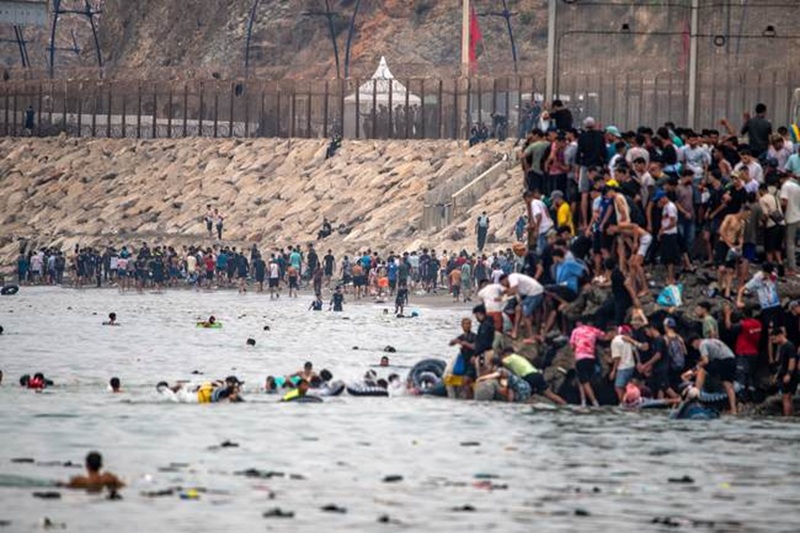
Spanish Intelligence Warned of Ceuta Mass Crossing a Day Before 70,000 Migrants Arrived
There’s a particular kind of political nightmare where the paper trail shows you were warned, and the only question left is whether you understood the warning. That’s roughly where Spain finds itself now, a few weeks after more than 70,000 migrants crossed into Ceuta from Morocco over the span of two days.
Newly declassified documents have confirmed that Spain’s intelligence agency, the CNI, flagged the possibility of a mass crossing a full day before it happened. The disclosure has reopened a bruising political fight and left Prime Minister Pedro Sánchez’s government fending off accusations that it either missed or downplayed a warning that, in hindsight, looks fairly explicit.
What the intelligence agency actually saw
On July 29, the CNI was tracking chatter across social media, specifically two groups with a combined reach of around 180,000 people that were pushing followers toward Ceuta ahead of Morocco’s Throne Day holiday on July 30. The agency’s message to Spain’s government delegation in Ceuta warned of organized calls to storm the border fence and attempt sea crossings around it.
Spain didn’t just sit on that information. The CNI also passed word to Morocco’s own intelligence services, the DGST and DGED, laying out the same concerns about people scaling the fence or swimming past it. A separate assessment from Spain’s border and immigration agency rated the odds of irregular sea crossings as high, and land crossings as moderate. Then the holiday arrived, and so did everyone else.
A crisis that outran every estimate
Over July 30 and 31, more than 70,000 people crossed into or attempted to enter Ceuta, a tiny Spanish enclave on Morocco’s coast that’s used to managing migration pressure, but not at anything like this scale. The border there is normally one of the more fortified stretches of Europe’s external frontier, which made the sheer size of the crowd almost impossible to contain through normal means.
It quickly turned into a humanitarian catastrophe as well as a political one. Aid organizations estimate roughly 140 people died during the crossing or in its immediate aftermath, though nobody has settled on a firm number.
Where the government’s story gets shaky
This is the part that’s actually splitting Spain’s leadership. Sánchez has stuck to the position that no one predicted a crossing of this magnitude that the intelligence pointed to a crossing, not an unprecedented one involving tens of thousands of people in a matter of hours. His own defense minister, Margarita Robles, has told a different version: that the Ceuta delegation was explicitly warned the day before that something on this scale might happen.
The documents that have now surfaced back up Robles more than they back up Sánchez, at least on the narrow question of whether a warning went out. What’s still genuinely unresolved is whether that warning conveyed just how large the crossing would be, or whether the scale caught everyone CNI included off guard.
Morocco’s uncomfortable spot in all of this
Spain’s decision to loop Moroccan intelligence in on the threat has put Rabat under its own cloud of suspicion. Subsequent reporting and police reviews have raised pointed questions about why Moroccan security forces appeared to do so little to stop the crossing once it began. Morocco has firmly denied any suggestion that it let the crossing happen on purpose, and has said there’s no hard evidence tying its authorities to the outcome.
It’s a delicate accusation to make: stick, partly because Spain and Morocco lean on each other constantly for border security and migration management, burning that relationship over one incident carries its own risks.
What’s Making Headlines You Can’t Miss?
Could Hoekstra Face Expulsion From Canada?
Check out why thousands of Canadians are demanding action against the US ambassador.
Who Is Martina Strong, Really?
Uncover the diplomat’s UAE appointment and the political delays surrounding her confirmation.
Why Did Clancy’s Jury Deadlock?
Find out what led to the mistrial and why the jury couldn’t reach a verdict.
Why Is Lake Ontario Renamed?
Browse what Apple Maps’ surprising “Lake America” change means and why it happened.
Which Haunted Hotels Should You Visit?
Experience five spooky American hotels known for paranormal encounters and eerie stays.
The bigger problem Spain still hasn’t solved
Strip away the finger-pointing, and what’s left is a harder structural question: how do you respond to a migration surge that can be organized and amplified on social media within a single day? Spain’s intelligence services clearly saw something. Turning that kind of early signal into fast, coordinated action on the ground, reinforcing the border, mobilizing humanitarian resources, coordinating with Morocco in real time is a different challenge entirely, and one Spain visibly failed at this time.
Weeks later, thousands of the migrants who crossed are reportedly still in Ceuta, and the political reckoning over who knew what, and when, shows no sign of wrapping up soon.
FAQs
1. What happened in Ceuta?
More than 70,000 migrants entered or attempted to enter Spain’s North African enclave of Ceuta from Morocco on July 30 and 31, 2026.
2. Did Spanish intelligence warn about the crossing?
Yes. Declassified documents show that Spain’s CNI warned Spanish and Moroccan officials on July 29 about social media plans for a mass crossing.
3. Did Spain know that 70,000 migrants would arrive?
Not necessarily. Spanish officials acknowledge warnings about a possible mass crossing but dispute whether the intelligence predicted the extraordinary scale of the eventual influx.
4. What was Morocco’s role?
Morocco has denied deliberately facilitating the crossing. Spanish reports and police assessments have raised questions about the conduct of Moroccan security forces, but the allegations remain disputed.
5. Why is the Ceuta crisis important?
The episode has raised questions about Spain’s border preparedness, intelligence-sharing, migration policy and its relationship with Morocco.

