

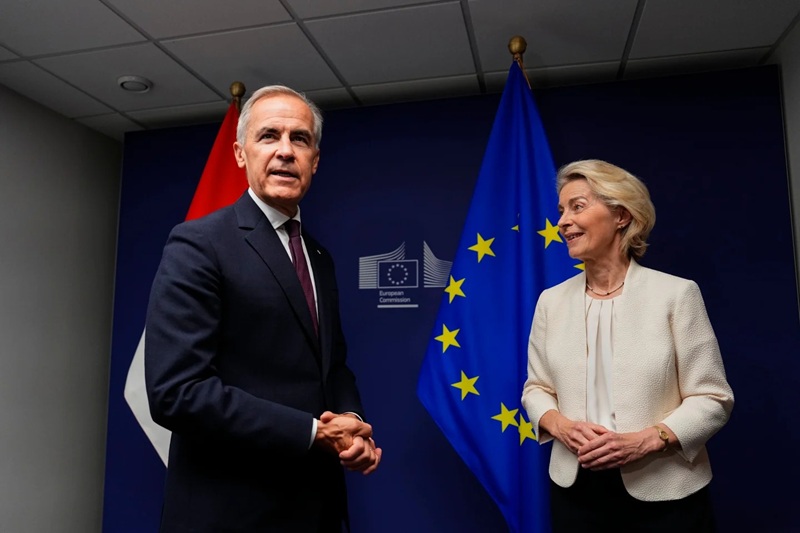
Canada-EU Alliance: Mark Carney Backs Historic Proposal to Make Canada the EU’s First Associate Member
Something big might be brewing between Canada and Europe. Prime Minister Mark Carney has thrown his support behind a bold idea: making Canada the European Union’s very first “associate member.” If it happens, it could mean much tighter cooperation with the EU on everything from trade and defence to energy, tech, and critical minerals. The idea came from European Commission President Ursula von der Leyen, who floated it on September 16. The timing makes sense Canada’s been actively looking to widen its circle of international partners and deepen its economic footing in Europe.
So What Would “Associate Member” Actually Mean?
To be clear, this isn’t Canada joining the EU outright. Nobody’s talking about full membership here. Instead, it would be an entirely new kind of relationship, something that goes further than the trade partnership the two already have, but stops short of Canada becoming an EU member state. Von der Leyen said she wants to work with Carney to make this happen, though she hasn’t spelled out exactly what the legal or political framework would look like yet. That’s still being figured out. Carney responded warmly to the idea the next day, September 17, during a speech to the European Parliament. He was careful to note, though, that Canada’s sovereignty isn’t up for negotiation whatever shape this partnership takes, Canada stays Canada.
Why Now?
For decades, Canada’s economic and security relationship has leaned heavily on one partner: the United States. But with global trade tensions rising and geopolitics getting messier, Ottawa is clearly trying to hedge its bets and build out other options. Europe is a natural fit. Trade between Canada and the EU hit C$178.6 billion in 2025, and the EU already sits as Canada’s second-biggest trading partner behind the U.S. Carney’s been framing this less as a push for total self-sufficiency and more about building what he calls “collective resilience” spreading the risk around a bit.
More Than Just Trade
This isn’t only about moving goods across the Atlantic more easily. The conversations on the table cover critical minerals, energy security, defence industries, AI, quantum computing, space, financial services, and advanced manufacturing. There’s even talk of making it easier for people to travel, study, and work between the two. None of this is starting from scratch; the Comprehensive Economic and Trade Agreement (CETA) has quietly been in place since 2017, laying some groundwork. On top of that, Canada and the EU kicked off talks back in March on a digital trade agreement, covering things like online commerce and consumer protections.
What’s Next?
Here’s the catch: the EU doesn’t even have an “associate member” category yet. This concept doesn’t officially exist within the union’s structure, so European officials have real work ahead of them to define what it would mean in practice legally, economically, and politically.
All eyes are now on the Canada-EU summit happening in Montreal this October, where the two sides are expected to hash out more of the details.
Related Articles You May Find Interesting
Why Did Crypto Clarity Act Fail?
Check out the key reasons the cryptocurrency bill failed to advance in the US Senate.
Who Are Trump’s New Envoy Picks?
Find out about Wesley Hunt and Kimberly Greenwood’s new diplomatic appointments.
Why Did US Expand Iran Sanctions?
Uncover the networks targeted by the latest US sanctions over alleged support for Hezbollah and Iraqi militias.
How Could Financial Power Shape Markets?
Explore Scott Bessent’s views on using financial power as a foreign policy tool and its global impact.
What Happened in Turmus Ayya?
Dive into the US ambassador’s West Bank visit amid rising settler violence in Turmus Ayya.
Why It Matters
If this actually comes together, it could mark a real shift moving Canada and the EU from a standard trade relationship into something closer to a full strategic partnership. Canada brings energy resources, critical minerals, Arctic know-how, and growing strength in AI and quantum tech to the table. Europe offers Canada a bigger, more diversified market to lean on. Of course, nothing’s locked in yet. A lot hinges on how negotiations play out, what legal structures get built, and whether both sides are willing to turn an ambitious headline into actual policy.
FAQ
Is Canada joining the EU?
No this is a new “associate member” status, not full membership, and the details are still being worked out.
Whose idea was this?
Ursula von der Leyen proposed it on September 16, 2026.
What’s in it for Canada?
More trade diversification, deeper defence and tech cooperation, and better access to European markets and investment.
What sectors are involved?
Critical minerals, energy, defence, AI, quantum tech, space, financial services, and manufacturing.
When will we know more?
Likely at the Canada-EU summit in Montreal this October.

