

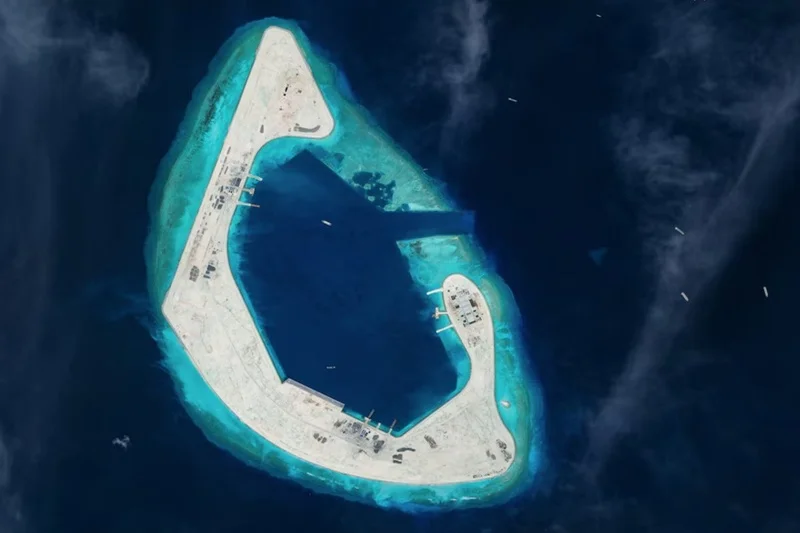
China’s Antelope Reef Expansion Raises New Questions for US Indo-Pacific Strategy and South China Sea Security
A few years ago, Antelope Reef was barely a speck. Now it may be on its way to becoming one of the biggest military outposts in one of the world’s busiest waterways. The Antelope Reef expansion is forcing the US and its allies to ask a hard question: how do you respond when the map keeps changing under your feet?
What Is Antelope Reef, and Why Does It Matter?
Antelope Reef sits in the Paracel Islands. It is claimed by China, Vietnam, and Taiwan, and it lies roughly 400 kilometers from Vietnam’s coast. Beijing has held the Paracels since driving South Vietnamese forces out in a brief 1974 battle. Hanoi has objected ever since. The reef sits in a corridor that carries about one-third of global maritime commerce. That is why a patch of sand and coral gets so much attention.
From Sandbar to Strategic Base
The change has been fast. Analysts at the Asia Maritime Transparency Initiative once described the reef as “little more than a sandbar” with just a couple of buildings. Then the dredgers arrived. Reports of dredging began surfacing in January. By spring, a CSIS analysis found the reclaimed area had reached about 6 million square meters, nearly matching Mischief Reef. AMTI says the reef could now support a 2,743-meter runway, like those China already has on four other features.
Latest Updates: A Runway Takes Shape
The newest reporting suggests construction is well advanced. Analysts estimate the runway could be finished by mid-2027. China has not publicly confirmed a military base. State media have said Antelope will serve civilian needs such as weather forecasting and scientific research.
Washington isn’t buying that. A State Department spokesman called the work a bold attempt to advance unlawful maritime claims.
Why the US Indo-Pacific Strategy Is Being Tested
Think of it this way. A runway on Antelope would let Chinese jets and ships operate farther out, with less warning time for everyone else. A completed base would be China’s most significant military expansion in the South China Sea in a decade. It would extend the reach of Chinese warships and aircraft in a region where Beijing, Washington, and US allies already compete over Taiwan.
There is also a timing problem. Some analysts argue China has taken advantage of a US that is stretched between the Middle East and the Indo-Pacific. If that reading is right, a reduced American presence made it easier for Beijing to build quickly. Not everyone sees an immediate shift in the balance of power. Some experts note that China already firmly controls the Paracels, so the practical change may be more gradual. But gradual changes add up.
What It Means for Ordinary People
This isn’t just a story about warships. When shipping lanes get riskier, insurance costs rise, and those costs eventually show up in the price of electronics, fuel, and groceries. For coastal communities in Vietnam, the Philippines, and beyond, a bigger Chinese footprint also means more pressure on fishing grounds.
FAQs
Where is Antelope Reef?
It’s in the Crescent Group of the Paracel Islands, about 300 km from Sanya in China and 400 km from Da Nang in Vietnam.
Is China building a military base there?
Satellite analysis points that way. Beijing hasn’t confirmed it and has described the project in civilian terms.
How big is it now?
CSIS estimates about 6 million square meters of reclaimed land, close to Mischief Reef.
Related Reads You Shouldn’t Miss
How Is China Reshaping Indo-Pacific Alliances?
Check out how Quad nations are responding to growing security challenges in the Indo-Pacific.
Why Are China and Russia Growing Closer?
Find out how Arctic shipping routes are strengthening China-Russia geopolitical ties.
What Happens Inside The Twilight Zone?
Dive into the mysterious nightly migration of trillions of deep-sea creatures.
Which Religions Are Among History’s Oldest?
Explore 10 ancient religions that have shaped human history and civilizations.
Why Are North Korea’s Missiles Alarming Asia?
Uncover why North Korea’s new missile developments are raising concerns in Japan and South Korea.

