

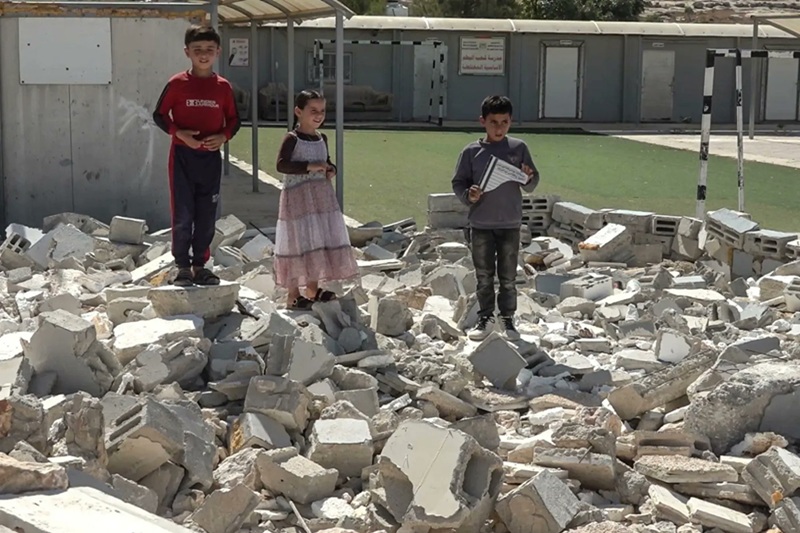
Palestinian Parents Fear for Children as West Bank Settler Attacks Threaten School Safety
For Palestinian families in the occupied West Bank, the school run used to be routine. Now it’s a daily calculation weighing a child’s education against the risk of the road.
Settler violence has been climbing across the territory, and it’s no longer confined to isolated incidents. It’s reaching into daily life in ways that make even the walk to class feel uncertain. The UN says more than 1,500 Palestinian children were displaced in 2026 alone, caught up in a pattern of settler attacks, home demolitions, and forced evictions.
When Schools Themselves Become Targets
The violence hasn’t stayed on the margins of education, it’s moved into the classrooms. The UN’s humanitarian affairs office (OCHA) found that ten schools in Area C sat empty after the communities around them were driven out. Eight had been vandalized; two bulldozed entirely. And the pressure keeps building: another 84 schools are facing demolition or stop-work orders, a shadow hanging over roughly 13,000 students. Earlier reporting from the UN paints a similarly grim picture: armed raids on school buildings, wrecked classrooms and equipment, teachers and students intimidated, and stretches where movement restrictions simply kept children from reaching their desks. That leaves parents with an impossible tradeoff: send your kids out into a landscape that’s grown more hostile by the month, or keep them home and watch their education slip.
A Generation Absorbing the Damage
It’s the children in the West Bank’s rural and herding communities who tend to bear the brunt. OCHA’s tally for the first part of 2026 is stark: 16 Palestinian children killed and 187 injured in incidents involving Israeli forces or settlers, spanning the West Bank and East Jerusalem alongside a steady rise in displacement. The wounds aren’t only physical. UN researchers have pointed to a mounting toll of fear, anxiety, and trauma among children who live with this kind of exposure day after day. Sometimes the barrier is simply logistical. In May, more than 100 students trying to reach a school in Hebron found themselves stuck at a checkpoint, unable to get through one of many reported delays that have chipped away at ordinary school days.
The Violence Hasn’t Let Up
If anything, September has underscored how volatile things remain. On September 2, two Palestinian teenagers 16 and 19 years old were killed near Ramallah, in the village of al-Mughayyir, during a confrontation involving Israeli settlers and Israeli forces, according to Palestinian officials cited by Reuters. The Israeli military described its response as reacting to a “violent disturbance” and said the matter is under investigation. Days later, two more Palestinians were killed in separate clashes elsewhere in the West Bank. Each new incident deepens a fear that’s becoming harder for families to shake: that violence near their homes, on their roads, and around their children’s schools might simply become the backdrop of growing up here.
What’s Making Headlines You Can’t Miss?
Could Hoekstra Face Expulsion From Canada?
Check out why thousands of Canadians are demanding action against the US ambassador.
Who Is Martina Strong, Really?
Uncover the diplomat’s UAE appointment and the political delays surrounding her confirmation.
Why Did Clancy’s Jury Deadlock?
Find out what led to the mistrial and why the jury couldn’t reach a verdict.
Why Is Lake Ontario Renamed?
Browse what Apple Maps’ surprising “Lake America” change means and why it happened.
Which Haunted Hotels Should You Visit?
Experience five spooky American hotels known for paranormal encounters and eerie stays.
Why This Matters Beyond the Classroom
School isn’t just where children learn arithmetic and history. For kids growing up amid this kind of instability, it’s one of the last places offering routine, friendship, and something resembling a normal childhood. When a school shuts its doors, or a community is uprooted, or a child becomes too afraid to make the trip, the fallout doesn’t end with that school year. Interrupted education tends to echo forward narrowing job prospects, deepening poverty, and layering trauma on top of already-difficult lives. The scale of the disruption is broader than any single school. OCHA counted more than 1,380 settler-related incidents across the West Bank in the first seven months of 2026, touching over 250 Palestinian communities, and displacing more than 2,300 people in the process. For parents living through this, the question of whether their children can safely reach a classroom is really the same question as whether their community can safely stay put at all.
International attention on settlement expansion and settler violence continues to build but for families on the ground, the concern is far more immediate and far simpler: just getting their kids to school, and back home again, without fear.
FAQs
1. Why are Palestinian parents worried about school safety?
Parents are concerned about settler attacks, military restrictions, road closures and violence affecting routes to schools and surrounding communities.
2. How are West Bank settler attacks affecting education?
Schools have reportedly been vandalized, abandoned or placed under demolition and stop-work orders, while movement restrictions have prevented some students from attending classes.
3. How many children have been affected by the violence?
UN OCHA reported that more than 1,500 Palestinian children had been displaced during 2026 because of settler attacks, demolitions and forced evictions.
4. What is the psychological impact on children?
Repeated exposure to violence and intimidation can contribute to fear, anxiety and trauma, according to UN assessments.
5. Why is the issue important internationally?
Disruption to education, civilian displacement and continuing settler violence raise wider concerns about human rights, regional stability and the prospects for a future political settlement.

