

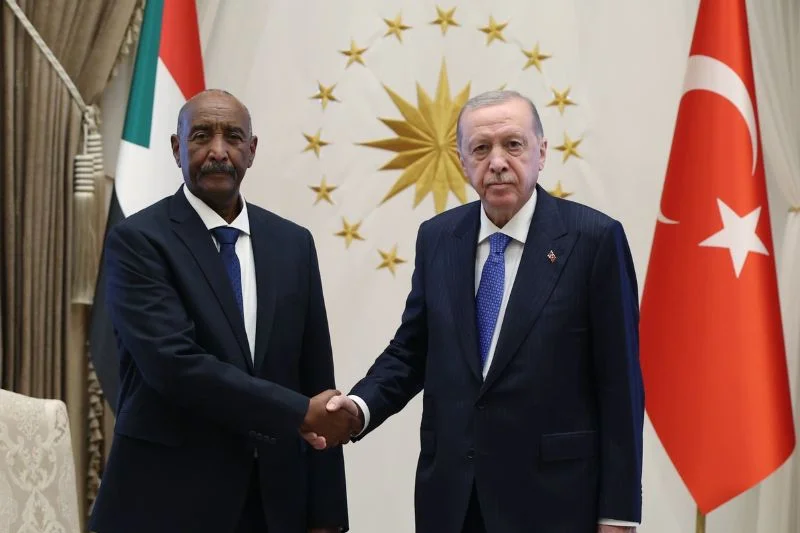
Turkey’s Role in Sudan War: How Ankara’s Strategy, Trade and Security Ties Are Shaping the Conflict
Sudan’s war is not taking place in a vacuum. The fighting between the Sudanese Armed Forces (SAF) and the Rapid Support Forces (RSF) is part of a wider regional contest over diplomacy, trade, ports, security and strategic influence. Turkey has become a significant part of that picture. Sudan’s proximity to the Red Sea, its agricultural potential and its place in Turkey’s larger African strategy make it important to Ankara. “Turkey provides Sudan with diplomatic access, commercial partnerships, humanitarian assistance and potential reconstruction opportunities. The question is, what impact are these interests having on a war that has already ravaged the lives of millions?
Why Sudan Matters to Turkey
Turkey and Sudan have a long-standing close relationship. Ankara was one of the first countries to recognize independent Sudan in 1956 and relations improved considerably under President Recep Tayyip Erdoğan’s government. Erdoğan’s 2017 visit to Khartoum was a watershed moment. The two countries signed a series of agreements on trade, agriculture, energy, defense and other sectors. Turkey also developed an interest in Suakin and the Red Sea coastline of Sudan, indicating Ankara’s broader interest in maritime connectivity and the Horn of Africa. The relationship has endured the political turmoil in Sudan and the war that erupted in April 2023.
Economic Engagement Is Still Growing
Despite the conflict, Turkey has maintained its economic ties with Sudan. In 2024, Turkey’s exports to Sudan were $276.9 million, and imports from Sudan were $67.8 million, with a total trade volume of $344.7 million in bilateral trade. Agriculture is of special importance. Sudan has huge agricultural land and natural resources while Turkey has expertise in farming machinery, irrigation and agricultural development.
Turkey and Sudan will hold the 16th Joint Economic Commission meeting in eight years in May 2026. The two sides discussed cooperation in agriculture, energy, mining, trade and investment. The relationship is also moving into port infrastructure.” In July 2026, Sudan signed a deal with Turkish company Ergaz to develop a gas terminal at Suakin port on a build-operate-transfer basis. The planned facility will improve fuel storage and maritime logistics. These projects show why Turkey’s commercial interests are important to the conflict, but they also show why Sudan’s economy is strategically important for Turkey.
The Security Question
It gets more contentious when you bring defense cooperation into the discussion. Ankara officially supports Sudan’s sovereignty, territorial integrity and efforts to end the fighting. Erdoğan said Turkey would continue its support and humanitarian assistance to Sudan, but stressed the importance of Sudan’s territorial unity in March 2026. But reporting has raised serious questions about Turkish defense involvement. A 2025 investigation by the Washington Post uncovered evidence that Turkish defense company Baykar provided military equipment, including TB2 drones, to Sudan’s army. Turkey has denied involvement in the fighting. This is an important distinction: official Turkish statements, recorded equipment transfers, credible investigative reporting and unsubstantiated allegations should not be confused with each other. But the appearance of Turkish-made drones on the battlefield in Sudan has made Ankara’s defense relationship a major point of discussion about foreign involvement in the war.
Turkey Is Part of a Much Bigger Regional Network
Sudan cannot be understood in isolation from other powers engaged around Sudan. Ankara has been at odds with countries like Egypt, Saudi Arabia and the UAE for influence and has ties with Qatar. At the same time, Sudan’s strategic location links it to Red Sea security, Gulf interests, Iran, Russia, the United States and African institutions. This makes Turkey an economic partner and a diplomatic actor in a complex regional web. In May 2026, Erdoğan again stated that Turkey supports diplomatic efforts for a ceasefire and a comprehensive political process, while promising continued humanitarian assistance.
The Human Cost Comes First
For the average Sudanese, geopolitical competition only matters insofar as it impacts their daily lives. The war has gone on for more than three years and over 34 million people need humanitarian assistance, according to the United Nations. Over 9 million people have been displaced internally, while millions more have crossed Sudan’s borders. The humanitarian crisis is also increasingly connected to food insecurity, damaged infrastructure and limited access. The UN reported in August 2026 that there were ongoing shortages of clean water, healthcare and basic services. Drone attacks have damaged civilian infrastructure in conflict-affected areas. That’s why Turkey’s role should ultimately be measured not only by trade deals or diplomatic meetings, but by whether its influence helps reduce violence and expand humanitarian access.
What Happens Next?
Turkey has what few other external powers have: diplomatic relations with Sudan, commercial interests and humanitarian networks and lines of communication with the country’s authorities. That offers Ankara an opportunity to pursue dialogue while shielding legitimate economic interests. But there’s no way to begin Sudan’s recovery without more security. Turkey’s economic and diplomatic engagement can be a force for good if it supports stability, agriculture, reconstruction and humanitarian access. But if external competition leads to increased military dependence, Sudan’s economic resources could be trapped in a destructive war. Therefore, the true test of Turkey’s role for Sudanese civilians is simple: does Ankara’s expansion help to bring peace closer or simply deepen its position in a country fighting for its own survival?
FAQs
1. Why is Sudan strategically important to Turkey?
Sudan offers Turkey access to the Red Sea region, agricultural opportunities, commercial markets and an important position within Ankara’s wider African strategy.
2. Does Turkey support Sudan’s army?
Turkey officially supports Sudan’s sovereignty and territorial integrity. Investigative reporting has also alleged Turkish defence equipment reached the Sudanese army, although Ankara has denied involvement in the conflict.
3. How important is trade between Turkey and Sudan?
Bilateral trade reached about $344.7 million in 2024, with agriculture, machinery, steel, energy and other sectors forming important parts of the relationship.
What’s Making Headlines Around the World?
What Does Todd Blanche’s DOJ Win Mean?
Check out what Todd Blanche’s confirmation could mean for the US Department of Justice.
Why Are Canadians Targeting Hoekstra?
Find out why Canadians are calling for US Ambassador Pete Hoekstra’s expulsion.
How Is Etna Disrupting Malta Flights?
Uncover the latest updates on Mount Etna’s eruption and its impact on Malta flights.
Could New Sanctions Derail US-China Talks?
Browse the latest US-China tensions and how fresh sanctions could affect upcoming negotiations.
What Caused the Statue Boat Tragedy?
See what happened to the boat near the Statue of Liberty and the charges against its captain.

