Trilateral Summit US, Japan and South Korea Talk to Focus on Indo-Pacific
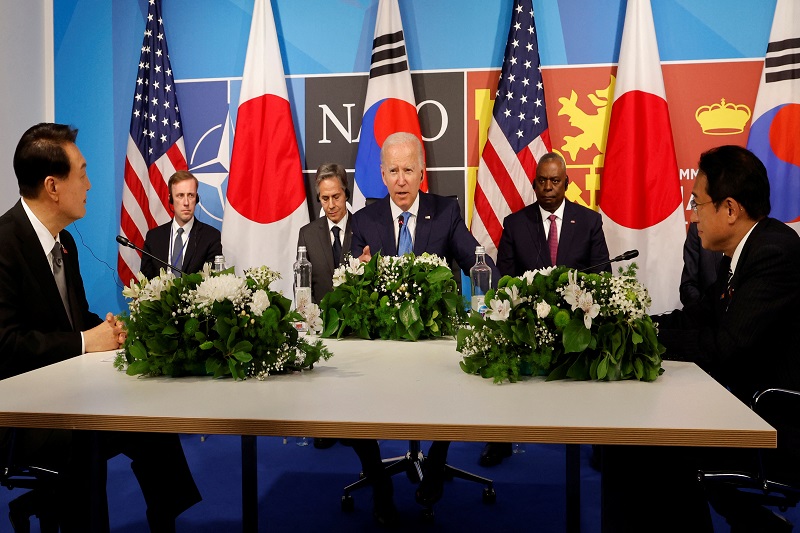
The US, Japan and South Korea are looking at strengthening their alliance through an unprecedented historical trilateral summit which will be held at Camp David on August 18. US President Joe Biden will host Japanese Prime Minister Fumio Kishida and South Korean President Yoon Suk Yeo in Washington.
US Secretary of State Antony Blinken said the summit is a collaboration on a trilateral basis that is further institutionalized in a variety of ways, to include regular meetings at a variety of levels, senior levels in their respective governments. Concrete initiatives can be expected to address regional security such as nuclear provocations, economic security, humanitarian assistance, greater people-to-people exchanges, as well as the use of emerging technologies amid geopolitical competition.
South Korea, Japan and the US have vowed to share North Korea missile warning data in real time to improve their country’s ability to detect and assess the threats posed by incoming missiles. Last week, the US ambassador to Japan Rahm Emanuel said the three countries are expected to agree on holding annual summits to boost cooperation on regional security, including conducting annual joint exercises. Talks will also focus on non-traditional security goals in supply chain resiliency, critical technologies, and energy security.
Keep Reading
Scott Snyder, senior fellow for Korean Studies and Director of the Program on US-Korea Policy, at Council on Foreign Relations, believes the Biden administration came into office wanting to reinvigorate these alliances and pursued essentially a parallel approach. “The real driver that has enabled it to be possible to have a trilateral summit has been the advent of the Yoon administration and his focus on reconciliation with Japan.” There has also been normalization in the Japan-South Korean relationship.
Sheila Smith, senior fellow for Asia-Pacific Studies, Council on Foreign Relations, admires the Biden administration for developing the Quad. “They talked about the Indo-Pacific with Japan, Australia, and India. Then they very quickly began to restore the really high-level security consultations in the trilat. President Yoon has taken a significant step from Seoul, which was reciprocated cautiously by Prime Minister Kishida.” She highlighted that the Japanese have been quite worried about the domestic politics in South Korea, but welcomed a stronger and more direct conversation at the bilateral level.
The US, South Korea and Japan are committed to a free and open Indo-Pacific, amid threats posed by China and North Korea in the region.