

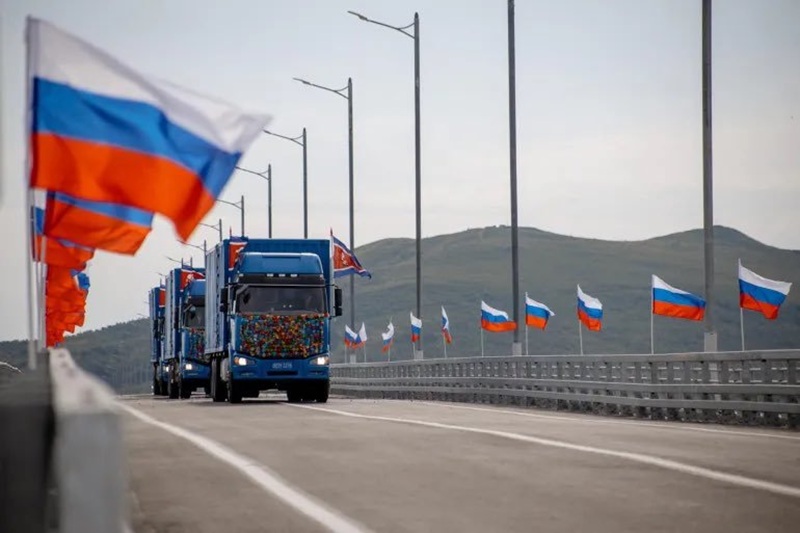
Russia and North Korea Open First Road Bridge: New 1km Link to Boost Trade and Cross-Border Travel
For all the decades Russia and North Korea have shared a border, there’s never been a road connecting them. That changed this week. On September 7, 2026, the two countries cut the ribbon on their first road bridge, a short but symbolically loaded crossing over the Tumen River linking Russia’s Khasan area with North Korea’s Rason region. It’s only a kilometer long. Two lanes. But don’t let the size fool you. This bridge says a lot about where the Moscow and Pyongyang relationship is headed.
What Actually Opened
The bridge is built to carry up to 300 vehicles a day, according to Russian officials. At the opening ceremony, trucks flying both nations’ flags rolled across first a made-for-camera moment if there ever was one. Russian Prime Minister Mikhail Mishustin and his North Korean counterpart, Premier Pak Thae Song, joined the inauguration by video link rather than in person. There’s a name behind the bridge worth knowing too: it honors Yakov Novichenko, a Soviet officer whom North Korea credits with saving Kim Il-sung’s life during a 1946 assassination attempt. That’s not an accidental choice, naming it after him ties the new infrastructure directly into the mythology both countries use to frame their alliance as something with deep roots.
Why This Wasn’t Already a Thing
Here’s what’s easy to miss: Russia and North Korea have been connected by rail since the 1950s, via the so-called Friendship Bridge, plus some air routes. But a dedicated road link? Never existed until now. Construction only broke ground in April 2025, following a 2024 summit between Vladimir Putin and Kim Jong Un where the two leaders agreed to build it. So this isn’t replacing an old connection, it’s filling a gap that’s been there the entire post-war era. A road bridge is more flexible than rail for moving goods and people, and it gives both sides an alternative to an aging line that’s now over 70 years old.
What’s Making Headlines You Can’t Miss?
Could Hoekstra Face Expulsion From Canada?
Check out why thousands of Canadians are demanding action against the US ambassador.
Who Is Martina Strong, Really?
Uncover the diplomat’s UAE appointment and the political delays surrounding her confirmation.
Why Did Clancy’s Jury Deadlock?
Find out what led to the mistrial and why the jury couldn’t reach a verdict.
Why Is Lake Ontario Renamed?
Browse what Apple Maps’ surprising “Lake America” change means and why it happened.
Which Haunted Hotels Should You Visit?
Experience five spooky American hotels known for paranormal encounters and eerie stays.
The Bigger Picture
Nobody’s pretending this is just about trade logistics. Since Russia’s full-scale invasion of Ukraine in 2022, the Moscow-Pyongyang relationship has deepened fast militarily, politically, and economically. Western governments and Ukraine have accused North Korea of supplying Russia with military support during the war. Against that backdrop, a new physical link between the two countries inevitably raises questions. Some analysts have pointed out that easier road access could also make it simpler to move sensitive or military-related cargo without much visibility. That’s speculative, but it’s the kind of concern that tends to follow any new infrastructure between two governments already under this much international scrutiny. At the same time, it’s worth keeping the scale in perspective. A 300-vehicle daily cap is a meaningful upgrade for a border that had zero road capacity before but it’s not going to reshape regional trade patterns overnight. This is an incremental step, not a floodgate.
What to Watch Next
The real story will play out in how fast cargo and passenger traffic actually ramps up. North Korea has ambitions to grow economic activity in its Rason region, and Russia has long talked about developing its Far East through more cross-border trade and tourism. This bridge gives both sides a concrete tool to try. For everyday travelers and businesses, it could eventually mean a much simpler way to move between the two countries. But for the governments involved, the real value isn’t measured in vehicles per day; it’s another tangible link in a partnership that keeps getting harder to describe as anything but strategic.
FAQs
1. Where is the new Russia-North Korea road bridge?
It crosses the Tumen River between Russia’s Khasan area and North Korea’s Rason region.
2. How long is the Russia-North Korea bridge?
The bridge itself is approximately 1 kilometer long and has two lanes.
3. How many vehicles can use the bridge?
Russian officials say the crossing is designed to handle up to 300 vehicles per day.
4. Why was the bridge built?
The main stated goals are to increase cargo movement, facilitate passenger transport, encourage tourism and strengthen economic cooperation.
5. Does Russia already have a connection with North Korea?
Yes. The countries have a railway connection through the Friendship Bridge, as well as air links. The new crossing is their first dedicated road bridge.

