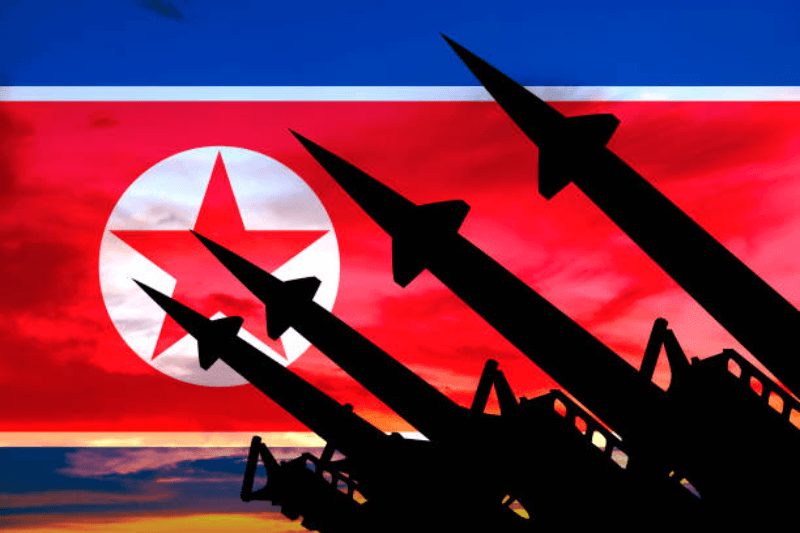
North Korea’s Chilling New ‘Cluster Bomb’ Missiles Spark Panic Alerts in Japan and South Korea
Air raid sirens aren’t something most people expect to hear at dawn. However, for residents in parts of Japan and South Korea, that unsettling situation felt a bit more real this week. North Korea conducted another series of missile tests, causing alarm throughout the region. Experts are worried about what they call North Korea’s cluster bomb ballistic missiles. This development could disrupt the already delicate security situation in East Asia.
A Test That Raised More Than Eyebrows
According to North Korean state media, leader Kim Jong Un personally supervised the launch of multiple short-range ballistic missiles from the country’s eastern coastline near Sinpo. The weapons reportedly traveled about 130 to 140 kilometers before landing in the sea. What makes this test different isn’t the distance; it’s the payload. These missiles are believed to carry cluster-type warheads designed to release many smaller explosives mid-air. Instead of hitting a single spot, they spread destruction over a wide area, potentially targeting airfields, military bases, or groups of troops with much greater efficiency. Military analysts say this kind of capability isn’t just about causing damage; it’s about overwhelming defenses.
Why Japan and South Korea Reacted Quickly
Japan detected the launches early in the morning and immediately activated its emergency alert systems. Although the missiles did not land in Japan’s Exclusive Economic Zone, their proximity raised concern. Officials stressed that even near-misses are taken seriously, especially with new weapon types involved. In South Korea, the military monitored the launches in real time. While authorities did not share full details, they raised readiness levels and increased coordination with U.S. forces. For civilians, the response was more noticeable. Social media was filled with questions, anxiety, and speculation. No damage or injuries were reported, but the psychological impact was hard to ignore.
What Makes These Missiles Different
Cluster munitions are controversial for a reason. When used, they release dozens, sometimes hundreds, of smaller bomblets over a wide area. Some fail to explode right away, creating long-term risks for civilians. More than 100 countries have banned their use through international agreements. North Korea, however, is not a signatory. If used effectively with ballistic missile systems, these weapons could present a serious challenge to defense systems like THAAD or Patriot batteries. Instead of intercepting a single warhead, defenses may need to deal with several incoming threats simultaneously.
The Strategy Behind the Timing
It’s clear that this was done on purpose. While diplomatic talks are still going nowhere and sanctions are still in place, Kim Jong Un has kept building up North Korea’s weapons. Experts say that these tests are meant to send a message to more than just South Korea and Japan. Some experts see it as a way to keep people from getting too upset: a sign that North Korea can act quickly and strongly if things get worse. Some people see it as a way to get an advantage and force their opponents back to the negotiating table.
Ripple Effects Beyond the Military
The impact went beyond defense circles. Financial markets responded quickly. Stocks in Tokyo showed signs of stress soon after the news broke. In South Korea, currency changes indicated investor unease. Airlines adjusted flight paths as a precaution. These reactions highlight a broader truth. Even small tests can shake economic confidence in a region closely linked to global supply chains.
A Region on Edge
It’s not new for North Korea to test missiles. But adding cluster bomb ballistic missiles makes things more complicated. For South Korea, the stakes are very high because major population centers are close enough to hit. Japan, which has a large U.S. military presence, is also a key target in any possible escalation. Most diplomatic channels are closed. As tensions rise around the world, it seems like there is less room for mistakes than ever.
Beyond One Launch: The Bigger Picture of North Korea’s Expanding Arsenal
This isn’t just about one weapon system or one test at its core. It’s about how North Korea’s military capabilities are always getting better, making it harder to control them in the usual ways. The balance changes a little with each launch and each upgrade. There doesn’t seem to be an immediate conflict coming up, but the risk of a mistake is still there. Japan and South Korea are still on high alert for now. The world, on the other hand, is left to watch and hope that deterrence lasts longer than escalation.
FAQs
What are North Korea cluster bomb ballistic missiles?
They are short-range missiles with warheads that spread multiple smaller explosives over a large area, increasing their destructive reach.
Why did Japan issue alerts?
Missile launches close to its territory triggered emergency systems, even though the missiles did not land in its waters.
Did Kim Jong Un oversee the test?
Yes, North Korean state media reported that Kim Jong Un personally supervised the launch.
How serious is the threat to South Korea?
Experts think these weapons could challenge existing missile defenses and pose significant risks, especially to densely populated areas.
Summary:
North Korea tests cluster bomb ballistic missiles under Kim Jong Un, prompting alerts in Japan and South Korea. Experts warn of rising regional threats.