

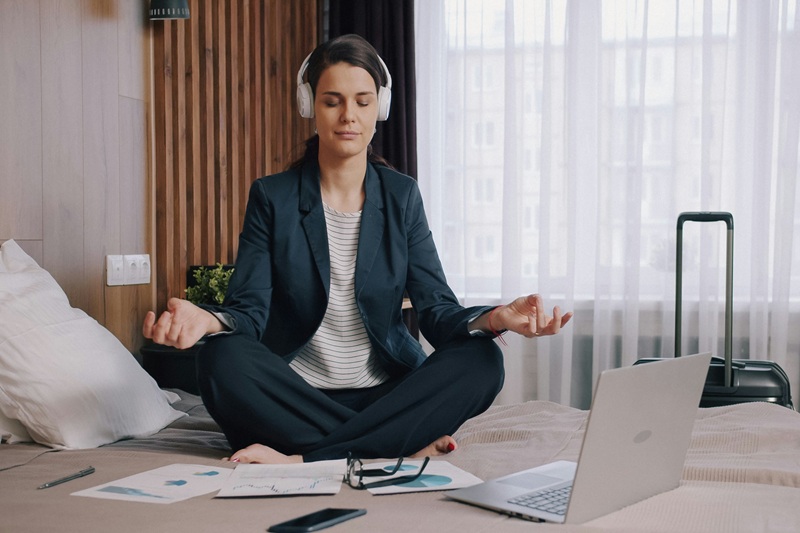
How the ‘Most Powerful’ Stress-Relief Technique Works: Simple Ways to Calm Your Mind and Body
You know that moment right after you finally sit down after a brutal day, and your body just… lets go with a long, involuntary sigh? Turns out that’s not just relief. It’s science. Researchers at Stanford have identified a simple breathing pattern that appears to calm the body and mind faster than meditation, box breathing, or any other technique tested. It’s called the physiological sigh, and it’s quickly becoming known as the most powerful stress-relief technique backed by real data. The best part? It takes less than a minute, costs nothing, and works almost anywhere.
What Exactly Is a Physiological Sigh?
A physiological sigh isn’t your average deep breath. It involves a double inhale through the nose one deep breath followed immediately by a second, shorter one then a long, slow exhale through the mouth.This isn’t a new invention. The pattern is actually an unconscious reflex first identified by scientists in the 1930s, and your body performs it spontaneously several times an hour without you even noticing. The average person sighs roughly once every five minutes, often as a way to reopen tiny collapsed air sacs in the lungs. What’s new is the discovery that doing it on purpose repeatedly, in a specific pattern can trigger a fast, measurable drop in stress.
Why This Simple Trick Works So Well
According to neuroscientist Andrew Huberman and his research team at Stanford University, who studied the technique through controlled clinical trials, the mechanics are surprisingly straightforward. The second inhale helps re-inflate small air sacs in your lungs that tend to collapse under stress. The extended exhale then does the heavy lifting: it clears built-up carbon dioxide and sends a strong signal to the parasympathetic nervous system to downshift, dropping your heart rate within seconds.
In short: it works on your breathing, your blood chemistry, and your nervous system all at once which is why it acts faster than most relaxation techniques.
How to Do It
- Inhale deeply through your nose until your lungs feel full.
- Take a second, shorter inhale on top of it, to top off your lungs completely.
- Exhale slowly and fully through your mouth to make this breath longer than both inhales combined.
- Repeat one to three times for quick relief.
For immediate relief from acute stress, one to three physiological sighs are often enough, according to researchers.
The Science Behind the Headlines
This isn’t just anecdotal wellness advice. A peer-reviewed study found that structured breathwork, especially exhale-focused cyclic sighing, produced greater improvements in mood and greater reductions in respiratory rate compared with mindfulness meditation. In the actual trial, participants who practiced the technique for five minutes daily over one month outperformed mindfulness meditation, box breathing, and cyclic hyperventilation for reducing stress and improving daily mood. That’s a notable finding, because meditation has long been treated as the gold-standard, go-to stress management tool. This research suggests a 30-second breathing pattern may beat it for immediate results.
Why It Matters Right Now
Stress-related burnout, anxiety, and sleep disruption have become near-universal complaints in modern life from overworked professionals to students juggling deadlines. Most conventional stress-relief advice (therapy, meditation retreats, apps, supplements) requires time, money, or consistency that many people simply don’t have. The physiological sign’s appeal is its accessibility. It requires no equipment, no app, no quiet room, and no training. Its foundation in a natural physiological process makes it accessible across different populations, and it’s increasingly being recommended by therapists, sleep coaches, and physical therapists as a first-line, low-cost intervention. That accessibility is likely why it’s spreading fast on social media and in workplace wellness programs it fits into a five-minute break between meetings just as easily as a moment of panic before a big presentation.
Curious stories, fresh insights, and more to explore.
How Does Parenthood Affect Elite Athletes?
Check out how young children and parenthood can influence the health and performance of top athletes.
Could Hormuz Talks Change Oil Prices?
Find out how Iran-Oman shipping talks could affect global oil prices, trade, and supply routes.
How Are Dates Becoming Soft-Serve?
Uncover how an Abu Dhabi ice cream maker transforms date palms into a unique soft-serve dessert.
Why Did Crawford Gift Zelensky?
See how boxer Terence Crawford’s Ukraine visit led to an unexpected puppy gift for President Zelensky.
Why Is Europe Watching Iran Closely?
Dive into why European nations are strengthening diplomatic and security oversight of Ira
A Word of Caution
Experts note the technique is generally safe for most people, but caution is advised for certain groups. It’s generally considered safe during pregnancy, though individual assessment is recommended, and people should avoid forcing or over-doing the breaths, discontinuing if dizziness, lightheadedness, or chest pain occurs.
FAQs
Q1: What is the physiological sigh, in simple terms?
It’s a breathing pattern of two quick inhales through the nose followed by one long, slow exhale through the mouth, repeated a few times to calm your body fast.
Q2: How is this different from just taking a deep breath?
A regular deep breath is one inhale. The physiological sigh uses two stacked inhales to fully re-inflate the lungs before a long exhale, which more strongly triggers the body’s calming response.
Q3: How many times should I do it?
For sudden stress or anxiety, one to three sighs are usually enough. For longer-term benefits, research used five minutes of practice daily.

