

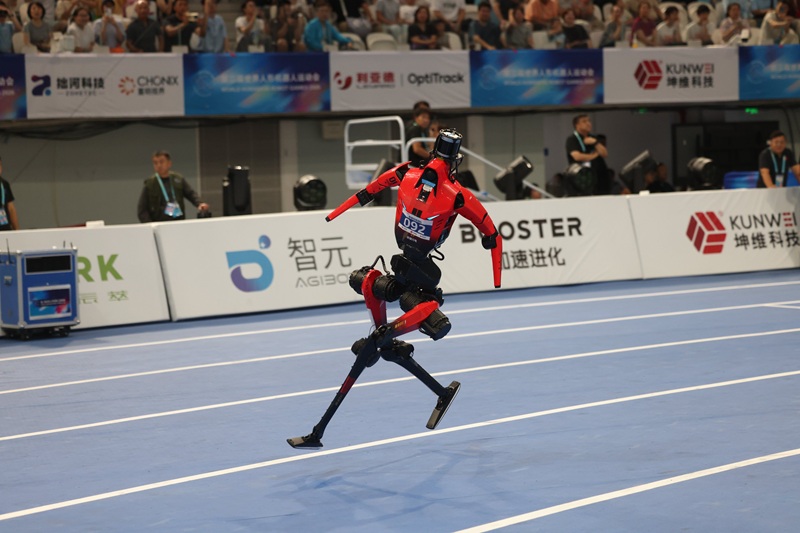
Beijing Hosts World Humanoid Robot Games 2026 as Robots Compete in Sports and Real-World Tasks
What happens when robots stop being lab experiments and start competing like athletes and working like people? That question is being put to the test this week as the World Humanoid Robot Games 2026 assembles thousands of humanoid machines for a competition that goes far beyond running and football. The games’ second edition will take place from Aug. 22 to Aug. 26 at Beijing’s National Speed Skating Oval, also known as the “Ice Ribbon.” The event has grown exponentially this year, with 666 teams and 2,056 humanoid robots from 16 countries competing.
Robots Compete in Football, Running and Table Tennis
The World Humanoid Robot Games 2026 is a fusion of traditional sports spirit with technology-oriented challenges for machines. Robots are competing in events including sprinting, football, table tennis, weightlifting, tug-of-war, martial arts and gymnastics and dance. New head-to-head competitions have also been introduced by the organizers to make the games more competitive and visually similar to human sports events. But perhaps the most compelling is the increasing speed of thef robots. Chinese humanoid robots already attracted international attention at the event after two of the machines reportedly finished a 100-meter race faster than Usain Bolt’s world record of 9.58 seconds. But speed is only a part of the story.
From Robot Sports to Real-World Work
The 2026 edition is characterized by more focus on practical tasks. In addition to sport competitions, robots are tested in scenarios based on factories, hotels, houses, logistics facilities and emergency situations. Problems include such things as assembly work, housekeeping, assistance in retail, sorting books and detail work like hooking up cables and handling small objects. Some tasks are made specifically to reveal weaknesses that are not easy to see in a simple race. For example, a robot may be able to run fast, but plugging in a cable, recognizing an object correctly or recovering from an error involves a much more sophisticated control. Over 40 percent of this year’s events are application-oriented scenario competitions, reflecting Beijing’s efforts to bridge the gap between robotics research and industrial applications.
Curious stories worth exploring next?
Where Can Solo Travellers Feel Safest?
Check out 15 tourist destinations ideal for safe and memorable solo travel for those aged 50 and above.
How Is UAE Becoming A Tech Hub?
Dive into the UAE’s AI investment strategy and discover how the Gulf is building its global technology future.
What Caused Japan’s Deadly Floods?
Uncover the record-breaking rainfall, deadly flooding and disruption that stranded thousands at Narita Airport.
Where Can You See Basking Sharks?
Explore Ireland’s best spots for an unforgettable close-up encounter with giant basking sharks in the wild.
How Did Bali’s Ferry Catch Fire?
Find the latest details on the ferry fire, rescue operation and the 172 passengers who survived.
Why the Humanoid Robot Games Matter
The games are becoming a real-world testing ground for an industry that could eventually change manufacturing, logistics, hospitality and household services. In its first year in 2025 there were 280 teams and over 500 robots. One year later, the numbers have ballooned to 666 teams and more than 2,000 robots. This rapid growth reflects China’s ambition to be a major player in humanoid robotics. Humanoid robotics is a strategic area for advanced manufacturing and new industrial capabilities, Beijing has identified. For companies, the reward could be a lot more than a medal. A robot that can reliably assemble components, move goods or do repetitive service tasks could eventually be a commercially useful machine.
The Bigger Question: Can Robots Actually Do the Job?
Despite the impressive demonstrations, the games also highlight how much work remains. Real workplaces are not predictable. Floors can be uneven, objects can be misplaced, people can move unexpectedly, and machines must operate safely over long periods of time. Even if a robot does great in a controlled competition setting, it might have trouble with these everyday problems.
That is why the move to real world tasks is so important. “One analysis of the event said that the competition is increasingly becoming a map of where humanoid robots could see their first commercial applications. The World Humanoid Robot Games 2026 therefore offer more than an unusual sporting spectacle. They provide a glimpse into a possible future where robots are judged not only by how fast they can run, but by whether they can actually get useful work done.
FAQs
1. What are the World Humanoid Robot Games 2026?
They are an international competition in Beijing where humanoid robots compete in sports and practical, real-world tasks.
2. When are the 2026 robot games being held?
The second World Humanoid Robot Games are taking place from August 22 to 26, 2026.
3. How many robots are competing?
Organizers say 2,056 robots representing 666 teams from 16 countries have registered.

