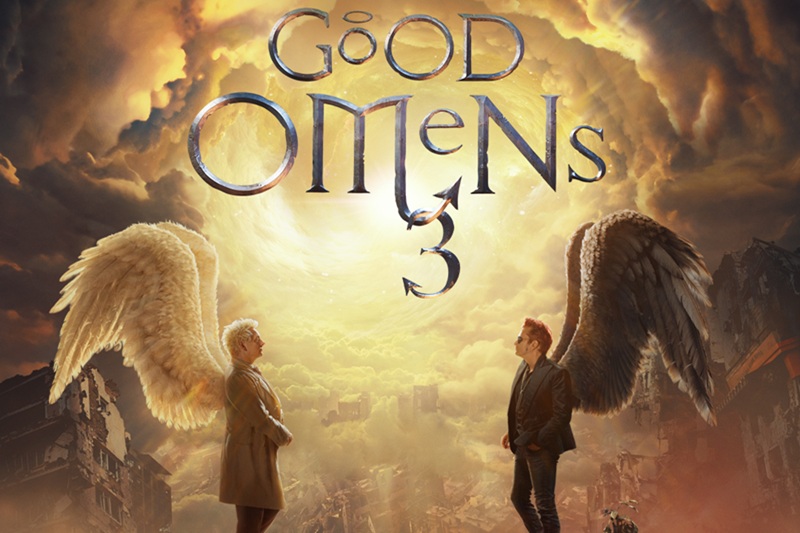
Good Omens Season 3: What Neil Gaiman’s Exit Means for the Finale
Finally, after waiting for such a long time, the ending of Good Omens is here. However, it is not what people had anticipated when they were first introduced to the show. It will debut on Prime Video on May 13, 2026, featuring one episode lasting 90 minutes. For viewers invested in the complicated relationship between angel Aziraphale and demon Crowley, the farewell feels both emotional and uncertain. The biggest reason is the absence of creator Neil Gaiman from the show’s production leadership during its final chapter. While Gaiman still retains writing credit on the finale, his departure from active production has changed the conversation around the series entirely. What was once expected to be a full third season evolved into a single feature-length episode, giving the ending a far more intimate and high-stakes tone.
Why Neil Gaiman’s Exit Changed Everything
Since its debut in 2019, Good Omens has become one of streaming’s most distinctive fantasy series. Adapted from the 1990 novel co-written by Gaiman and the late Terry Pratchett, the show balanced absurd comedy, biblical mythology, and emotional storytelling in a way few fantasy dramas managed. Gaiman served as creator, writer, executive producer, and showrunner. His presence touched everything, from the humorous dialogue to the human element in Aziraphale’s and Crowley’s relationship. That changed in 2024, when numerous women claimed that Gaiman sexually assaulted them. He denied the allegations, calling them false and “ridiculous.” The controversy reportedly led to a pause in pre-production before Gaiman stepped back from direct involvement so the project could continue.
The decision dramatically altered the trajectory of Season 3. Instead of another full episodic run, the story was condensed into one final cinematic installment titled “The Beginning Is Also The End.” Many fans feared an instant decrease in pace, a lack of closure for some plots, and whether the show could keep its unique tone without Gaiman being the one running things in production.
A Smaller Finale With Bigger Emotional Stakes
The finale picks up after the devastating Season 2 ending, where Crowley confessed his feelings and asked Aziraphale to leave Heaven behind. Instead, Aziraphale accepted a leadership role in Heaven, leaving the pair emotionally fractured for the first time in the series.
That cliffhanger transformed the relationship into the emotional core of the finale. With only 90 minutes to conclude the story, the new format appears laser-focused on the bond between the two leads, played by Michael Sheen and David Tennant. Early promotional material hints at reconciliation, with the iconic bookshop reopening after being symbolically “closed.” The streamlined approach may ultimately work in the final’s favor. Rather than juggling multiple side stories across several episodes, the narrative now carries the urgency of a final chapter with no room for detours. Fans who mainly care about Aziraphale and Crowley’s future could see this as a more emotionally satisfying sendoff. Still, there are trade-offs. Supporting characters who helped define the show’s quirky universe may receive far less screen time than audiences hoped. The broader mythology involving Heaven, Hell, and the Second Coming storyline may also be resolved more quickly than originally intended.
Cast Additions and Final Surprises
The finale also expands its ensemble cast. Returning performers are joined by Michael McKean, Gloria Obianyo, and Bilal Hasna, with reports of a cameo appearance from Toby Jones.
The extra scenes imply that the last episode would remain spectacular, even though it’s on a smaller scale. Nevertheless, taking into consideration previous seasons, it appears that while previously it was more about expanding the universe, now it is time to end the story and the conflict that has driven the plot of the show from the very beginning.
The Broader Consequences for the Entertainment Industry
Apart from the series itself, the mentioned changes reveal a much broader tendency that prevails in the entire entertainment industry. In the wake of recent events, production companies have begun to distance themselves from projects associated with people who have made misconduct claims against their creators. In this context, the way that Good Omens has been dealt with by Amazon may provide useful lessons for other streaming services struggling with similar issues. It could also be viewed as a business move, one where Good Omens’ creators transform the finale into an event in order to generate a sense of urgency among subscribers.
Why Fans Are Watching the Finale
Regardless of whether they feel betrayed by Gaiman’s actions, fans of the show are clearly eager to see the final episode. Much of that loyalty comes from the chemistry between Sheen and Tennant, whose performances turned Aziraphale and Crowley into one of television’s most beloved fantasy pairings. For longtime viewers, the finale represents more than the end of a series. It will be the final episode of the show that mixes comedy, tragedy, camaraderie, and doomsday into an unexpected personal experience. While it is yet unclear whether the finale lives up to its potential or fails to satisfy the viewer’s expectations, Good Omens has already established itself as one of the most unique fantasy shows available for streaming. On May 13, 2026, all the questions will be answered.
FAQs
1. What is Good Omens Season 3’s format?
A single 90-minute finale episode is streaming on Prime Video, premiering May 13, 2026.
2. Why did Neil Gaiman leave the show?
He exited amid sexual assault allegations by four women, stepping down as producer/showrunner but contributing to the finale’s script.
3. Does the ending provide closure to Aziraphale and Crowley’s storyline?
The one-hour special revolves around the cliffhanger left by the end of Season 2, with signs of a resolution in the promos.
4. Is Good Omens Season 3 canon without Gaiman?
Yes, because Gaiman co-wrote the episode.
5. How will the finale deal with new characters?
It spotlights Michael, Uriel, Jesus, and more, with Toby Jones in a cameo, but prioritizes the main arcs.