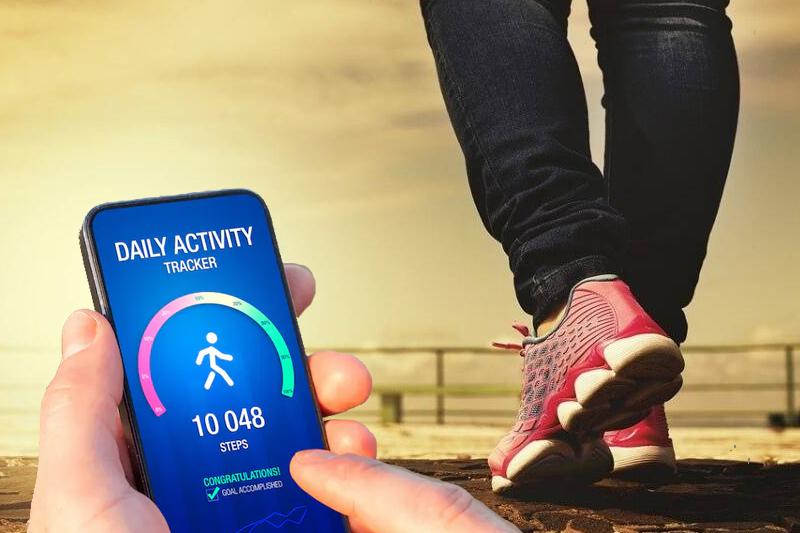
Good Health Comes With 10,000 Steps Daily, Really?
Recent studies show that walking has no magic number for health benefits. What fits you?
Walking has many physical and mental health benefits. Do you need 10,000 steps per day to improve your health and fitness?
A US-based sports medicine doctor, fitness expert, award-winning author, and medical columnist named Dr. Jordan Metzl recently told a news outlet that the goal of taking 10,000 steps a day comes from an ad campaign for pedometers during the 1964 Tokyo Olympics. He told a news site that the goal was “made up.”
“From a doctor’s perspective, while the number of steps may not be critical, regular physical activity is still essential for overall health and wellbeing. The American Heart Association recommends 150 minutes of moderate-intensity aerobic activity and two days of muscle-strengthening per week. Dr. RR Dutta, HOD, internal medicine, Paras Health, Gurugram, suggests walking, running, cycling, or swimming.
Dr. Edwina Raj, clinical nutrition dietetics head, at Aster CMI Hospital, Bengaluru, agrees. For significant health benefits, adults should move more, sit less, and do 150-300 minutes of moderate-intensity or 75-150 minutes of vigorous aerobic activity per week. To maximize health benefits, she recommends muscle-strengthening exercises twice a week of moderate or higher intensity.
“Children and adolescents (6-17 years) should engage in 60 minutes or more of moderate-to-vigorous physical activity daily,” she says.
Dr. Ishwar Bohra, associate director-orthopedics, BLK-Max Super Speciality Hospital, New Delhi, says that everybody is different and has different needs, strengths, and abilities, so one goal like 10,000 steps a day cannot be set. I think it should be customized by age and body type. Non-athletic and over 40 people should not have to walk 10,000 steps a day. Start with 6,000 steps a day and take breaks. Morning walks are recommended for fresh air and energy. Regular evening walks are also good. Slowly walk farther. Ordinary people should walk 3 km. Dr. Bohra suggests 8 km for those trying to reach a health goal.
Keep Reading
To fitness
Even a daily walk can improve your health. “Walking or exercising has physical, emotional, and mental benefits. Walking relaxes and boosts endorphins and other painkilling hormones. Regular walks can mobilize your knees, back, and joints, making you feel refreshed. Dr. Bohra of BLK-Max Super Speciality Hospital says it benefits cardiac and lung health.
“Post-Covid, heart and lung complications increased. Thus, regular walks strengthen the heart and lungs, he says.
Walking is one of the safest weight and heart-healthy exercises. “It reduces breast cancer risk, improves immune function, eases arthritis joint pain, maintains mental health by releasing feel-good hormones or endorphins, relaxes the mind, and improves sleep pattern. Dr. Raj of Aster CMI Hospital recommends running and cycling.
Never late
Good news if you’ve never exercised by walking. Dr. Sanjay Kumar, director, and HOD, Cardiology, at Fortis Escorts Hospital, Faridabad, advises starting these activities early. If you have chronic health issues, consult your doctor before starting these activities. He adds that these activities on a hard surface can injure joints like knees.
Dr. Paras Health Dutta concurs. Before starting an exercise program, consider your health and any medical conditions. Before starting an exercise program, people with hypertension, heart disease, back pain, or bone issues should consult a doctor. “To ensure safety and prevent health conditions from worsening, exercise type or intensity may need to be modified,” he says.
Hypertensives may need to monitor their blood pressure during exercise and avoid high-intensity activities that could raise their blood pressure. Under medical supervision, heart patients may start with low-intensity exercise and gradually increase it. Low-impact exercises like walking or swimming can improve cardiovascular health without stressing the spine or joints.
Start exercising at any age. However, older adults may need to take extra precautions to avoid injury. Dr. Dutta suggests that older adults start with low-intensity activities and gradually increase the intensity and include balance and flexibility exercises to reduce fall risk.
Keeping up
A new study suggests that speed may be just as important as taking 10,000 steps a day when it comes to lowering the risk of getting sick or dying. The study was published in the journals JAMA Internal Medicine and JAMA Neurology. It looked at the number of steps taken by 78,500 adults who wore trackers.
The University of Sydney in Australia and the University of Southern Denmark found that taking 10,000 steps a day lowers the risk of dementia, heart disease, cancer, and death. But a power walk had other benefits as well.
Dr. Kedar Kulkarni, a consultant cardiologist at the Ruby Hall Clinic in Pune, suggests taking more than 10,000 steps every day as a good way to exercise. Starting dose: 3 km in 30 minutes. “More is better,” is what he says.
Dr. Kulkarni says that you should do any exercise that makes you sweat and feel out of breath. You can alternate brisk walking, jogging, and Surya Namaskar. The heart works better. It makes you feel better. “It will also make you hate cigarettes,” he says.
Some common points you must know –
Overuse injuries
Repeating the same activity can stress joints, muscles, and bones, causing shin splints, plantar fasciitis, etc.
Trips and falls
Uneven terrain, poor lighting, and other hazards can increase falls and injuries, especially in older adults.
Heat illnesses
Exercising in hot, humid weather can cause dehydration, heat exhaustion, or heat stroke.
Safety measures
- Intensifying and prolonging exercise
- Starting slowly and gradually increasing activity can reduce overuse injuries.
Proper footwear
Arch-supporting and cushioned shoes can reduce foot and ankle injuries.
Staying hydrated
Water before, during, and after exercise can prevent dehydration and heat-related illnesses.
Body awareness
Paying attention to exercise pain and adjusting activity levels can prevent injury and improve health.
Observing surroundings
Awareness of hazards like uneven terrain, poor lighting, and other obstacles can reduce falls and injuries.