

Drone Carrying Explosives Found at German Airport: What Police Have Revealed So Far
A drone rigged with an explosive device turned up inside a restricted zone at Germany’s Leipzig/Halle Airport, setting off a bomb disposal operation and a counterterrorism probe that’s now got security officials across Europe on edge.
What Actually Happened
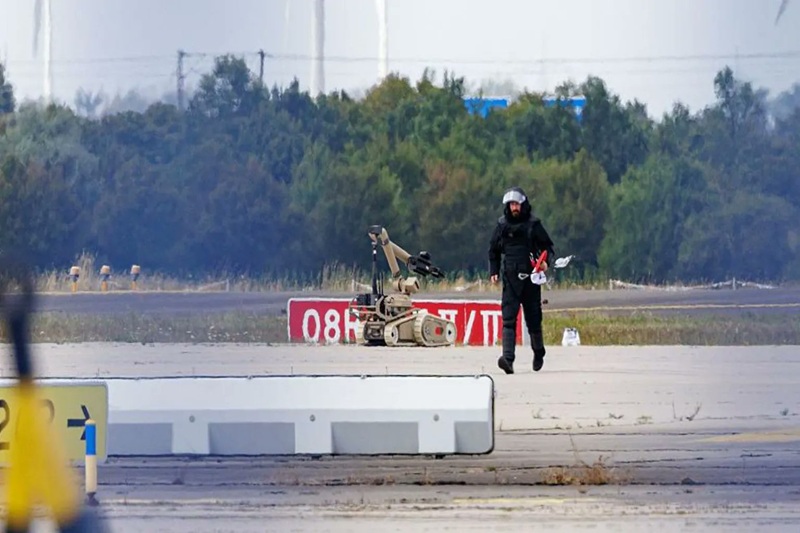
An airport worker spotted the drone overnight near the southern runway, sitting somewhere it had no business being deep inside the airport’s secured perimeter. Bomb techs moved in fast, pulled the detonator, and defused the device. As it turns out, the explosive never had a real chance to go off: police say the triggering mechanism was faulty. There’s a second, stranger wrinkle to the story. Around the same time, a cargo plane took a hit from an unidentified flying object mid-route and had to land in Hanover. The damage was minor and the plane came down safely, but investigators haven’t ruled out a connection between that strike and the drone found on the ground in Leipzig.
Who’s Investigating, and What They’re Saying
Federal police, Saxony state authorities, and counterterrorism units are all working the case together. So far, what’s actually confirmed is fairly narrow: the drone was carrying explosives, the bomb squad neutralized it without incident, part of the airport was temporarily locked down, and investigators are treating the whole thing as a probable act of sabotage rather than some kind of accident. Nobody’s been arrested. No one’s named a suspect. Investigators are looking at whether this fits into a wider pattern of hybrid attacks that have been hitting infrastructure elsewhere in Europe, but they’re being careful not to get ahead of the evidence.
Why Leipzig, of All Places
This isn’t just any regional airport. Leipzig/Halle is one of the busiest cargo hubs on the continent, and it plays a genuinely strategic role: it’s the European base for Ukraine’s Antonov cargo fleet, and it also supports German military and NATO logistics. That combination of heavy freight traffic plus military relevance is exactly why security analysts see this as more than a random prank or a curious hobbyist flying where they shouldn’t.
More Stories You Shouldn’t Miss
Could Tom Holland’s Luxury Stay Surprise?
Discover the lavish details behind Tom Holland’s extravagant stay at Mumbai’s iconic Taj Mahal Palace.
What Makes India’s Brain Atlas Revolutionary?
Explore how Indian scientists are unlocking the mysteries of the human brain with cutting-edge 3D mapping.
Why Did US Seize Iranian Tanker?
Uncover the dramatic events behind the US Navy’s tanker seizure and its impact on India.
Why Reject Two Citizenship Offers?
Find out why Rashid Khan chose loyalty over offers from India and Australia.
How Did Vikram-1 Create History?
Check out how Skyroot’s Vikram-1 became a milestone for India’s private space ambitions.
Why People Are Taking This Seriously
Drone sightings near European airports aren’t new; there’s been a steady drip of them, mostly unauthorized flights or suspected surveillance runs. What’s different here is the payload. A drone built to carry and detonate explosives, found inside a secured perimeter, is a meaningful escalation, not just another nuisance incident. German Interior Minister Alexander Dobrindt called it a sign of “a new level of danger” and pushed for stronger protection of critical national infrastructure. That kind of language from a sitting minister tends to move policy expect renewed pressure across Europe to fast-track counter-drone technology and tighten security around airports and military sites that, until now, weren’t really built to defend against this kind of threat.
What Happens From Here
Investigators are still working through forensic evidence pulled from the drone itself, combing airport surveillance footage, and trying to trace where the device actually came from. Officials have been explicit that no conclusions have been reached about who’s behind it despite plenty of speculation online about possible foreign involvement, German authorities say they’re waiting on the evidence before pointing fingers. Whether or not this turns out to be state-linked sabotage, it’s likely to be remembered as a turning point the moment European airport security had to start reckoning with drones not just as a flight-safety nuisance, but as a potential weapon.
FAQ
Where was it found?
Inside the restricted security area at Leipzig/Halle Airport in eastern Germany.
Did it go off?
No, the detonator failed, and bomb disposal teams safely defused it.
Any suspects?
None named publicly; the investigation is ongoing.
Why does the location matter?
It’s a major cargo hub tied to Ukraine’s Antonov fleet and NATO logistics.
Will this change airport security?
Likely expect renewed investment in anti-drone systems across Europe.

