

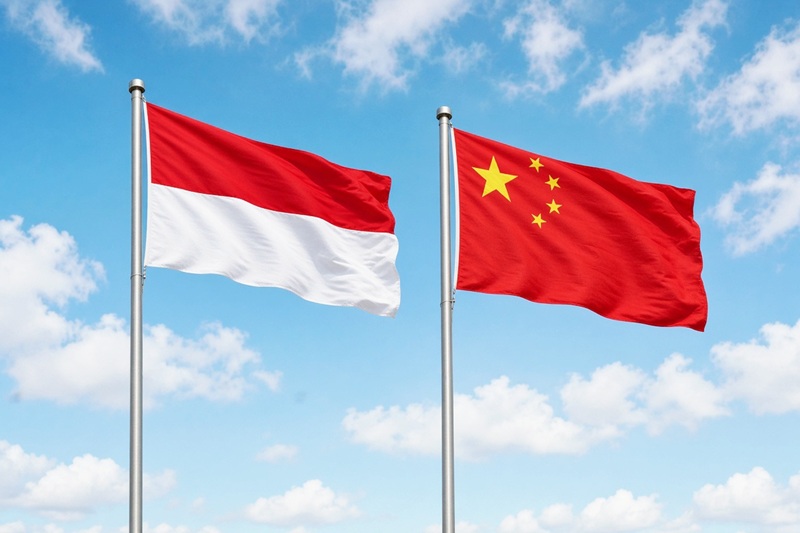
Why China-Indonesia Cooperation Could Reshape Southeast Asia’s Strategic Landscape
Something is shifting in Southeast Asia, and it centers on Jakarta and Beijing. For years, the relationship between China and Indonesia ran mostly on trade and infrastructure money. That’s no longer the whole story. Defence cooperation, critical minerals, AI, energy, and maritime affairs are all now part of the mix, and the pace of change has picked up noticeably. The timing isn’t an accident. With the U.S. and China still jostling for influence across the Indo-Pacific, Indonesia is trying to do something harder than picking a side: keep its options open while deepening ties with whoever can help it get where it wants to go. Because Indonesia carries real weight in the region, how this plays out matters well beyond its own borders.
The Relationship Is Outgrowing Its Old Shape
Just this week, on August 20, China’s Foreign Minister Wang Yi and Defence Minister Dong Jun sat down with Indonesian officials in Jakarta. What came out of those talks wasn’t just another round of trade pledges; the two sides committed to more joint military exercises, officer exchanges, and cooperation stretching across defence, energy, minerals, and technology. AI, satellites, green energy, fisheries, and rail transport all came up too. The military angle is the part worth paying closer attention to. Naval cooperation between the two countries has been ramping up, and in August their warships ran a joint drill east of Taiwan, practicing communications and resupply at sea. That’s not a small gesture. None of this means Indonesia is abandoning its other relationships. President Prabowo Subianto has stuck to the country’s long-standing playbook of staying non-aligned and engaging seriously with China while keeping its ties to the U.S. and other powers intact.
Follow the Money and the Minerals
Economics is still the backbone of this relationship. China is one of Indonesia’s most important trading partners, and Indonesia, in turn, gives Beijing something it badly wants: access to critical minerals, a huge consumer market, and a growing manufacturing base especially for electric vehicles. A lot of this is being channeled through the “Two Countries, Twin Parks” initiative, which links industrial zones between the two nations and is meant to speed up supply chains and technology transfer. It’s already producing real numbers in May alone, agreements tied to the framework brought in roughly $500 million in new investment commitments, according to Indonesia’s Coordinating Ministry for Economic Affairs. Tech cooperation is expanding too. In July, Indonesia signed on as part of the newly formed World Artificial Intelligence Cooperation Organization, and officials from both sides have been talking about AI governance and digital investment.
Why This Isn’t Just a Bilateral Story
Indonesia isn’t just another country in the region, it’s Southeast Asia’s largest economy and a heavyweight within ASEAN. So when Jakarta pulls closer to Beijing on both the economic and defence fronts, the rest of the region is watching closely, because whatever happens here tends to set a tone. For China, a stronger relationship with Indonesia means more economic reach and more diplomatic clout in a part of the world that matters enormously to its long-term strategy. For Indonesia, Chinese capital and technology could help it build out infrastructure, grow its industrial base, and hit its energy goals.
That said, it’s not a friction-free partnership. Indonesia’s maritime claims sometimes bump up against China’s in the South China Sea, and other ASEAN members remain wary of anything that tips the regional balance too far in one direction. ASEAN-China dialogue keeps circling back to the same themes of international law, maritime cooperation, and avoiding accidents at sea because those tensions haven’t gone away.
What to Watch Next
This isn’t really a story about Indonesia choosing China over America. It’s more about Jakarta widening its own set of options pulling in whatever mix of investment, technology, and security cooperation serves its interests best. If the momentum in minerals, tech, trade, and defence keeps building, this could turn into one of the more consequential relationships shaping Southeast Asia’s future. But the real measure of success won’t be diplomatic statements or investment totals; it’ll be whether ordinary Indonesians actually see the benefits: more jobs, better infrastructure, stronger local industry. And for the wider region, the open question is whether all this cooperation adds stability to Southeast Asia, or just another layer of complexity to an already crowded strategic picture.
FAQ
Why does this relationship matter?
Indonesia is Southeast Asia’s biggest economy; China is a major global power. Their closer ties could shift trade patterns, security dynamics, and diplomacy across the region.
Is military cooperation really increasing?
Yes, more joint exercises, officer exchanges, defence-industry ties, and naval engagement are all on the table now.
What industries are involved?
Critical minerals, manufacturing, infrastructure, energy, EV supply chains, digital tech, and AI.
Is Indonesia siding with China over the U.S.?
Not really Jakarta has long pursued a non-aligned foreign policy and continues to engage both powers.
Could this reshape ASEAN?
Possibly. Given Indonesia’s influence within the bloc, deeper ties with China could ripple into regional trade integration and maritime diplomacy.
Stay informed with these stories shaping global headlines and raising new questions.
Could Hormuz Tensions Trigger Wider Crisis?
Check out the latest developments surrounding the US naval blockade of Iran and rising Strait of Hormuz tensions.
What Happened to Italy’s Renaissance Treasures?
Uncover the shocking museum heist involving four priceless Renaissance masterpieces stolen from Italy.
Why Did Police Investigate Elderly Man?
Find the details behind the Singapore assault investigation following an elderly man’s interaction with a child.
Why Did Trump Cut Military Exercises?
Browse the latest developments after Trump ordered a substantial reduction in joint military exercises.
What Does France’s Muslim Brotherhood Report Reveal?
Explore France’s new report and the questions it raises about Islamist networks across Europe.

