UAE’s Humanitarian Response to Sudan: From Emergency Relief to Long-Term Recovery
The war in Sudan has created a humanitarian crisis that stretches well beyond its borders. “Millions of people have been forced to flee their homes, families are fighting to obtain food and clean water, and health care facilities are under enormous strain. For those who have fled to neighboring countries, displacement has brought with it a new set of challenges: finding shelter, medical care and a way to rebuild their lives.
In this context, the UAE’s humanitarian response to Sudan has extended beyond emergency food deliveries and medical supplies. It works on refugee assistance, health infrastructure, community development and diplomatic engagement, among other things, demonstrating an approach that connects immediate relief with longer-term recovery.
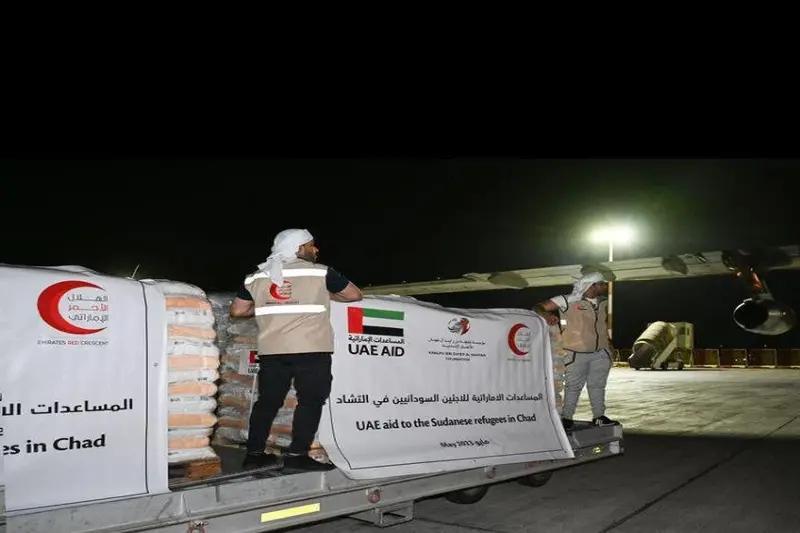
Since the conflict began in April 2023, the United Arab Emirates has positioned itself as a humanitarian partner supporting Sudanese civilians and communities hosting refugees.
From Emergency Aid to Long-Term Humanitarian Support
The UAE announced one of its major commitments, a $100 million pledge to support humanitarian operations in Sudan and neighboring countries, during the International Humanitarian Conference for Sudan in Paris in April 2024.
The commitment was split into two large allocations: $70 million to humanitarian organizations working inside Sudan and $30 million for Sudanese refugees in neighboring countries including Chad, Uganda, South Sudan and Ethiopia.
The UAE subsequently dedicated 70% of its pledge to international organizations, including the United Nations Office for the Coordination of Humanitarian Affairs (OCHA), the World Food Program (WFP), the UN Refugee Agency (UNHCR), the Food and Agriculture Organization (FAO) and the World Health Organization (WHO).
This approach recognises that humanitarian crises cannot be addressed through short-term assistance alone. Families need food today, but they also need functioning healthcare services, safe living conditions and opportunities to rebuild their livelihoods.
Food, Medical Supplies and Healthcare Support
Emergency aid remains a major part of the UAE’s response. As of September 2024, the country sent out 159 relief flights carrying about 10,000 tons of food, medical and other supplies to people affected by the conflict.
Maritime assistance was also part of the effort, including a shipment of some 1,000 tons of urgent relief supplies.
But the delivery of supplies is only half the challenge. People fleeing conflict also need access to reliable medical services, especially in places where local healthcare systems are struggling with growing demand.
To meet this need, the UAE set up field hospitals in Amdjarass and Abéché in Chad. They provide treatment for vulnerable members of host communities and Sudanese refugees.
In March 2025, the UAE also opened a 100-bed field hospital in Madhol, South Sudan, extending medical assistance to refugees, returnees and local residents.
Supporting Sudanese Refugees, Women and Children
Displacement poses particular risks for women and children, including lack of access to maternal health care, protection services, food and education. The UAE has extended further assistance to these vulnerable groups.
In September 2024, the UAE contributed US$10.25 million to UN agencies to help Sudanese refugee women in Chad. The funding covered maternal and child health care, reproductive health services, psychosocial support and gender-based violence programs.
The scheme also acknowledged the importance of supporting the communities receiving refugees. When large numbers of displaced families arrive, local hospitals, water systems and food supplies come under additional pressure.
Clean Water and Community Development in Chad
Long term humanitarian assistance also requires basic infrastructure.
In October 2025, a number of projects in eastern Chad were concluded by the Mohammed bin Rashid Al Maktoum Global Initiatives, in collaboration with UNHCR. These were:
- Drilling 10 wells to provide clean drinking water to some 65,000 people.
- Establishment of a fully equipped health care clinic in the Arkom refugee settlement.
- Building health facilities to serve more than 66,000 refugees and members of the host community.
Combined, the projects reached over 131,000 individuals.
Investments like these can have a ripple effect beyond the immediate refugee population. Access to clean water reduces the strain on local resources, and healthcare facilities can help communities deal with disease and other public health challenges.
Diplomatic Engagement and the Search for Peace
Humanitarian intervention cannot be effective in solving the problem on its own. In the absence of access for humanitarian workers and some developments towards a ceasefire agreement, millions of civilians will be left in uncertainty.
In August 2024, the UAE was a member of the group known as “Aligned for Advancing Lifesaving and Peace in Sudan ” which had its meetings in Switzerland. The group included the UAE as well, as well as the US, Saudi Arabia, Egypt, Switzerland, the African Union and the UN.
During the talks, the necessary steps to ensure the humanitarian access and security of civilians were identified. The discussions had also led to an agreement on the use of the Adre border check-point from Chad to Sudan and back.
Besides, the UAE has called for an immediate ceasefire, peaceful resolution of the conflict and transition to a civilian form of governance.
Why Long-Term Recovery Matters
The size of the humanitarian disaster in Sudan shows that international cooperation is needed. According to UNICEF’s report released in August 2026, 33.7 million people in Sudan need humanitarian help, out of which 17.3 million are children.
This means that emergency food deliveries and emergency medical assistance are not enough to cover all the needs.
Besides, restoring the health systems and providing access to clean water, providing livelihoods and supporting education will also have to be carried out as the situation develops. The countries around Sudan also need to be supported.
The UAE has shown how emergency humanitarian assistance can work in conjunction with health infrastructure, refugee protection, and community development. However, success will depend on the availability of funding, safe humanitarian space, good partnerships, and a progress towards peace.
Explore How the UAE Is Shaping Global Technology, Trade, Diplomacy, and Development
Can the UAE Become a Global AI Hub?
Could Colombia-UAE Trade Transform Global Markets?
How Is UAE Diplomacy Bringing Prisoners Home?
Are UAE Flight Disruptions Affecting Travellers Today?
What Makes the UAE’s Development Model Different?