Roman Secret Superhighway Germany: 1,600-Year-Old Canal Found Beneath Farmland Stuns Experts
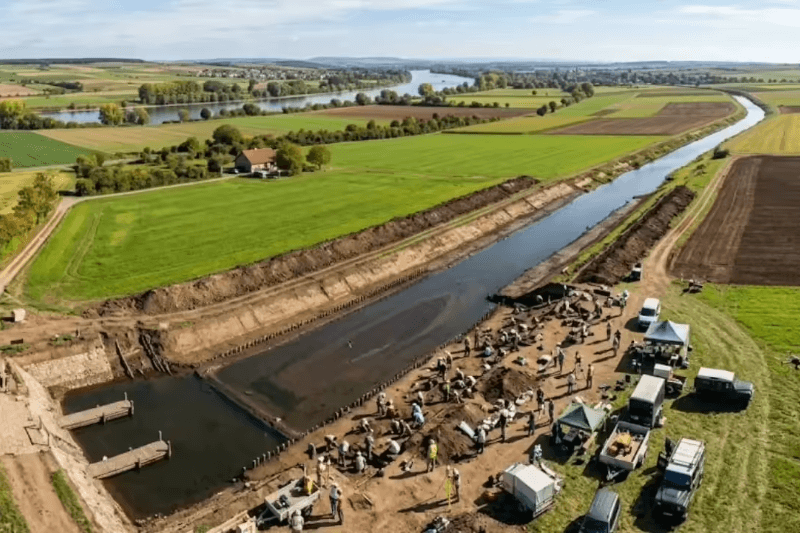
In a discovery that feels almost like a movie, archaeologists in Germany have found what many are calling a Roman “secret superhighway” hidden under regular farmland. Buried for nearly 1,600 years, this massive canal is changing how historians view Roman engineering and military strategy along the empire’s northern border. The discovery happened in the Groß-Gerau district, close to the winding banks of the Rhine, an area that once marked an important boundary of the Roman Empire.
A Canal Hidden in Plain Sight
At first glance, the fields near Trebur-Astheim look like any other agricultural land. But beneath the soil lies a remarkably straight, man-made canal that is about 15 meters wide and 2.5 meters deep.
What makes this discovery even more impressive is how it was found. Researchers did not start by digging. Instead, they used tools like ground-penetrating radar, magnetometry, and electrical resistance surveys. These non-invasive methods revealed the canal’s outline with surprising clarity, almost like tracing a ghost beneath the earth. Only later did soil sampling confirm what the scans suggested: this was not a natural formation; it was a carefully built Roman waterway.
Built for War, Not Just Water
Historians think the canal goes back to the time of Valentinian I (364–375 AD). During this period, Rome faced constant pressure from Germanic tribes at its borders. Instead of depending only on the unpredictable Rhine, Roman engineers created this direct route to move troops, weapons, and supplies quickly between fortified positions. The canal connected the river to a nearby “burgus,” which was a compact Roman fort with its own harbor.
In simple terms, this was not just about roads and water routes it was about strategy. A straight, controlled water route allowed for quicker response times and reduced risks compared to navigating the twists of the Rhine and dealing with seasonal floods.
A Rare Engineering Feat
While the Romans are known for their roads and aqueducts, large-scale navigation canals like this one are quite rare in northern Europe. Most Roman waterworks in the area were built for irrigation or drinking water, not military transport.
The discovery of a secret ancient superhighway in Germany is significant because is shows that the Romans did not just settle along their empire’s borders; they also planned for long-range communication. The sediment samples taken from this area suggest that the canal was used by people long after the Roman Empire fell and could have been used as recently as the 7th or 8th centuries A.D., indicating that local populations continued to maintain and utilize it long after Roman authorities ceased to control the area.
Technology Meets Ancient History
The secret behind this great find is both old and new: modern science, and ancient history. Researchers used geophysical imaging combined with the science of radiocarbon dating to reconstruct the canal’s structure, use, and time period without the need for large-scale excavations. Soil cores taken from around the canal showed layers of sand and silt that correlated with how a boat would have moved through the water. This subtle yet strong evidence suggests an actual waterway that had real traffic (there was a boat moving through it). It is just another reminder that many parts of Europe’s landscape hide entire chapters of history yet to be discovered.
Why This Discovery Matters Today
Not only is this structure significant for its historical context, but it may also have some practical implications today. For example, local governments are already searching for means to develop this land into a heritage tourism site which would increase the number of visitors coming into this region, thereby generating revenue for rural businesses from tourism-related activities. However, it also creates an opportunity for discussion on land use and preservation. Farmers who have worked this land for centuries have unknowingly done so in a way that has preserved this structure; going forward, there will be a need to establish a balance between development and preservation of the canal. Additionally, on a larger scale, discoveries such as this one are instrumental to connecting us with our past. There are many different ways historical events may occur, even in locations where you would not expect there to be much historical significance.
FAQs
What is the Roman “secret superhighway”?
It is a 1,600-year-old canal, 15 meters wide, built for quick military boat travel from the Rhine to a fort at Trebur-Astheim.
When and why was it built?
It was constructed around 364-375 AD by Emperor Valentinian I to improve defenses against Germanic tribes.
How was it found?
Geophysical scans like radar detected its shape beneath farms; soil cores confirmed the details.
Was it used after Rome fell?
Yes, it was maintained into the 7th and 8th centuries by later groups for trade.
Why is this discovery significant?
It shows Rome’s engineering skills and could enhance local tourism and history education.
Summary:
Archaeologists uncover a massive Roman canal in Germany dubbed a “secret superhighway” used for military logistics along the Rhine. A rare glimpse into Roman engineering.