

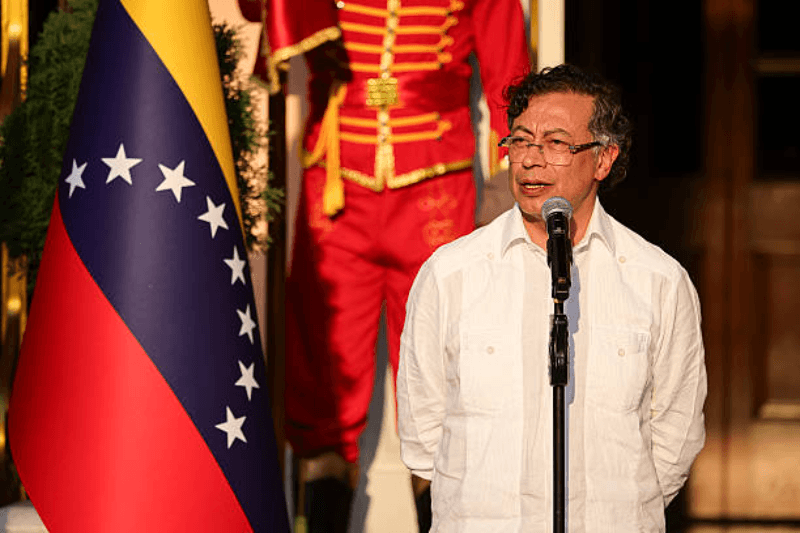
Petro in Caracas: Colombia Becomes First to Recognize New Venezuela Government
In a moment that could reshape politics across Latin America, Colombia’s president Gustavo Petro arrived in Caracas this week, becoming the first foreign leader to publicly engage with Venezuela’s new leadership after the dramatic fall of Nicolás Maduro. His visit, marked by a high-profile meeting with acting president Delcy Rodríguez, signals more than a diplomatic courtesy. It is a clear acknowledgment of a shifting power structure in Venezuela, one that is already stirring debate far beyond the region.
Venezuela: A Crisis That Redefined The Country
The present day politics in Venezuela emerged from the highly controversial American military campaign termed as “Operation Absolute Resolve.” The raid resulted in the capture of Maduro and his wife, Cilia Flores, who now face charges in the United States. In the aftermath, Rodríguez stepped into power, backed by state institutions and, quietly, by Washington. Her leadership was initially framed as temporary, with a short mandate intended to guide the country toward elections. But deadlines have come and gone, and Venezuela now sits in a tense political limbo. Petro, who has long criticized foreign intervention, struck a careful balance. While he rejected Maduro’s disputed electoral legitimacy in the past, he also openly condemned the U.S. action. His government nonetheless moved early to recognize Rodríguez’s authority in a limited, transitional sense.
Inside the Caracas Meeting
Petro’s arrival on April 24 was anything but symbolic. Welcomed by Foreign Minister Yvan Gil, he headed straight to the presidential palace for talks that focused heavily on security and economic recovery. At the heart of discussions was the sprawling Colombia–Venezuela border, a region long plagued by illegal armed groups, drug trafficking networks, and human smuggling routes. Strategies were developed that included intelligence sharing and patrols. Energy cooperation became another point of agreement. With supply issues at home, Colombia has taken an interest in Venezuelan gas. Reviving cross-border trade largely dormant for years—was another key objective, with both governments signaling a willingness to rebuild economic ties step by step.
Why Colombia’s Move Matters
Colombia’s decision to engage directly carries weight. By doing so, Bogotá became the first government in the region to publicly legitimize Rodríguez’s leadership, even if informally. That move could influence how other Latin American nations respond. Many have remained cautious, unsure whether Rodríguez represents a genuine transition or simply continuity under a different face. Economically, the implications are significant. Venezuela’s oil sector, once crippled, is slowly reopening. Should the status quo remain intact, trade between the two nations might quickly recover, providing much-needed relief to border populations as well as migrants. To the millions of Venezuelans who have left their homeland during times of turmoil, the prospects of stabilization no matter how tentative hold promise for a better future ahead.
Divided Reactions at Home and Abroad
The reaction has been anything but uniform. In Venezuela, opposition voices remain skeptical. While some welcomed the end of Maduro’s rule, many view Rodríguez as too closely tied to the old system to represent meaningful change.In Colombia, Petro’s supporters see the visit as a pragmatic step toward regional stability and sovereignty. Nevertheless, the critics feel that early involvement may amount to recognizing a regime whose commitment to democracy is yet to be proven. The US, under President Trump, has also made its views known, with conflicts clearly evident on issues such as drug enforcement and regional dominance.
Turning Point or a Hail Mary Pass?
Petro’s trip is not only diplomacy but a high-risk move. On the other hand, it may bring about a more stable border area, reduce armed factions, and restore economic activities. On the other, the absence of clear electoral timelines in Venezuela raises questions about how long this transitional government might last.
There are also deeper concerns about influence. Rodríguez’s openness to U.S. interests in energy has created some doubt about how independent she is, and whether she can be engaged by regional players such as Petro without giving up their own standpoints.
The Way Forward
At this point, the meeting in Venezuela represents a definite departure from ideology to pragmatism.Petro appears to be betting that engagement, rather than isolation, offers the best chance at stability. Whether that approach pays off will depend largely on what happens next inside Venezuela particularly whether long-promised elections finally materialize. Until then, Colombia’s move stands as both a signal and a test. Others in the region are watching closely, weighing whether to follow Bogotá’s lead or wait for clearer answers.
FAQs
1. When did Colombia recognize the new Venezuelan regime?
The government of Colombia officially acknowledged the interim presidency of Delcy Rodriguez early January 2026 following the arrest of Maduro by the Americans, and this was followed by a visit by President Petro.
2. What issues were discussed during the Petro-Rodriguez meeting?
Issues discussed: Security on the border from criminal organizations (drugs and smuggling), intelligence sharing, military mirror exercise, energy cooperation (gas imports), and reopening of trade.
3. How is this visit historic?
This is the first ever visit to Venezuela by a foreign leader after the ouster of its dictator Maduro in January, thereby making Colombia a pioneer of sorts for other countries.
4. What is the border security agreement?
Independent but coordinated patrol activities through intelligence coordination focusing on guerrillas and criminals without joint command, expanding previous plans from March.
5. What has been the public reaction to this?
Mixed: The opposition is hesitant regarding Rodriguez’s inclusion, supporters of Petro celebrate, Trump criticizes. Promises stability yet sparks discussions about America’s proxy wars.
Summary:
Colombia’s Petro makes historic Caracas visit, backing acting Prez Delcy Rodríguez post-US Maduro ouster. Military intel pact targets border mafias first foreign nod to new Venezuela era.


