

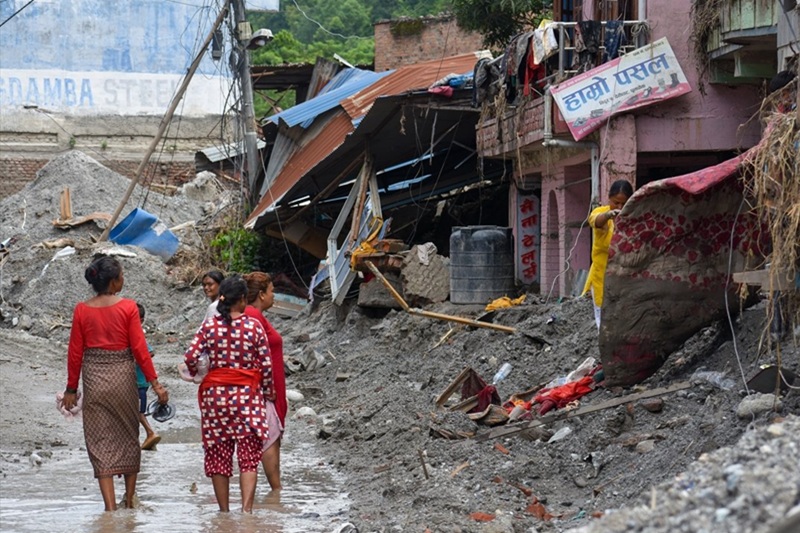
Nepal Declares National Mourning After Deadly Floods Kill More Than 1,300: Search for Missing Continues
Thirteen days after the mountains gave way, Nepal stopped on Monday to grieve. The country declared a national day of mourning, flags dropping to half-mast outside government buildings and embassies around the world, as the death toll from the floods and landslides that tore through the north of the country climbed past 1,300. For thousands of families, though, mourning isn’t really possible yet they still don’t know if the person they’re waiting for is alive. It started on August 26th, when an avalanche of ice and rock came down near the Nepal-China border, close to Rasuwa district, and triggered flash floods that swept through the region. Homes disappeared. So did roads, bridges, and the hydropower infrastructure the country leans on so heavily. The damage wasn’t contained to Nepal, either; the same event caused serious destruction across the border in Tibet. There’s a reason the mourning day falls exactly now. In Nepal’s Hindu-majority culture, grief traditionally runs its course over thirteen days before families move into rituals of remembrance. That calendar collided head-on with a disaster that, by day thirteen, still hadn’t finished counting its dead.
A Toll That Keeps Moving
Getting a single, settled number out of this disaster has proven almost impossible, and that in itself says something about how remote and how badly damaged the affected areas are. Domestically, Radio Nepal put the confirmed death toll at 1,342 as of September 7th, with nearly 4,000 people still unaccounted for. Reuters, tallying the destruction across both Nepal and Tibet, arrived at a higher and grimmer picture: over 1,380 dead and more than 5,500 missing. Neither number is necessarily wrong; they’re just measuring different things, one country’s ledger against a cross-border one, and both are still moving as crews reach places they couldn’t get to before. Adding to the anguish, a large share of the recovered bodies haven’t even been identified yet, which means some families who assume the worst still can’t get confirmation either way.
Digging Through the Tunnels
Some of the hardest, most technical work is happening underground, at the hydropower sites that dot the disaster zone. Hundreds of workers there are still unaccounted for, and rescue officials believe a number of them may be sealed inside tunnels that the floodwater and debris cut off. Nepal isn’t doing this alone. Teams from India, China, South Korea and the United States have joined the search, working alongside local crews through mud and wreckage that in some places has barely been touched since the disaster hit. There have been a handful of genuinely remarkable moments in the middle of all these people pulled out alive from collapsed structures and blocked tunnels, days after anyone expected to find survivors. It’s not much, set against the scale of the loss, but it’s kept alive the idea that there could still be people surviving in pockets of space underground.
Waiting Without Answers
For the families still standing outside government offices in Kathmandu, the disaster hasn’t ended, it’s just changed shape. Not knowing whether a husband, a daughter, a father is dead, alive, or still buried somewhere has its own particular cruelty, distinct from grief itself. Some have gone ahead with funeral rites anyway, without a body to bury, just to have somewhere to put the loss. It brings a kind of closure, but it clearly isn’t the same as an answer. And underneath the mourning, there’s real anger building at how slow the rescue effort has felt, and at how little information families say they’re getting from officials.
What’s Making Headlines You Can’t Miss?
Could Hoekstra Face Expulsion From Canada?
Check out why thousands of Canadians are demanding action against the US ambassador.
Who Is Martina Strong, Really?
Uncover the diplomat’s UAE appointment and the political delays surrounding her confirmation.
Why Did Clancy’s Jury Deadlock?
Find out what led to the mistrial and why the jury couldn’t reach a verdict.
Why Is Lake Ontario Renamed?
Browse what Apple Maps’ surprising “Lake America” change means and why it happened.
Which Haunted Hotels Should You Visit?
Experience five spooky American hotels known for paranormal encounters and eerie stays.
What Happens After the Water Recedes
Beyond the immediate human toll, this disaster is forcing some uncomfortable questions in Nepal about how ready the country actually was for its infrastructure, its early-warning systems, and its whole approach to living in unstable mountain terrain. The economic exposure is real. Nepal’s hydropower sector, its tourism industry, and the mountain roads that connect remote communities to everything else have all taken direct hits, and that kind of damage tends to outlast the headlines by months or years. Officials and disaster experts are already pointing to the bigger pattern here: glacial hazards, increasingly extreme weather, terrain that was never especially forgiving to begin with. For a country built into the Himalayas the way Nepal is, this is likely to reopen serious conversations about evacuation planning and early warning long after the search teams have gone home. For now, though, none of that is the priority. The priority is still the missing and the thousands of people in Nepal for whom this day of mourning is really just another day of waiting.
FAQs
1. When did the Nepal floods happen?
The catastrophic flooding began on August 26, 2026, following an ice-rock avalanche and flash floods in northern Nepal and surrounding areas.
2. How many people have died in the Nepal floods?
More than 1,300 people have died. Nepal’s latest reported figure cited by Radio Nepal was 1,342 recovered bodies, while broader Nepal-Tibet figures reported by Reuters put the toll at about 1,380.
3. How many people are still missing?
Nepal reported nearly 4,000 people unaccounted for, while figures covering Nepal and Tibet put the number above 5,500.

