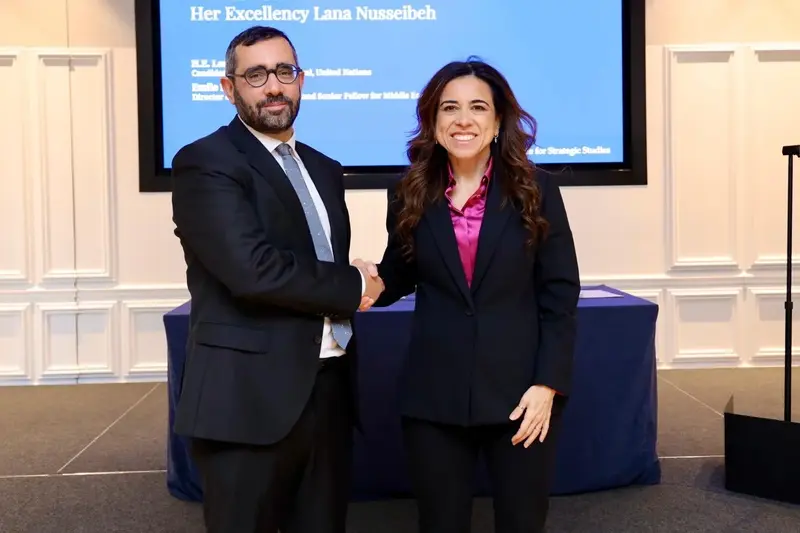
Lana Nusseibeh’s UN Secretary-General Bid: Can She Make History as the First Woman to Lead the United Nations?
The United Nations may well be approaching a momentous inflection point. This will be the first time in over eight decades that a woman may lead the United Nations, its most prominent international institution. One of the contenders for this post is Lana Zaki Nusseibeh, an Emirati diplomat who has become prominent due to her involvement in the fields of international diplomacy and humanitarian negotiation.
On October 21, 2026, the United Arab Emirates officially named Nusseibeh as a candidate who will contest against the incumbent, António Guterres, whose second term is set to conclude on December 31st. Nusseibeh would become the United Nations’ first female and the second Arab Secretary-General if she wins. Her candidacy takes place at an unprecedented time in the history of the UN which is facing a series of complex conflicts, geopolitical tensions, human disasters, and serious doubts regarding the role of the global institutions. Nusseibeh supporters see her as a skilled compromise creator able to get conflicting interests to settle their issues.
Who Is Lana Nusseibeh? A Diplomat With Extensive UN Experience
Nusseibeh brings over 20 years of government and diplomatic experience. She has been the UAE’s Permanent Representative to the United Nations for over ten years, becoming the first woman to hold this role.
Nusseibeh was twice President of the UN Security Council during the UAE’s 2022–2023 non-permanent membership, as well as the Vice-President of the UN General Assembly and President of the Executive Board of UN Women.
Her many roles have afforded her expertise in several areas of international affairs, including international security, humanitarian aid, women’s rights, development, and institutional reform.
Nusseibeh’s many years of government and diplomatic experience is seen as useful in navigating the complexities associated with the interplay between the main powers while ensuring the UN continues to carry out its functions.
Gaza Resolution 2720 and the IRENA Achievement
One of the most crucial moments in Nusseibeh’s diplomatic career was working on the initiative that culminated in the adoption of UN Security Council Resolution 2720 on December 22, 2023.
This resolution established various mechanisms meant to assist with coordinating and enhancing humanitarian assistance reaching Gaza under extreme conditions during a conflict.
The UAE spearheaded this effort and Nusseibeh had a major part to play in rallying support from fellow members and ensuring successful negotiations.
Her efforts were praised by the leadership of the Palestinian Authority too. In April 2024, Riyad Mansour, the Palestinian Permanent Observer at the United Nations, gave her the “Shield of Palestine” for her outstanding work in diplomacy during her time in the UAE’s Security Council.
Her accomplishments did not end upon becoming the ambassador of the UAE to the United Nations. Nusseibeh was active in supporting the UAE’s bid to be the headquarters of the International Renewable Energy Agency (IRENA).
In this manner, she has shown that she has participated in different aspects of diplomacy.
GCC Countries and Civil Society Support Her Candidacy
Regional support has become an important element of Nusseibeh’s candidacy. On 22 October 2026, the Gulf Cooperation Council announced their support for Nusseibeh and this support was extended from all six GCC countries namely, the UAE, Saudi Arabia, Qatar, Bahrain, Kuwait and Oman.
GCC Secretary-General Jasem Mohamed Albudaiwi commended Nusseibeh’s professional and diplomatic experience and appreciated her profile as being beneficial to enhancing the image of the United Nations.
Nusseibeh has also obtained endorsement by civil society organisations. On 27 October when she had an interactive dialogue with United Nations member states, she indicated her support from 25 Afghan women-based civil society organisations.
These organisations applauded Nusseibeh’s work on safeguarding women, education and women’s participation, especially in communities affected by conflict.
Furthermore, Nusseibeh stressed the importance of protecting women and girls at the global level.
The endorsements of Nusseibeh add an additional and broader dimension to her candidacy.
Her Vision: A More Effective and Independent United Nations
The main focus of Nusseibeh’s bid will be the following four key objectives: conflict prevention and early warning, protection of humanitarian aid, development and human rights promotion, and reforms in the UN.
In the spirit of Nusseibeh’s vision for the organisation, the candidate wants to see better decision making and clear priorities with fewer redundancies, as well as better accountability.
Nusseibeh also expressed a desire for the organisation to be politically independent, in a sense, as she has not made herself available to any government in particular.
In order to campaign fully, Nusseibeh has opted out of her government roles entirely. This will be consistent with her promises of impartiality and independence in her bid for the Secretary-General position.
The November Straw Polls: A Challenging Road Ahead
Although she has backing from the region and significant diplomatic expertise, Nusseibeh will have to go through a very competitive vetting process.
The UN Security Council held a preliminary vote regarding Nusseibeh in late November 2026, with the reports indicating that she got seven positive votes, six against and two who were undecided. Reports also stated that three permanent members opposed Nusseibeh’s nomination in that round.
This example shows the problem of getting support from all five permanent members – USA, Russia, China, France and the UK – since the veto power of any one nation can kill Nusseibeh’s nomination in this case.
While the reports of support from the U.S and Russia are there, but also the concerns surrounding the UAE policy especially in relation to Sudan and alleged support to Sudan’s RSF have added complexity to the matter. UAE denied allegations about its support to the Rapid Support Forces in Sudan.
In conclusion, no matter how powerful support is from regions, she still cannot make it to be appointed as UNSG.
Why Her Candidacy Matters
It is important to understand that Nusseibeh is not just significant as the opportunity to appoint the first woman as Secretary General but is significant in terms of the representation of a region, organisation’s credibility, and the future of multilateralism.
Nusseibeh has a very good experience from negotiations in Gaza as well as renewable energy diplomacy and leading a Security Council. But it will be crucial to find a way to build on those relationships and translate that to effective co-operation in a very difficult and diverse international environment.
It has to be noted that the next Secretary General will inherit an organisation that needs to show that international cooperation can yield results.
While her getting the job is questionable, her bid has definitely ensured the presence of the issue of women leadership, the inclusion of Arab nations, and practical steps towards reform of the UN diplomacy in the discussions about the future.
Explore Hidden Destinations, Media Shifts, and Global Political Developments
Which Hidden US Destinations Deserve More Attention?
What Happened During France’s Latest Protests?
Why Are Americans Tired of Breaking News?
Why Did the US Renew Visa Sanctions?
Is Switzerland Rethinking Its Traditional Neutrality?