

Germany NATO Eastern Flank Deployment: How German Troops Are Preparing for a Potential Conflict
Just a few kilometres from the Belarusian border, thousands of German soldiers are out in the field running Leopard tanks, flying drones, moving artillery, and testing electronic-warfare gear. This isn’t a routine drill. It’s the visible edge of one of the biggest shifts in German military policy since the Cold War.
A Permanent Brigade, Not Just a Rotation
Germany has spent the past few years quietly moving from “we send troops when needed” to “we’re staying.” The centerpiece of that shift is the 45th Armoured Brigade the Lithuania Brigade which Berlin is building into a permanent, roughly 5,000-strong force stationed in Lithuania by the end of 2027. That’s a big jump from what came before. German troops have rotated through Lithuania as part of NATO’s multinational battlegroup since 2017, but that was always framed as a shared, temporary presence. A dedicated brigade permanently based on Lithuanian soil is something else entirely: it’s Germany taking direct, long-term ownership of a piece of NATO’s frontline defense. The job description is simple enough on paper: help defend NATO territory and make any aggression against the Baltic states look like a bad idea.
What the Training Actually Looks Like
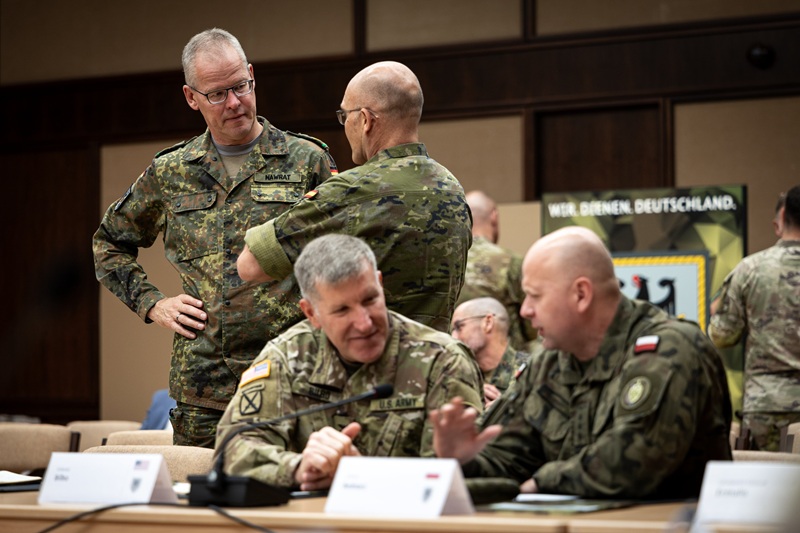
You get a sense of how seriously this is being taken from Freedom Shield I, a major exercise run in Lithuania in 2026. Close to 2,900 troops from eight NATO countries took part, roughly 2,300 of them German. Around 800 vehicles were involved, along with Leopard 2A6 tanks and a lot of drones. The drills weren’t just about firepower. Soldiers spent as much time on electronic warfare, drone operations, and coordinating artillery as they did on the more traditional stuff, and there was a heavy emphasis on moving equipment quickly. It’s not hard to see where that emphasis is coming from; it mirrors, almost deliberately, the kind of fast, tech-driven fighting that’s defined the war in Ukraine.
Why Lithuania, Specifically
Geography does a lot of the explaining here. Lithuania shares a border with Belarus, one of Russia’s closest allies, and sits uncomfortably near Kaliningrad, Russia’s heavily militarized exclave on the Baltic coast. Any serious flare-up in that corridor would almost certainly pull in multiple countries fast, and it would test NATO’s ability to move troops and supplies through a genuinely tight strategic space. Lithuania, for its part, has welcomed the German commitment without much hesitation. Foreign Minister Kęstutis Budrys has pointed to the brigade as a key piece of deterrence, a way of keeping Russian influence from pushing any further toward NATO’s borders.
A Bigger Shift Inside Germany
Step back, and this is really a story about Germany rethinking itself. For most of the post-Cold War era, German defense planning rested on a fairly comfortable assumption: a large-scale war in Europe simply wasn’t a realistic prospect. Russia’s invasion of Ukraine broke that assumption, and Berlin has been recalibrating ever since pouring more money into readiness, ammunition stockpiles, air defense, and long-range weapons systems.
There’s also a political dimension. European countries have faced growing pressure to shoulder more of their own defense burden rather than leaning so heavily on Washington, and Germany’s eastern flank buildup is part of its answer to that. It’s not only about tanks and troop numbers, either. Germany is increasingly worried about hybrid threats, drone incursions, sabotage, and similar gray-zone tactics. Recent incidents around Leipzig/Halle Airport have added to that unease, and countries around the Baltic Sea have been talking more seriously about coordinating against suspected hybrid attacks.
Curious stories, fresh insights, and more to explore.
How Does Parenthood Affect Elite Athletes?
Check out how young children and parenthood can influence the health and performance of top athletes.
Could Hormuz Talks Change Oil Prices?
Find out how Iran-Oman shipping talks could affect global oil prices, trade, and supply routes.
How Are Dates Becoming Soft-Serve?
Uncover how an Abu Dhabi ice cream maker transforms date palms into a unique soft-serve dessert.
Why Did Crawford Gift Zelensky?
See how boxer Terence Crawford’s Ukraine visit led to an unexpected puppy gift for President Zelensky.
Why Is Europe Watching Iran Closely?
Dive into why European nations are strengthening diplomatic and security oversight of Ira
Deterrence, Officially A Warning Sign, Unofficially
German and NATO officials are careful to describe all of this as deterrence, not preparation for war, the goal being to make any attack look too costly to seriously consider. And a permanent German brigade carries a political message beyond its battlefield role: an attack on Lithuania wouldn’t just be a fight with Lithuania. It would be a fight with the alliance behind it. None of this means conflict is coming. But it’s a clear sign that European governments have stopped treating a major war as a distant hypothetical and are choosing to get ready for one now, rather than scrambling to catch up later.
FAQs
1. Why is Germany deploying troops to Lithuania?
Germany is establishing a permanent brigade in Lithuania to strengthen NATO’s eastern flank and deter potential aggression.
2. How many German troops will be stationed in Lithuania?
Germany plans to have around 5,000 military personnel permanently stationed there by the end of 2027.
3. What is the Germany NATO eastern flank deployment?
It refers to Germany’s expanding military commitment to NATO’s eastern flank, particularly its permanent brigade in Lithuania.
4. Are German troops preparing for a war with Russia?
The training prepares troops for a potential conventional conflict, but its stated purpose is deterrence and defence rather than preparing to launch a war.
5. What was Freedom Shield I?
Freedom Shield I was a large NATO exercise in Lithuania involving nearly 2,900 troops, including thousands of German soldiers, practising collective defence operations.

