

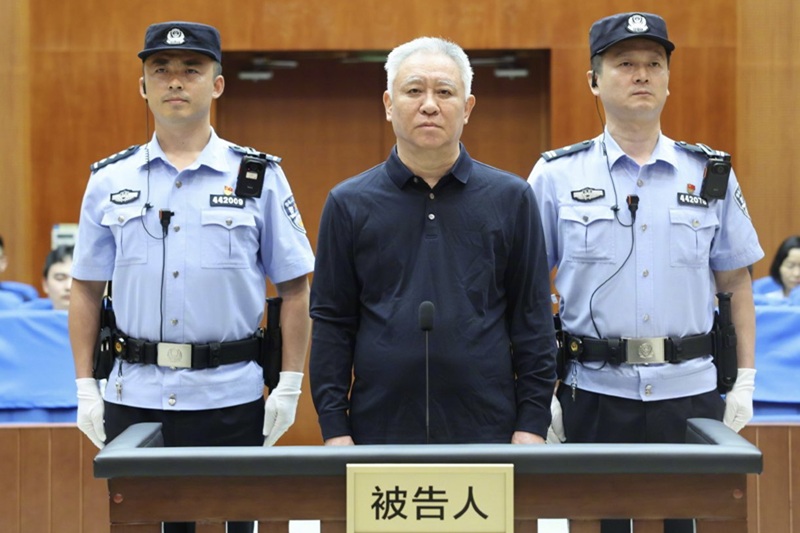
China’s Property Crisis Deepens as Evergrande Founder Sentenced to Life in Prison
For years, Hui Ka Yan was the face of China’s real estate boom, a man who built Evergrande from a single company into one of the largest property empires on Earth, and along the way became one of the country’s richest people. This week, that story reached its final, grim chapter. A court in Shenzhen sentenced him to life in prison. The verdict, handed down on Thursday, capped a stunning fall for a man once celebrated as a symbol of China’s economic ascent. The Shenzhen Intermediate People’s Court found Hui, 67, guilty of large-scale financial crimes and ordered his personal assets confiscated on top of the prison term.
What He Was Convicted Of
The charges trace back to Evergrande’s conduct between 2016 and 2021, a period when the company was still expanding at breakneck speed. Prosecutors accused Hui and the firm of inflating the value of its assets, hiding the true scale of its liabilities, illegally collecting public deposits, and engaging in fundraising fraud. The court didn’t mince words, calling the misconduct serious and saying it inflicted real damage on Chinese society. Evergrande itself was fined 8.82 billion yuan, and its main property subsidiary on the mainland, Hengda Real Estate, was hit with an additional 7 billion yuan penalty. A number of other company executives were also sentenced to prison time. Hui had already pleaded guilty back in April and offered an apology during the proceedings, which likely shaped the final outcome. Even so, a life sentence marks one of the most severe conclusions to any corporate downfall in modern Chinese history.
How a Property Giant Became a Cautionary Tale
It’s worth remembering just how big Evergrande got. Riding China’s decades-long housing boom, Hui pushed the company to expand aggressively, financing much of that growth with enormous amounts of borrowed money. At its peak, Evergrande carried more than $300 billion in liabilities making it, by some measures, the most indebted property developer on the planet. Then, in 2021, it all came apart. Evergrande defaulted on its debt, and the shockwaves didn’t stay contained to one company. The default became a defining moment for China’s broader property crisis, one that’s still playing out today. Homeowners were left in limbo, suppliers went unpaid, investors took losses, and banks were forced to reckon with exposure to a sector that suddenly looked far shakier than anyone had priced in. Thousands of construction sites simply stopped, leaving buyers who’d already paid for apartments with nothing to show for it.
Why This Doesn’t Really Fix Anything
Here’s the uncomfortable truth: putting Hui behind bars doesn’t untangle the mess he helped create. China’s property sector is still under serious strain, even after years of government efforts to prop up housing demand. Home prices remain soft, developers are still under financial pressure, and getting buyers to trust the market again has proven difficult. The damage has rippled into China’s corporate bond market too. S&P Global Ratings found that roughly 40% of onshore bonds that were restructured since 2020 have gone on to default a second time, a sobering statistic that shows just how hard it’s been for distressed Chinese companies to actually turn things around, rather than just delaying the reckoning.
A Message, Not a Solution
There’s no question the sentence sends a signal that reckless borrowing and cooked books can end careers and land people in prison, even someone as powerful as Hui once was. But few analysts expect this ruling to do much for confidence in the housing market itself. Evergrande’s liquidation is still grinding on, unfinished buildings still dot Chinese cities, creditors are still fighting over what’s left, and demand for new housing remains weak. For the millions of ordinary families still waiting on apartments they paid for years ago, Hui’s prison sentence is almost beside the point. The real question hanging over China’s economy isn’t what happens to one disgraced billionaire, it’s whether people will ever feel safe putting their savings into property again.
FAQs
1. Why was Evergrande founder Hui Ka Yan sentenced to life in prison?
He was convicted of serious financial crimes, including fundraising fraud, misuse of funds and illegally taking public deposits.
2. How much debt did Evergrande have?
Evergrande had more than $300 billion in liabilities when its financial crisis became acute, making it one of the world’s most indebted property developers.
3. Is China’s property crisis over?
No. Property prices, developer finances and buyer confidence remain under pressure despite government support measures.

