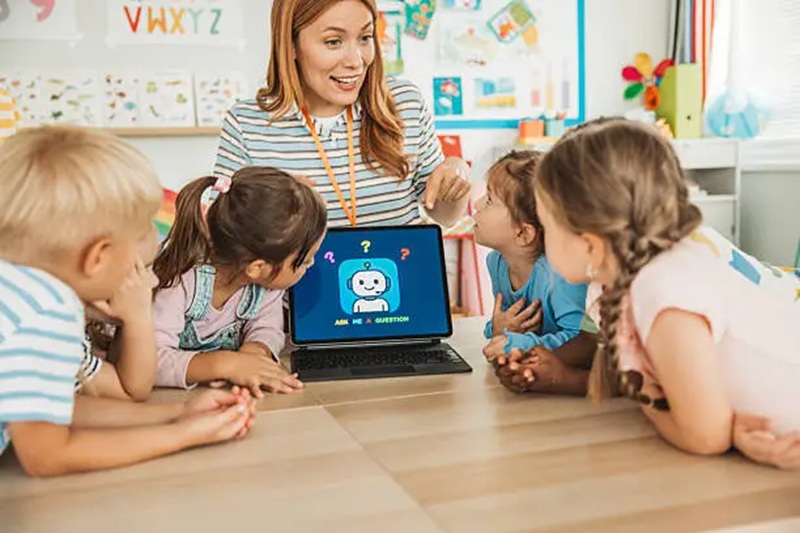
AI in Schools Needs Guardrails, Not Blanket Bans: Who Should Be Responsible for Teaching Children to Use It?
Picture a kid finishing their homework in ten minutes flat because a chatbot did most of the thinking for them. It’s easy to look at that and want to slam the door on AI in classrooms entirely. But the real question isn’t whether kids should be allowed near this technology, it’s whether we’re actually preparing them to use it well.
That question has gotten a lot louder lately. New York City has been pulling back on student-facing AI tools. California just passed a wave of new protections around how kids interact with AI and social media. Meanwhile, plenty of people in education are arguing the opposite: that what schools need isn’t restriction, it’s better teaching about how AI actually works.
Banning It Doesn’t Make the Problem Go Away
The worries are real. AI tools can spit out answers that sound confident and turn out to be wrong. They make it easier for a student to hand in work they didn’t actually write. There’s also the murkier issue of what happens to a kid’s data once they start typing into these systems.
But here’s the thing: a school ban doesn’t stop any of that. Kids run into AI constantly outside the classroom: on their phones, through search engines, scrolling social media, and eventually in whatever job they end up doing. If school is the one place where nobody explains how technology works, kids are left to figure out its blind spots entirely on their own, including which things they should never type into a chatbot in the first place. UNESCO has actually put together a framework for this, built around getting students to think critically about AI rather than just consume it covering ethics, how these systems work technically, and keeping the human at the center of it all.
It Can’t Fall on Just One Group
Schools obviously carry a big part of this. Kids need to be taught, directly, how to sanity-check what a chatbot tells them, how to spot bias, how to protect their own information, and where the line sits between “using AI to help me think” and “letting AI think for me.” But teachers can’t just be handed this responsibility without support. UNESCO has laid out 15 separate skills teachers need across things like AI ethics and classroom practice and by its own admission, most teachers still don’t have real national guidance to work from. Asking a teacher to police AI use without training is setting them up to fail.
Parents matter here too. A lot of the modeling around “is this a shortcut or a tool” happens at home, not in a classroom. And then there’s the part schools have zero control over: the tech companies and the governments regulating them. It shouldn’t be a school’s job to discover a safety problem only after a product is already sitting on every student’s laptop. That’s on the companies to build in the first place, and on policymakers to actually enforce.
The Debate Just Got Real
This isn’t hypothetical anymore. In September 2026, Microsoft signed onto enforceable AI privacy and safety commitments for schools, worked out with the American Federation of Teachers and the United Federation of Teachers things like not training AI models on student data and requiring an actual human in the loop for high-stakes decisions.
California went further still. Governor Newsom signed laws requiring AI chatbot safety measures, parental controls, and risk assessments. None of this is about whether kids should touch AI anymore. It’s about the conditions under which they do.
Teach It Both Ways
A workable policy might be simpler than it sounds: teach both, test both. Have students do some assignments completely unaided, so teachers can actually see how they think on their own. Let them use approved AI tools for other work but make them explain what they used it for, check its answers, and catch its mistakes.
That’s neither treating AI like magic nor treating it like the enemy. It’s just honest about what it is.
What’s Making Headlines You Can’t Miss?
Could Hoekstra Face Expulsion From Canada?
Check out why thousands of Canadians are demanding action against the US ambassador.
Who Is Martina Strong, Really?
Uncover the diplomat’s UAE appointment and the political delays surrounding her confirmation.
Why Did Clancy’s Jury Deadlock?
Find out what led to the mistrial and why the jury couldn’t reach a verdict.
Why Is Lake Ontario Renamed?
Browse what Apple Maps’ surprising “Lake America” change means and why it happened.
Which Haunted Hotels Should You Visit?
Experience five spooky American hotels known for paranormal encounters and eerie stays.
Why This Actually Matters
These kids are going to graduate into a workplace where AI is just… there. Shielding them from it now might feel protective, but it also leaves them less equipped to spot when it’s wrong or being misused later. The better move isn’t unrestricted access, it’s teaching them young, with real privacy protections, trained teachers, involved parents, and clear boundaries on what’s okay. Schools probably don’t have to pick a side between embracing AI and shutting it out. The actual job is teaching kids to live with it without losing their own judgment along the way.
FAQ
Should AI be banned in schools?
Not really some specific uses might need limits, especially around privacy or academic honesty, but a total ban tends to do more harm than good.
Who’s responsible for teaching kids about it?
No single group. Schools, teachers, parents, companies, and governments all have a piece of this.
What should students actually learn?
The basics of how AI works, how to fact-check it, how to spot bias, how to protect their data, and how to use it without letting it replace their own thinking.
Does AI actually help kids learn?
It can be for brainstorming, personalized practice, and working through problems. But it still needs a human checking its work.
What’s the biggest risk?
Over-reliance. If AI does the thinking and the writing, kids lose the reps they need to build real critical thinking and creativity.