What Was Found Inside a 1,600-Year-Old Egyptian Mummy? Researchers Uncover Rare Homer’s Iliad Fragmen
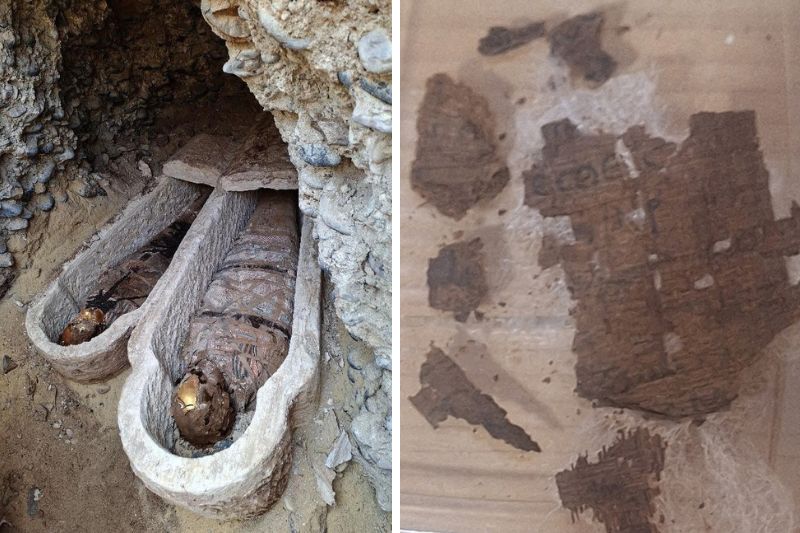
Imagine opening an ancient Egyptian mummy and finding not jewelry, gold or a sacred spell, but a page from one of the world’s greatest literary masterpieces. And that’s exactly what archaeologists have found, in a find that is changing our understanding of ancient Egypt and classical Greek culture. Scientists at the ancient Egyptian city of Oxyrhynchus have discovered a rare piece of Homer’s Iliad tucked inside a 1,600-year-old Egyptian mummy. The remarkable find is believed to be the first archaeological evidence of a Greek literary text being intentionally placed inside a mummy, making it one of the more unusual finds of recent years.
What Was Found Inside the 1,600-Year-Old Egyptian Mummy?
The papyrus fragment was found at Oxyrhynchus (modern Al-Bahnasa), one of the richest archaeological sites in Egypt. The mummy, dating to the Roman period, had a papyrus with verses from Book II of Homer’s Iliad placed carefully inside. The remaining passage is from the famous “Catalogue of Ships,” a section of the epic poem describing the Greek fleet’s voyage to Troy during the Trojan War. The papyrus was not placed with the body as a funerary offering, but was placed deliberately on or within the mummy during the embalming process.
Why Is This Discovery So Important?
Archaeologists have previously discovered magical texts, religious spells and writings for funerary texts linked to mummies from Egypt. But the discovery of a Greek literary piece used for embalming is without precedent. The discovery suggests that Greek literature in Roman Egypt may have had a symbolic or even spiritual significance. Many scholars believe it may have been regarded as offering protection or guidance to the dead in the afterlife, akin to traditional Egyptian funerary writings. The finding also points to the rich cultural exchange between Egyptian and Greek cultures long after Alexander the Great’s conquest of Egypt.
How Researchers Made the Discovery
The excavation was led by the Oxyrhynchus Archaeological Mission of the University of Barcelona, which has been working at the site since 1992. In the latest round of excavations, researchers uncovered several mummies and elaborately decorated sarcophagi from the Roman period. One mummy was unusual in that it was accompanied by papyrus that was part of the embalming ritual. Experts later identified the text as a fragment of Homer’s Iliad and the find was unique in archaeological history.
What This Means for History
The discovery changes the way historians understand cultural life in Roman Egypt. The find suggests the Greek literature might have had a religious or ceremonial use, as well as an educational or artistic use. It is a society where Egyptian burial practices and Greek intellectual culture merged in unexpected ways. It also tells archaeologists that ancient funeral rites were more varied than previously believed. Future excavations may reveal further examples of literary texts employed in burial practices, potentially revising some aspects of ancient Mediterranean history.
Public and Academic Reaction
The finding has attracted worldwide attention from historians, archeologists and literature specialists. Many scholars consider it a landmark find linking two of history’s most influential civilizations by one archaeological object.
The discovery has ignited a wave of public enthusiasm beyond the academic community, a reminder that even after centuries of excavations, Egypt still holds extraordinary secrets under its sands.
Discover More Trending Stories You Shouldn’t Miss
What Caused Venezuela’s Deadly Earthquake?
Explore the latest updates on the Venezuela earthquake, rising death toll, rescue efforts, and the impact on affected communities.
Why Is OpenAI’s AI Speaker Unique?
Discover how OpenAI’s first screenless AI speaker could redefine smart homes with its innovative AI-powered features.
Why Visit Thailand Beyond Luxury Travel?
Check why experiential tourism is making Thailand the top travel destination for authentic adventures in 2026.
What Makes StepX Neo Revolutionary?
Explore the features of StepFun’s StepX Neo, the world’s first agentic AI smartphone, and what sets it apart.
Who Stole The Odyssey Premiere Spotlight?
Discover the standout fashion moments as Zendaya, Anne Hathaway, Tom Holland, and the cast dazzled on the red carpet.
FAQs
What was found inside the 1,600-year-old Egyptian mummy?
Researchers found a fragment of papyrus containing verses from Homer’s Iliad, including part of the famous “Catalogue of Ships.”
What is the importance of this discovery?
It is the earliest known archaeological evidence for a Greek literary text purposely incorporated into the mummification process.
Where did they find the mummy?
The mummy was discovered in Oxyrhynchus (modern Al-Bahnasa) in central Egypt during an archaeological expedition by the University of Barcelona.