

The UAE as a Rapid‑Response Humanitarian Hub in Gaza
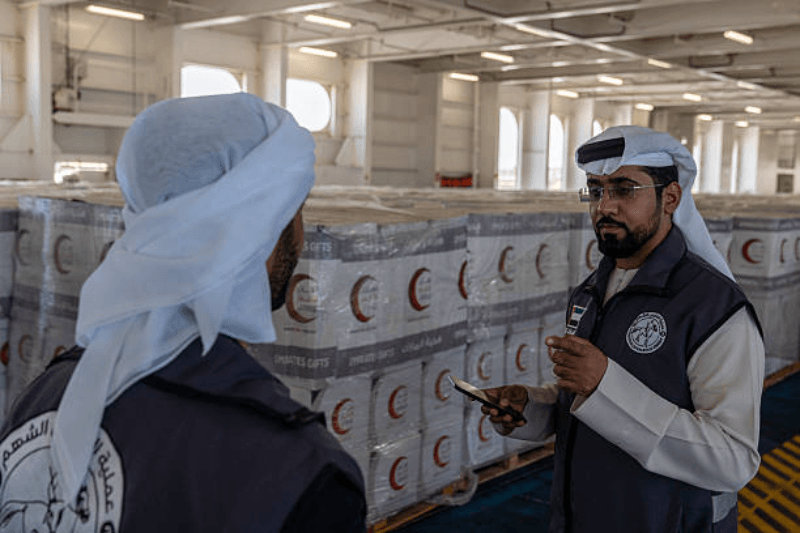
The UAE has transformed its role in the Gaza crisis from that of a large-scale donor to a vertically integrated humanitarian actor. By mid-2026, the UAE was the largest country donor to the Gaza humanitarian response globally, providing around $3 billion in aid to Gaza. Emirati agencies have also delivered more than 32,000 tonnes of supplies by flights, airdrops, ships and trucks in operations including “Gallant Knight 3”, taking multiple routes to avoid corridors vulnerable to closure. All five – Egypt, Jordan, Qatar, Saudi Arabia and Turkey – provide significant aid, but few can match the UAE for financial scale, tonnage or operational diversity.
Mobile Care, Field Hospitals and Evacuations
The UAE has also embedded itself in front-line medical response, and it’s not just about the money. Over 53,000 patients have been treated at a field hospital in Rafah and more than 20,000 others, including evacuees from Gaza, at a floating hospital off the coast of Al-Arish, Egypt. They provide emergency surgery, care for chronic diseases, prosthetics and help with a polio vaccination campaign that reaches more than 640,000 children under the age of 10.
The UAE has also conducted medical evacuation flights under presidential directives, which have transported some 2,900-3,000 patients and their families, including injured children and cancer patients, to UAE hospitals. The UAE’s blend of in-country field medicine and tertiary-care repatriation sets it apart from regional players with a narrower focus on field hospitals or multilateral health-project contracts.
Air Drops, Land Convoys, and Logistical Leverage
When land routes are limited, the UAE has dropped supplies from the air dozens of times, often in conjunction with air-force-led campaigns in Jordan, to maintain pressure for humanitarian access. These air operations are part of a broader logistics architecture that also includes Dubai’s humanitarian-supply hub, a staging node that has long been used by UN agencies and WHO for regional and global stockpiling. The 2025–26 U.S.–Iran war temporarily froze this hub, as it disrupted regional air corridors, highlighting the structural importance of the UAE’s civilian-logistics infrastructure for global humanitarian flows.
Egypt, by contrast, depends on the Rafah land bridge, while Qatar depends on airlift capacity and mediation-centred diplomacy. Saudi Arabia has tended to concentrate on big donations through KSrelief and multilateral deals, while Jordan has focused on airdrops and cross-border health care coordination. The UAE’s ability to move between air, sea and land routes and keep supply chains flowing despite political friction gives it a unique operational advantage.
UN Diplomacy and Resolution 2720
The UAE has also used the UN Security Council to institutionalise and monitor aid to Gaza, in addition to providing material assistance. In December 2023, the Council adopted Resolution 2720, which called for concrete actions to increase humanitarian aid while protecting UN and humanitarian personnel. Abu Dhabi prepared the resolution, which was adopted unanimously. It calls for safe and unimpeded expanded access, use of all available access routes into and within Gaza and the appointment of a Senior Humanitarian and Reconstruction Coordinator to verify and monitor the flow of aid.
This positions the UAE not only as a donor, but as a norm-setter in humanitarian governance, in contrast to Turkey and Qatar, which often operate through bilateral advocacy and media-driven diplomacy and to Saudi Arabia and Egypt, which prefer back-channel talks and regional summits.
Managing Regional Tensions and Strategic Positioning
Throughout the Israel-Hamas war and the ensuing U.S.-Iran conflict, the UAE has stood in solidarity with Palestinian civilians through aid and evacuations, while diplomatically aligning with Israel and the United States. “This has enabled it to maintain humanitarian channels open when other Gulf states have changed position under security and political pressures. Egypt and Jordan must balance domestic Palestinian-sympathetic constituencies with hard security and economic constraints, while Qatar and Turkey tend to focus on political messaging and media visibility over long-term logistics infrastructure.
UAE as a Hub for Swift Response Humanitarian Aid
Overall, the UAE’s approach indicates a shift from check-book diplomacy to end-to-end crisis-response architecture: financing, airlift, sea shipments, land convoys, field and floating hospitals, medical evacuations and UN-backed coordination. It is not a unique model, with Saudi Arabia, Qatar, Jordan, Turkey and Egypt all contributing large volumes, but few have combined so many operational layers in one emergency. Geopolitically, the UAE has employed Gaza as a testing ground for a middle‑power humanitarian posture combining logistics, medical capability and multilateral diplomacy that is increasingly that of a rapid-response humanitarian hub, rather than a traditional donor.


